A wide-ranging review published in Discover Neuroscience argues that one specific member of the NF-κB transcription factor family, NF-κB1, has been quietly overshadowed by the broader pathway it belongs to, and that this oversight may be holding back a promising therapeutic strategy for Alzheimer’s disease, Parkinson’s disease, Huntington’s disease and amyotrophic lateral sclerosis. The authors, led by Priyanka Banerjee and Sourav Ghosh, contend that most studies treat NF-κB as a single signaling system, when in fact the NFKB1 gene produces two functionally distinct proteins, the p105 precursor and the mature p50 subunit, whose effects can differ sharply depending on which cell is involved, which stimulus is applied, and how long the pathway stays switched on.
The NF-κB family comprises five members: NF-κB1 (p105/p50), NF-κB2 (p100/p52), RelA (p65), RelB and c-Rel. What makes NFKB1 unusual is that a single precursor protein, p105, is processed by the proteasome into p50, which can then pair with itself or with other Rel family proteins to form dimers with very different regulatory properties. The full-length transcript spans 3,452 base pairs across 25 exons and encodes a 971-amino-acid p105 protein. The p50 subunit covers amino acids 1 through 430 of that precursor, while a glycine-rich region acts as the proteasome’s stop signal, ensuring the newly generated p50 is released intact rather than fully degraded.
That processing step is not merely housekeeping. In resting cells, p105 serves as a regulatory scaffold, binding and stabilizing the kinase Tpl2 so that it remains inactive until inflammatory stimulation triggers IKK-mediated phosphorylation of p105 and its partial degradation, releasing Tpl2 to drive MAPK signaling. Meanwhile, the p50 homodimer has a surprising property: it binds nucleosomal DNA as readily as naked DNA, allowing it to act as a transcriptional regulator at both active and repressed chromatin. In unstimulated cells, p50 homodimers complexed with the deacetylase HDAC-1 repress NF-κB-dependent genes; upon stimulation with lipopolysaccharide or tumor necrosis factor, phosphorylated p65 complexes displace these repressors and initiate transcription.
The p50 homodimer is not simply a brake, however. The atypical IκB protein Bcl-3 can bind the p50 homodimer, promote its nuclear import, enhance its DNA binding and activate transcription at NF-κB-responsive genes. This co-regulatory role is highly gene-specific: in macrophages stimulated with LPS, Bcl-3 is required for the p50 homodimer to activate IL-10 transcription, yet the same dimer represses TNF transcription, with Bcl-3 apparently reinforcing that repression by recruiting HDAC-1 to the TNF promoter. The review’s central argument is that NF-κB1 function is therefore determined not just by how much p50 is present, but by its mode of processing, dimer composition, post-translational modification and associated co-regulators.
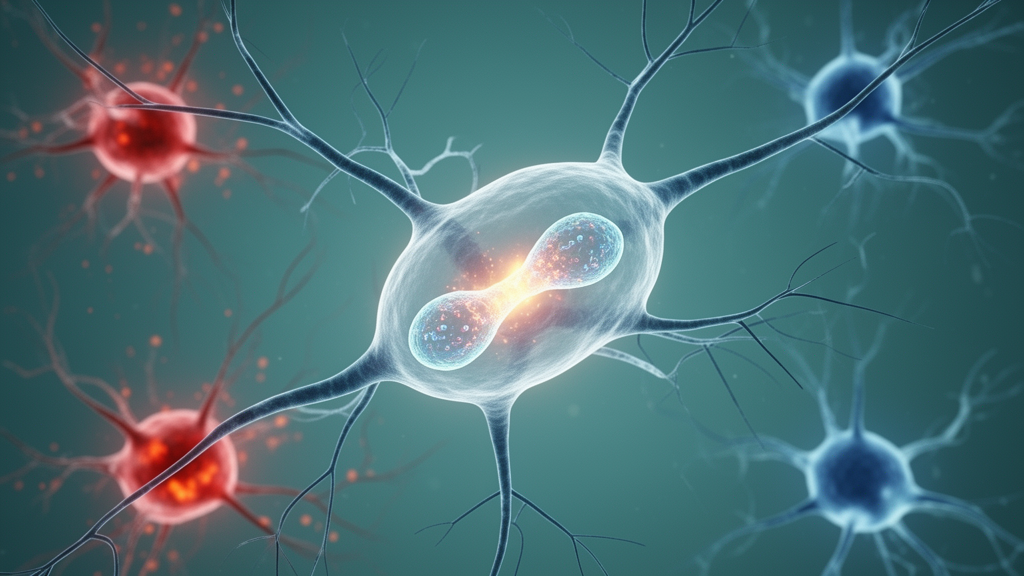
In the healthy central nervous system, NF-κB1 contributes to neurodevelopment, synaptic plasticity and memory. In neurons, basal activity controls homeostatic and anti-apoptotic genes, and the transcriptional regulation of synaptic proteins and factors such as CREB and BDNF feeds into long-term potentiation and spatial memory; mice lacking functional neuronal NF-κB signaling show reduced synaptic density, impaired long-term potentiation and pronounced learning deficits. Neurons respond weakly to classic inflammatory triggers such as TNF-α and IL-1β, partly because their IκBα degrades more slowly, a feature thought to help preserve the immune-privileged status of the brain. Glial cells behave in the opposite way: microglia and astrocytes have minimal baseline NF-κB1 activity but mount a strong, rapid response to injury or infection, transcribing pro-inflammatory cytokines, chemokines and adhesion molecules.
That cell-type divide underlies the pathway’s dual personality. Transient or moderate NF-κB1 activity in neurons can be protective, driving expression of manganese superoxide dismutase, Bcl-2 and cellular inhibitors of apoptosis, and preconditioning with TNF or ischemic stimuli can harden neurons against later apoptotic and oxidative threats. Sustained or excessive activation, especially in glia, instead upregulates TNF-α, interleukins, inducible nitric oxide synthase and Fas ligand, promoting inflammatory and neurotoxic responses. The review stresses that many experimental studies measure overall NF-κB activation rather than p50- or p105-specific functions, so the contribution of NF-κB1 itself often cannot be separated from that of RelA, c-Rel, RelB or NF-κB2, and pharmacological inhibitors cannot be taken as evidence of NFKB1-specific modulation unless target selectivity has been demonstrated.
Applied to individual diseases, the picture is consistently promising but consistently indirect. In Alzheimer’s disease, canonical NF-κB signaling regulates BACE1 expression, thereby promoting amyloid-β production, and altered microRNAs feed into the same axis, but the specific contribution of NFKB1 remains incompletely defined. In Parkinson’s disease, immunohistochemical studies of patients have shown increased nuclear NF-κB in mesencephalic dopaminergic neurons, yet these observations do not establish a causal role for NFKB1-derived p50 or p105. In Huntington’s disease, mutant huntingtin interacts with NF-κB signaling in ways that link synapse-to-nucleus communication, oxidative stress and mitochondrial dysfunction, but again the evidence concerns the pathway broadly rather than NF-κB1 specifically. In ALS, mutant SOD1 is associated with preferential NF-κB activation in microglia, optineurin mutations that normally restrain the pathway are disrupted, and neuron-specific NF-κB inhibition has improved motor performance and extended survival in experimental mouse models, with early astrocytic activation possibly protective and later activation harmful.
On the therapeutic front, the review is candid: current evidence for NF-κB1 modulation is predominantly preclinical. Genetic tools are advancing rapidly, including CRISPR/Cas9 knockout models, which in NFKB1-deficient human macrophages revealed that NF-κB1 both positively and negatively regulates hundreds of genes involved in cytokine signaling and immune regulation, as well as RNA interference, knock-in editing, and viral and nanoparticle delivery platforms aimed at cell-type-specific targeting. But most pharmacological approaches, such as parthenolide, act upstream on the broader cascade by blocking IκBα degradation or p65 nuclear translocation, and clinical evidence for direct NF-κB1-targeted therapy in neurodegenerative disease remains limited. The authors conclude that NF-κB1 should currently be regarded as a promising but predominantly preclinical target, with target specificity, CNS target engagement and clinical efficacy still to be established.
The obstacles to translation are substantial. Because NF-κB1 participates in immune responses and cell survival throughout the body, widespread suppression raises infection risks and off-target concerns, and the blood-brain barrier limits delivery of many inhibitors. Crosstalk with Notch, MAPK, NRF2, STAT3, CREB and PI3K/Akt pathways means that intervening in one node may trigger compensatory mechanisms or unintended consequences, and the review suggests that combination strategies pairing NF-κB modulation with interventions against amyloid, tau or mitochondrial dysfunction may ultimately be needed. Proposed biomarkers for monitoring response include phosphorylated NF-κB subunits, pro-inflammatory cytokines such as TNF-α and NF-κB-associated microRNA profiles, while single-cell RNA sequencing and spatial transcriptomics could map NF-κB1 activity across cell populations and brain regions. For now, the review’s most concrete message is a corrective one: before selective NF-κB1 modulation can reach the clinic, the field must first prove that the effects it has been attributing to NF-κB actually belong to p50 and p105.
Subject of Research: The role of the NF-κB1 transcription factor subunit in neurodegenerative diseases
Article Title: Targeted modulation of NF-κB1 in neurodegenerative diseases
Article References: Banerjee, P., Das, R., Sen, A., Rahaman, M., Sanyal, S., & Ghosh, S. (2026). Targeted modulation of NF-κB1 in neurodegenerative diseases. Discover Neuroscience, 21(1), Article 109. https://doi.org/10.1186/s13064-026-00341-x
Image Credits: AI Generated
DOI: 10.1186/s13064-026-00341-x
Keywords: NF-κB1, neurodegenerative diseases, Alzheimer's disease, Parkinson's disease, Huntington's disease, amyotrophic lateral sclerosis, neuroinflammation, p50 homodimer, p105 processing, transcriptional regulation, preclinical research, blood-brain barrier
News Source: Diana Fleming. (October 28, 2026). NF-κB1 Emerges as a Context-Dependent Switch in Neurodegenerative Disease. Scienmag.