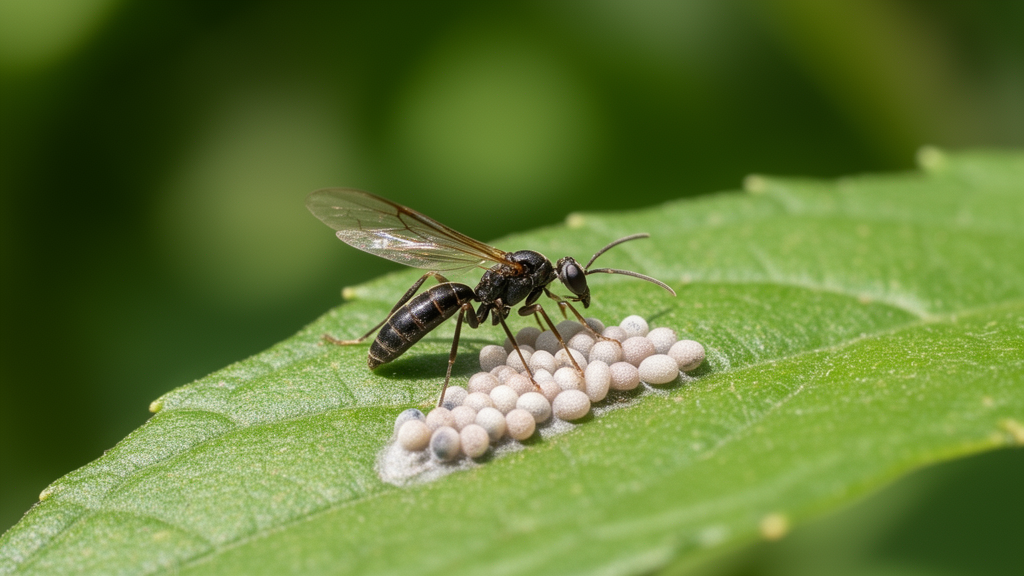
A tiny parasitic wasp that attacks the eggs of some of the world’s most destructive crop pests appears to find its targets using chemical cues on the egg surface, according to a new study published in the Egyptian Journal of Biological Pest Control. The egg parasitoid Telenomus remus Nixon, a member of the family Scelionidae, is considered a promising biological control agent against lepidopteran pests, particularly species of the genus Spodoptera. Its effectiveness in the field depends on its ability to locate and recognize host eggs, yet the chemical signals on the egg surface that underpin this recognition have remained poorly understood. The new research set out to identify those cues, test whether female wasps respond to them behaviorally, and explore which odor-detecting proteins in the wasp might be involved in perceiving them.
The research team, led by Rui Shi and Pu Tang with colleagues at several Chinese institutions, combined four approaches: chemical profiling of egg surfaces, behavioral testing with synthetic compounds, genome-wide searches for chemosensory genes, and computer-based molecular docking. They examined eggs from three moth species: Spodoptera frugiperda and Spodoptera litura, both natural noctuid hosts of the parasitoid, and Corcyra cephalonica, a pyralid moth commonly used as a factitious host for rearing the wasp in laboratories. This three-way comparison was designed to distinguish chemical cues specific to natural hosts, cues shared across host species, and cues associated with the artificial rearing host, a distinction that matters because T. remus is deployed against Spodoptera pests but is frequently mass-reared on C. cephalonica.
The behavioral tests used a Y-tube olfactometer, a simple apparatus in which an insect walks down a tube that splits into two arms, each carrying a different odor source. Female wasps were given a choice between a card holding fresh eggs, less than 24 hours old, and a blank card. Because the wasps are minute and preliminary assays with individually released females produced low response rates, the researchers released groups of roughly 30 previously untested females at the base of the tube and observed them for five minutes. A wasp was counted as having made a choice only if it entered one arm and stayed there for at least 30 seconds, and each individual was counted only once. The group, not the individual, was treated as the experimental unit, with six independent group replicates per treatment.
The results showed that female T. remus were significantly attracted to egg cards of all three host species. The attraction index, a measure running from negative to positive preference, had a median of 0.2583 for S. litura eggs, 0.1891 for S. frugiperda eggs, and 0.2106 for C. cephalonica eggs. One-sample Wilcoxon signed-rank tests found that each of these medians was significantly greater than zero, with P values of 0.0195, 0.0273, and 0.0371 respectively. The authors noted that the asterisks in their figures indicate deviation from zero within each species and do not represent pairwise comparisons among host species, so the data demonstrate attraction to each host’s eggs rather than a ranked preference among them.
To find out what chemicals the wasps might be responding to, the team extracted egg-surface compounds by immersing roughly half a gram of freshly laid eggs in hexane and analyzing the extracts with gas chromatography-mass spectrometry. The analysis, performed in triplicate with only compounds detected in all three replicates retained, revealed distinct egg-surface chemical profiles among the three species: 21 compounds were putatively identified from S. litura eggs, 21 from S. frugiperda eggs, and 24 from C. cephalonica eggs. The compounds included straight-chain and branched alkanes, aromatic compounds, aldehydes, fatty acids, ketones, alcohols, esters, and long-chain hydrocarbons. Several compounds appeared in all three species, including heptane, toluene, octane, styrene, tetradecane, hexadecane, and palmitic acid, but their relative abundances differed substantially. Octane dominated the profiles of both Spodoptera species, accounting for 59.48 percent of detected compounds in S. litura and 42.02 percent in S. frugiperda, while C. cephalonica eggs were characterized by high proportions of palmitic acid, cis-vaccenic acid, octane, and hentriacontane.
From these profiles the researchers selected 17 candidate compounds for behavioral testing at three exploratory concentrations: 1, 10, and 100 nanograms per microliter, applied to filter strips as 10, 100, and 1,000 nanograms per strip. The authors emphasized that natural amounts of these compounds on egg surfaces were not quantified, so the tested doses should not be regarded as estimates of natural exposure levels. Seven of the 17 compounds elicited significant behavioral responses at one or more concentrations: 1,3-di-tert-butylbenzene, toluene, oleic acid, hentriacontane, pentacosane, cyclohexanone, and tetradeca-1,13-diene. Positive responses were recorded for oleic acid at 10 and 100 nanograms per microliter, hentriacontane at 100, pentacosane at 1, and toluene at 10. In contrast, tetradeca-1,13-diene at 10 and 100 and cyclohexanone at 100 produced significant negative responses, meaning wasps preferred the solvent control arm.
One compound, 1,3-di-tert-butylbenzene, showed a notably mixed pattern, with an attraction index significantly greater than zero at the lowest concentration and significantly lower than zero at the two higher concentrations. The authors were careful to state that because each concentration was tested separately against zero with no direct statistical comparisons among concentrations, these results do not demonstrate significant differences between concentrations or a formal concentration-dependent response. They also cautioned that for the low-volatility compounds oleic acid, pentacosane, and hentriacontane, the Y-tube assay cannot distinguish between olfactory perception of airborne compounds and contact chemoreception resulting from physical contact with the stimulus source, so the positive responses to those substances should be interpreted with caution.
The study also took a molecular approach, searching the T. remus genome for chemosensory genes. The team identified 14 candidate odorant-binding protein genes, named TremOBPs, and 44 candidate odorant receptor genes, named TremORs, which were distributed across multiple hymenopteran OBP and OR clades rather than forming single species-specific clusters. The conserved co-receptor TremORco clustered with ORco homologues from other hymenopteran species, consistent with the conserved role of ORco in insect olfaction. Using AlphaFold3 to predict protein structures and AutoDock Vina for docking simulations, the researchers tested interactions between seven selected TremOBPs and 20 TremORs and the seven behaviorally active compounds. 1,3-di-tert-butylbenzene showed the lowest predicted docking scores across all seven selected OBPs, ranging from minus 6.8 to minus 9.6 kilocalories per mole, with the strongest predicted interaction at TremOBP1, and similarly low scores with several TremORs, reaching minus 10.4 kilocalories per mole at TremOR18 and TremOR24.
The authors stressed that molecular docking should be interpreted as a hypothesis-generating tool rather than direct evidence of odorant recognition, particularly for odorant receptors, whose function depends on the membrane environment, receptor conformation, and interactions with ORco. They also acknowledged several limitations of the study: compound identification relied mainly on NIST library matching without procedural blanks, retention indices, or full confirmation with authentic standards; the GC-MS analysis was qualitative, with no quantitative measurement of absolute concentrations; and interactions among wasps released simultaneously in groups may have influenced choices, so future individual-tracking assays are needed. Sequence annotation and phylogenetic placement alone cannot determine which chemosensory genes are expressed in antennae or involved in detecting egg-associated cues, so tissue-specific expression analysis, fluorescence competitive binding assays, heterologous expression, electrophysiology, or RNAi-mediated behavioral validation will be required for functional confirmation.
Despite these caveats, the study provides a framework for future work on semiochemical-based enhancement of parasitoid host location. The behaviorally active compounds identified here are candidates for evaluation in biological control applications, and the candidate OBPs and ORs offer molecular targets for subsequent functional validation. The comparison between natural pest hosts and the factitious rearing host may also help identify cues relevant to host recognition, parasitoid conditioning, and rearing quality. The researchers suggest that future assays using natural-ratio blends, concentration-response gradients, and host egg extracts with selective addition or removal of individual compounds will help clarify the roles of specific compounds within the full egg-surface chemical profile, and quantitative chemical analysis will be needed to establish the ecological significance of the responses observed at the exploratory doses tested.
Subject of Research: Chemical cues on moth eggs that influence host-seeking behavior in the egg parasitoid Telenomus remus
Article Title: Host egg-associated compounds elicit behavioral responses in the egg parasitoid Telenomus remus Nixon (Hymenoptera: Scelionidae)
Article References: Shi, R., Li, Z., Wang, P., Yang, L., Yan, Y., Ji, Z., Wang, Z., Ye, X., Chen, X., Xie, Y., & Tang, P. (2026). Host egg-associated compounds elicit behavioral responses in the egg parasitoid Telenomus remus Nixon (Hymenoptera: Scelionidae). Egyptian Journal of Biological Pest Control, 36(1), Article 28. https://doi.org/10.1186/s41938-026-00908-0
Image Credits: AI Generated
DOI: 10.1186/s41938-026-00908-0
Keywords: Telenomus remus, egg parasitoid, chemical ecology, semiochemicals, Spodoptera frugiperda, Spodoptera litura, Corcyra cephalonica, GC-MS, odorant-binding proteins, odorant receptors, molecular docking, biological control
News Source: Alan Morgan. (October 28, 2026). Egg chemicals guide a tiny wasp’s hunt for pest moth eggs. Scienmag.