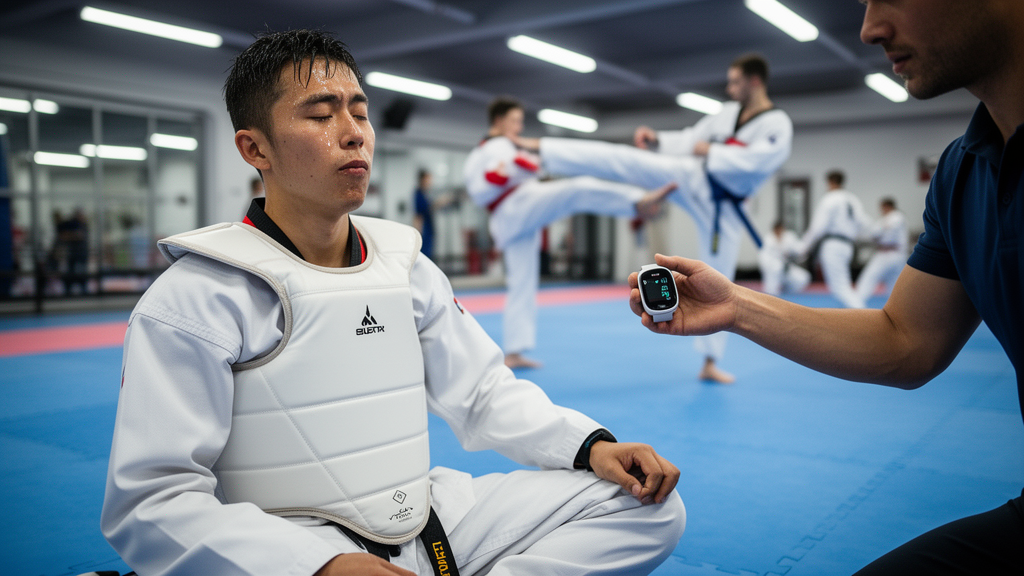
International-level taekwondo athletes recover their heart rate faster than national-level athletes after a short, explosive bout of repeated kicking, according to a new study published in BMC Sports Science, Medicine and Rehabilitation. Yet when it came to the force of their kicks, the two groups were statistically indistinguishable, and neither showed a meaningful drop in impact over the seven seconds of continuous effort.
The research, led by Tuğçe Yeşilçimen with Serdar Orkun Pelvan and Ahmet Talha Öztürk, set out to capture what happens inside the body during an extremely compressed window of high-intensity work. Nineteen male taekwondo athletes took part, ten competing at international level and nine at national level.
Each athlete first completed three maximal impact tests with both legs to establish a baseline for kick force. They then performed a seven-second repeated kicking protocol using the Double Airborne Palding Chagi technique, beginning with the right leg and alternating legs continuously throughout the bout.
During the protocol, the researchers recorded PSS impact values and heart rate continuously. Blood lactate concentration and heart rate were measured at rest, immediately before the protocol, and at one, three, and six minutes of recovery. The data were analysed with mixed-design ANOVA, linear mixed-effects models, and Welch’s t-tests, allowing the team to separate effects of time, athlete level, and their interaction.
The clearest physiological signal was metabolic. Blood lactate concentration rose significantly after the seven-second test and remained elevated throughout the recovery period, a large effect reported as F(2.16,36.64)=54.88, p<.001, with a partial eta-squared of 0.76 and a 90% confidence interval of 0.62 to 0.82. Even a bout lasting only seven seconds was followed by a significant and sustained rise in blood lactate concentration in both groups, indicating substantial metabolic stress under this test protocol.
Cardiovascular recovery told a different story across skill levels. During the recovery period, national-level athletes showed higher heart rates than their international-level counterparts, with F(1,17)=7.69, p=.013 and a partial eta-squared of 0.31. Conversely, heart rate recovery was greater in the international group: both the HRR60 and HRR60% measures favoured the elite athletes, with p=.037 and Hedges’ g of 1.52 and 1.54 respectively, indicating a large difference in how quickly their heart rates returned toward baseline.
Kick impact itself behaved differently. Maximal kick impact varied across the repeated baseline trials, with F(1.61,27.33)=11.62, p<.001 and a partial eta-squared of 0.41, but it did not differ between athlete levels, which showed F(1,17)=0.75, p=.399. During the seven-second repeated kicking protocol, impact values remained stable, with no significant effects of trial order, athlete group, or order-by-group interaction, all p-values exceeding .44.
The authors conclude that short-duration loading significantly increased blood lactate in both groups, while international-level athletes demonstrated greater heart rate recovery. In contrast, kicking impact performance was maintained throughout the seven-second protocol and did not differ between performance levels. In this sample, the two groups did not differ in kicking impact, whereas the international-level athletes showed greater heart rate recovery after the seven-second protocol.
The study’s authors note that future research should examine these responses in larger and more diverse samples. The current findings come from a small group of nineteen male athletes, and the published version is an early-release, peer-reviewed article that remains subject to further editorial edits.
Subject of Research: Physiological and kick-impact responses of taekwondo athletes to a 7-second repeated kicking protocol
Article Title: Physiological and protector and scoring system (PSS) ımpact responses to 7 s repeated kicking in taekwondo athletes of different levels
Article References: Yeşilçimen, T., Pelvan, S. O., & Öztürk, A. T. (2026). Physiological and protector and scoring system (PSS) ımpact responses to 7 s repeated kicking in taekwondo athletes of different levels. BMC Sports Science, Medicine and Rehabilitation. https://doi.org/10.1186/s13102-026-02204-8
Image Credits: AI Generated
DOI: 10.1186/s13102-026-02204-8
Keywords: taekwondo, heart rate recovery, blood lactate, kick impact, electronic body protector, high-intensity exercise, athlete performance, repeated kicking, Daedo PSS, combat sports, exercise physiology, anaerobic test
News Source: Ophelia Keating. (October 28, 2026). Seven Seconds of Kicking: Heart Rate Recovery Separates Elite Taekwondo Athletes. Scienmag.