Yet mental health in diabetes care is still assessed mainly through self-report scales and clinical interviews, which reflect retrospective psychological states at discrete time points and are susceptible to recall bias. A new scoping review published in Frontiers in Digital Health argues that a different kind of data stream — continuous, passive and drawn from the devices patients already carry — could reshape how clinicians watch over the mental state of people with diabetes, while cautioning that the field is still in its infancy.
The review, led by researchers at Changchun University of Chinese Medicine with a collaborator from Jilin University, systematically mapped the emerging literature on digital phenotyping: the collection of physiological, behavioural and voice signals through smartphones, wearables and continuous glucose monitoring. The team searched six English-language databases, including PubMed, Embase and the Cochrane Library, and four Chinese databases, covering publications from database inception to 10 September 2026. From 2,968 records initially retrieved, only 10 studies survived screening, a strikingly small evidence base for a field that has generated considerable enthusiasm. The review followed the PRISMA extension for scoping reviews and was registered on the Open Science Framework, though the authors note the registration was completed after screening had begun.
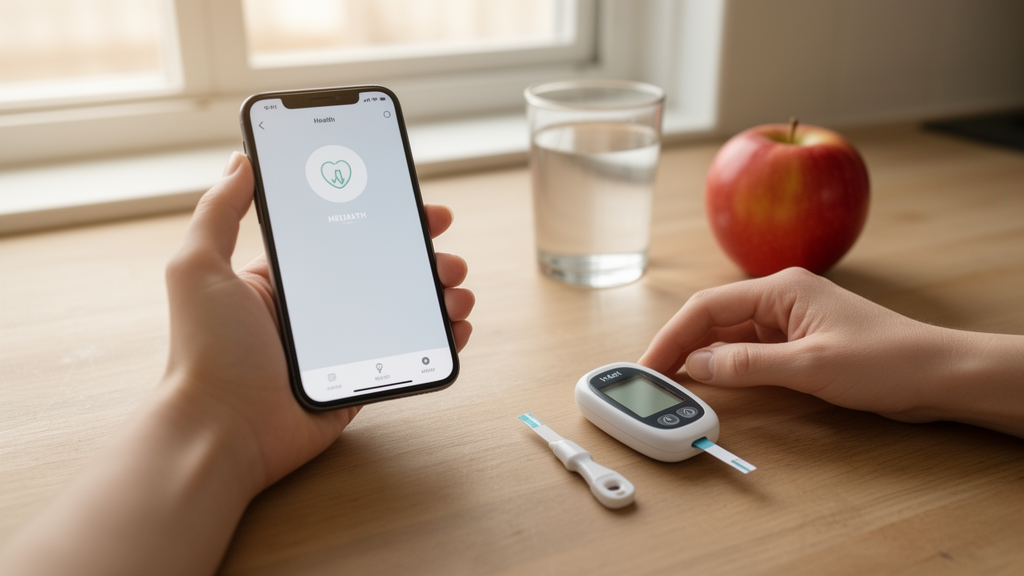
What the 10 included studies reveal is a field organised around four principal signal types. Continuous glucose monitoring dominated, providing not just glycaemic indicators such as time in range and glycaemic variability but, in several studies, a window into how patients perceive their own glucose patterns. Passive smartphone sensing — accelerometers, GPS, screen time, call logs and ambient light — formed the second pillar. Voice analysis, using acoustic features extracted by tools such as DisVoice, constituted a third, still experimental signal. Finally, ecological momentary assessment, in which patients report symptoms and moods in real time on their phones, was included as an active complement to passive collection.
The studies themselves spanned seven countries — Japan, South Korea, Germany, Ireland, Luxembourg, the United States and India — and sample sizes ranged from 47 participants to 142,432, reflecting enormous heterogeneity in design. In an Indian cross-sectional study of 47 people with type 1 and type 2 diabetes, machine learning models trained on smartphone sensor data found that depressive symptoms were associated with lower social contact and reduced daytime activity, with XGBoost and random forest achieving test accuracies of 81.1 and 80.0 percent. A much larger retrospective case-control analysis in the United States, drawing on glucose meter data, app interactions and coaching records for more than 142,000 people, used a LightGBM ensemble with SHAP interpretability analysis and achieved area under the curve values above 0.65 across three test sets, identifying race, sex and emotional state during blood glucose checks as important signals.
Glucose monitoring itself emerged as the most important digital phenotyping signal in the review. A Polish observational cohort of 77 people with type 1 diabetes found that higher scanning frequency with an intermittently scanned CGM device was associated with better glycaemic indicators and lower fear of hypoglycaemia. In Germany, a 17-day ecological momentary assessment study with three-month follow-up in 379 participants produced one of the review’s most clinically suggestive findings: patients’ subjective perception of their glucose had a stronger impact on diabetes distress than objective CGM indicators did. A companion 8-day study found that eight symptoms were significantly associated with glucose levels, and that depression and diabetes distress increased symptom scores by up to 12 percent. A Japanese study of 259 people with type 1 diabetes used a neural network to predict diabetes distress from CGM data, achieving an area under the curve of 0.728, with the Low Blood Glucose Index emerging as the most important predictive feature.
Voice and behaviour rounded out the signal spectrum. In Luxembourg, acoustic analysis of 679 participants found that stress was associated with 25 voice features and psychological distress with 18, with no overlap between the two voice patterns — a result the authors suggest could position voice biomarkers as low-cost, non-invasive tools for distinguishing different psychological states. In Ireland, a two-month longitudinal study using dynamic structural equation modelling showed that sleep quality and physical activity were significantly associated with daily mood in people with type 2 diabetes, and that these mood-behaviour associations differed from those in healthy individuals. In South Korea, stigma measured with a dedicated scale was significantly associated with time below range below 3.0 mmol/L and with anxiety.
Beyond mapping the studies, the review team applied machine learning to the literature itself. Using Python-based text mining on a cleaned corpus of 1,354 sentences and 21,301 words, they ran latent Dirichlet allocation topic modelling, BERT-based semantic clustering and keyword co-occurrence analysis. The LDA model settled on six topics, including diabetes symptoms and depression, stigma and psychological scales, sleep and mood, machine learning and passive sensing, model evaluation, and diabetes distress with glycaemic patterns. The co-occurrence network showed that the association between digital phenotyping signals and mental health outcomes sits at the core of current research, with machine learning acting as a bridge between signals and outcomes. Notably, the co-occurrence frequency between glucose and machine learning was noticeably low, though the authors caution this may reflect their keyword dictionary and corpus size rather than the actual extent of machine learning applied to glucose data.
The most sobering finding concerns individualisation. Of the 10 studies, only three genuinely achieved individualised risk prediction. Two German studies, by Ehrmann and colleagues and Hermanns and colleagues, used n-of-1 analysis to build separate glucose-psychological state association models for each patient. A United States study by Lee and colleagues used a Gaussian mixture model to identify four subgroups of glycaemic patterns, finding that the sustained hyperglycaemia group had the highest diabetes distress — a form of subgroup prediction rather than true individual modelling. The remaining seven studies were group-level models or association analyses, even where individual-level data were used in training. External validation of models was generally lacking, no multicentre or cross-national collaborative studies were identified, and no intervention studies appeared at all, meaning the promised closed loop from monitoring to prediction to intervention remains entirely aspirational.
The review’s authors are candid about these limitations and about their own analysis. The corpus was small, sentence-level co-occurrence analysis may overestimate the weight of longer documents, BERT clustering showed limited separation across all tested configurations, and LDA topic stability was only moderate across independent runs. No formal risk of bias assessment was performed, consistent with scoping review methodology, and only English and Chinese literature was included, potentially introducing selection bias. Most studies focused on a single psychological outcome rather than comorbid states, samples were dominated by young and middle-aged adults, and only one study explored voice features while none examined heart rate variability or electrodermal activity.
For now, the review’s conclusions are deliberately restrained. The evidence suggests digital phenotyping is associated with mental health outcomes in people with diabetes and that machine learning shows exploratory potential in predictive modelling, but the current evidence remains limited to the association and monitoring levels and does not support claims about causality, clinical intervention effects or clinical implementation. The authors point to multicentre external validation, multimodal signal integration, prospective validation and closed-loop monitoring-prediction-intervention design as the priorities ahead — and explicitly warn against asserting clinical usability before those steps are taken. What the field has demonstrated so far is feasibility and suggestive associations; what it has not yet demonstrated is whether continuous digital observation of glucose, behaviour and voice can actually improve mental health care for the hundreds of millions of people living with diabetes worldwide.
Subject of Research: Digital phenotyping for mental health monitoring and prediction in people with diabetes
Article Title: Digital phenotyping for mental health monitoring and personalized prediction in people with diabetes: a Python-based scoping review
Article References: Hou, W., Sun, W., Dai, H., Yang, H., Xu, G., Xie, X., Bai, F., & Xie, D. (2026). Digital phenotyping for mental health monitoring and personalized prediction in people with diabetes: a Python-based scoping review. Frontiers in Digital Health, 8, Article 2005262. https://doi.org/10.3389/fdgth.2026.2005262
Image Credits: AI Generated
DOI: 10.3389/fdgth.2026.2005262
Keywords: digital phenotyping, diabetes, mental health, continuous glucose monitoring, machine learning, ecological momentary assessment, smartphone sensing, voice biomarkers, diabetes distress, scoping review, personalized prediction, depression
News Source: Glenn Wilkins. (October 28, 2026). Smartphones, Glucose Sensors and Voice May Reveal Diabetic Minds, Review Finds. Scienmag.