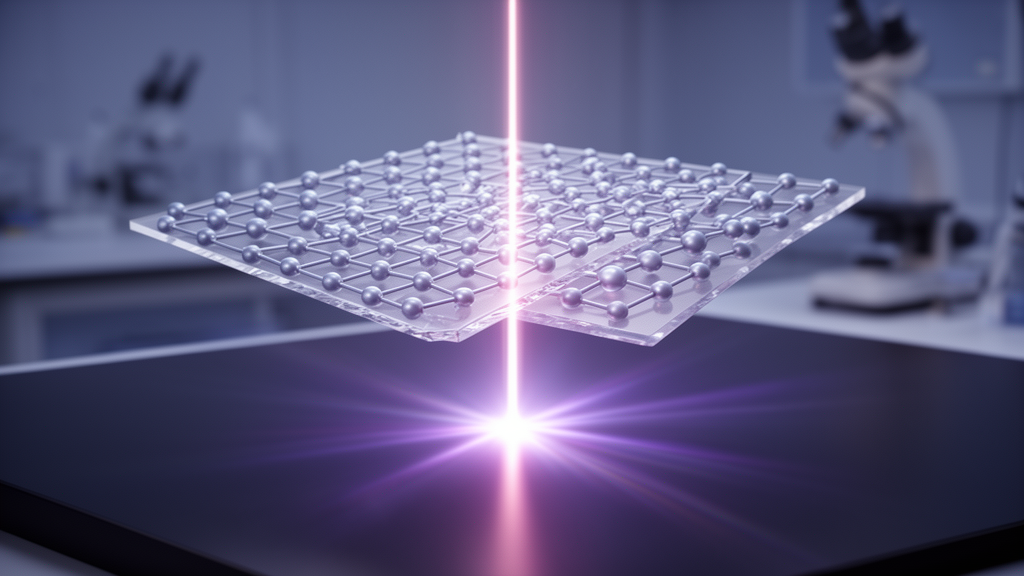
Researchers report that newly designed two-dimensional materials known as Janus monolayers could deliver second harmonic generation far stronger than that of conventional nonlinear optical crystals, according to a first-principles computational study published in Frontiers in Chemistry. The work, led by Shiqi Li of Jiangsu University with collaborators at Ningxia Normal University and Dalian University of Technology, proposes a family of compounds with the formula HfXY, where X and Y are different chalcogen elements drawn from oxygen, sulfur, selenium and tellurium.
The authors frame the search for new two-dimensional materials with enhanced SHG, and the uncovering of the mechanisms behind it, as crucial for enabling high-performance nonlinear photonics.
In the study, the team used first-principles calculations to design tetrahedral-phase HfXY monolayers and to evaluate their structural stability, electronic properties and SHG responses.
Stability screening was a key step. Phonon spectrum analysis, which probes whether a crystal structure would vibrate stably rather than spontaneously distort, confirmed that three of the candidate monolayers are dynamically stable semiconductors: HfOSe, HfOTe and HfSTe. The remaining compositions in the family did not pass this stability test, so the reported optical findings apply only to the three stable members.
The electronic structure analysis showed that all three dynamically stable Janus monolayers are indirect semiconductors. In each case, the valence band maximum sits at the Gamma point of the Brillouin zone while the conduction band minimum lies at the S point, meaning the lowest-energy electronic transition spans two different points in momentum space.
The headline result concerns the nonlinear optical response. The HfOSe and HfSTe monolayers exhibit pronounced out-of-plane SHG, with nonlinear susceptibility components reaching the order of 10² picometers per volt. According to the study, this is one to two orders of magnitude higher than in conventional bulk nonlinear optical crystals. The out-of-plane orientation of the response is notable because it arises directly from the vertical charge asymmetry created by the two different chalcogen layers, a feature that symmetric monolayers cannot offer.
The calculations also compared the Janus structures with their pristine, symmetric counterparts. The charge asymmetry introduced by the unequal top and bottom chalcogen layers enhances the SHG response of HfOSe and HfSTe beyond that of the corresponding pristine monolayers, the authors report. By tracing this enhancement to its intrinsic origins, the study links the magnitude of the nonlinear susceptibility to the internal distribution of charge in the tetragonal Janus geometry, providing a design principle rather than a single lucky discovery.
It is important to note what these results are and are not. All findings come from computer simulations; no monolayer samples were synthesized or optically measured in this work. The reported susceptibilities are theoretical predictions for ideal, isolated monolayers, and the dynamically stable compositions were identified computationally through phonon analysis. Experimental synthesis, characterization and optical testing would be needed to confirm the predicted SHG performance in real devices, and the study does not report such measurements.
With those caveats, the authors argue that their findings position tetragonal Janus monolayers as a promising materials platform for nonlinear photonics. They suggest the work will stimulate the exploration of multiphase Janus systems more broadly and support their eventual implementation in cutting-edge nonlinear photonic devices.
Subject of Research: First-principles prediction of enhanced second harmonic generation in tetragonal Janus HfXY monolayers
Article Title: Remarkably enhanced second harmonic generation in Janus HfXY (X, Y = O, S, Se, Te; X ≠ Y) monolayers
Article References: Li, S.-Q., Lei, Z., LI, R., Ban, Y., Bao, X., Ding, J., Su, H., Zhang, A., & Yin, H. (2026). Remarkably enhanced second harmonic generation in Janus HfXY (X, Y = O, S, Se, Te; X ≠ Y) monolayers. Frontiers in Chemistry, 14, Article 1986563. https://doi.org/10.3389/fchem.2026.1986563
Image Credits: AI Generated
DOI: 10.3389/fchem.2026.1986563
Keywords: Janus monolayers, second harmonic generation, two-dimensional materials, nonlinear photonics, first-principles calculations, HfOSe, HfSTe, semiconductors, nonlinear susceptibility, charge asymmetry, HfOTe, materials design
News Source: Bethany Barker. (October 29, 2026). New Janus Monolayers Show Strongly Enhanced Second Harmonic Generation in Simulations. Scienmag.