


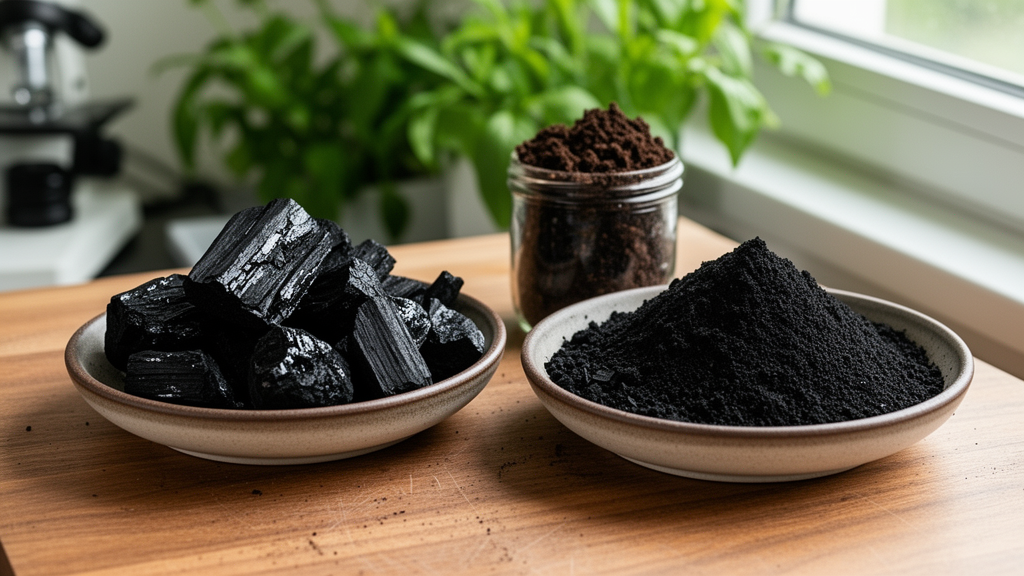
Charcoal left behind by natural forest fires and biochar manufactured in laboratories may influence soil carbon in strikingly similar ways, according to a new study from China. Researchers at Fujian Agriculture and Forestry University, working with colleagues at the Guangdong Academy of Sciences, compared how charcoal produced by broadcast burning of Pinus massoniana bark and engineered biochars made from the same feedstock affected carbon dioxide emissions from a subtropical plantation soil.
The study, published in Frontiers in Microbiology, centered on a 30-day laboratory incubation experiment. The team tested three engineered biochars pyrolyzed at 300, 500, and 900 degrees Celsius, referred to as B300, B500, and B900, alongside the natural fire-derived charcoal. They tracked cumulative soil CO2 emissions, changes in soil physicochemical properties, and shifts in bacterial diversity and community composition across the treatments.
The results revealed a sharp divide based on production temperature. Only the low-temperature biochar, B300, significantly increased soil CO2 emissions over the incubation period. In contrast, the two high-temperature biochars and the natural charcoal produced no significant changes in emissions, suggesting that the most carbon-rich, thermally altered materials are the most inert once mixed into soil.
Bacterial communities responded along the same lines. B300 addition markedly increased the relative abundances of the phyla Proteobacteria and Cyanobacteria while decreasing Acidobacteriota, Chloroflexi, and Verrucomicrobiota, changes the authors report as statistically significant. The natural fire-derived charcoal, by comparison, caused minimal changes in bacterial community composition, reinforcing the picture that it behaves like the high-temperature biochars rather than the low-temperature one.
To untangle which factors drove the emission patterns, the researchers used mixed-effects models that accounted for variation among treatments. These models showed that soil pH was negatively associated with cumulative CO2 emissions, meaning soils with higher pH released less carbon dioxide, while the relative abundance of Proteobacteria showed a positive association with emissions.
A complementary random forest analysis identified Proteobacteria and Acidobacteriota as potential predictors of cumulative CO2 emissions. The authors are careful to note, however, that these relationships require further validation before they can be considered established drivers of soil carbon loss.
Char itself is a carbon-rich pyrogenic material, generated either during natural fire events, as natural charcoal, or through the thermochemical conversion of plant biomass, as engineered biochar. Whether the two forms have comparable effects on soil CO2 emissions had remained unclear, and that gap motivated the direct comparison using an identical feedstock across a wide thermal gradient.
The broader implication is that biochars produced above 500 degrees Celsius behave like natural fire-derived charcoal in this subtropical plantation soil, both in their neutral effect on CO2 emissions and in their limited impact on bacterial communities. The authors describe such high-temperature biochars as potential functional analogues of fire-derived charcoal, a finding that could inform how biochar is deployed in soils where mimicking the stabilizing effect of natural charcoal is the goal.
As with any short-term incubation study, the findings reflect controlled laboratory conditions over 30 days rather than field-scale outcomes over seasons or years, and the authors frame the predictive relationships they observed as candidates for further testing rather than settled conclusions.
Subject of Research: Comparing natural fire-derived charcoal and engineered biochars in regulating soil CO2 emissions and bacterial communities in subtropical plantation soil
Article Title: Natural fire-derived charcoal resembles high-temperature biochar in regulating soil CO2 emissions from a subtropical plantation soil
Article References: Liu, H., Gao, Z., Huang, M., Man, J., Huang, Y., Liu, X., Wang, Y., & Hu, Y. (2026). Natural fire-derived charcoal resembles high-temperature biochar in regulating soil CO2 emissions from a subtropical plantation soil. Frontiers in Microbiology, 17, Article 1986273. https://doi.org/10.3389/fmicb.2026.1986273
Image Credits: AI Generated
DOI: 10.3389/fmicb.2026.1986273
Keywords: biochar, natural charcoal, soil CO2 emissions, pyrolysis temperature, bacterial community, soil carbon cycling, subtropical plantation soil, Pinus massoniana, incubation experiment, Proteobacteria, Acidobacteriota, soil pH
News Source: Morgan Morrow. (October 29, 2026). Fire Charcoal and High-Temperature Biochar Act Alike on Soil CO2 Emissions. Scienmag.



