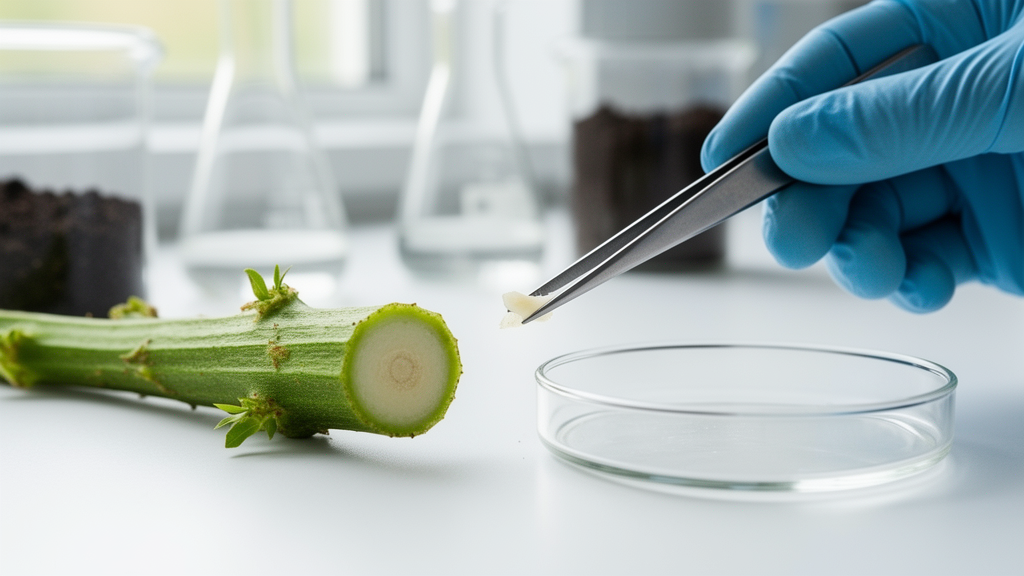
Plant invasions are shaped not only by the traits of the invading species and the environments it encounters, but also by the microscopic communities living inside its tissues. For the globally invasive plant Ageratina adenophora, a new controlled experiment suggests that where its internal microbes come from, and how hot or dry the surroundings are, can leave measurable fingerprints on both its endophytic microbiome and its growth.
Researchers used growth chambers to run a factorial experiment in which the plant-associated microbial sources available to A. adenophora were varied alongside temperature and water availability. The design allowed the team to ask how microbial source assemblages interact with these abiotic factors to influence the endophytic communities that colonize the plant and the performance of the host itself.
The results, published in Environmental Microbiome, show that endophytic community composition was primarily structured by plant tissue type. In other words, the microbial communities living in leaves differed systematically from those in roots, regardless of the other treatments. Microbial source assemblages nevertheless explained additional variation, and this effect was particularly evident in leaf-associated bacterial communities.
One treatment, in which the microbial sources were derived from A. adenophora itself, produced distinct endophytic community characteristics. Plants in this group showed higher leaf bacterial Shannon diversity and carried an enrichment of several discriminative taxa, indicating that the identity of the surrounding microbial sources can shape which endophytes establish inside the plant.
Abiotic conditions also mattered. Temperature and water availability were associated with tissue-specific microbial shifts, and the strongest treatment-associated changes appeared in root endophytic communities. This suggests that roots, in direct contact with soil and its moisture and temperature regimes, may respond more dynamically to environmental variation than the more buffered leaf compartment.
The effects of microbial source assemblages on plant growth were not uniform. Instead, they varied across abiotic conditions, meaning that a given microbial source treatment could be associated with different growth outcomes depending on temperature and water availability. This context dependence is a central message of the study: the influence of microbial sources on an invasive plant cannot be reduced to a simple count of source species.
To untangle these relationships, the researchers applied partial least squares path modeling, a statistical technique that can estimate direct and indirect pathways among blocks of variables. The modeling indicated that temperature and water availability were strongly associated with biomass variation. Root fungal community characteristics, meanwhile, showed a potential indirect statistical association with temperature-related biomass responses, hinting that below-ground fungal communities may be part of the chain linking climate conditions to plant performance.
The authors conclude that endophytic microbiome assembly in A. adenophora is associated with interactions among tissue-specific filtering, microbial source assemblages, and abiotic environments. Variation in microbial source assemblages, they argue, may influence invasive plant growth through context-dependent plant–microbe associations under changing environmental conditions, rather than through effects of source species number alone.
Because the experiment was conducted under controlled growth-chamber conditions, the findings provide a controlled test of these interactions rather than a direct measurement of field-scale invasion dynamics. Even so, the work highlights a plausible mechanism by which the microbial neighborhoods surrounding an invasive plant, together with temperature and water stress, could shape the internal communities that accompany its spread.
Subject of Research: How microbial source assemblages and abiotic conditions shape tissue-specific endophytic microbiomes and growth of the invasive plant Ageratina adenophora
Article Title: Plant-associated microbial source assemblages and abiotic conditions shape tissue-specific endophytic microbiomes and growth responses of Ageratina adenophora
Article References: Shi, W., Chen, L., Guo, X.-L., Zhang, N., Guo, Z., Guan, T.-J., Hu, Y.-W., Liu, Y.-X., & Fang, K. (2026). Plant-associated microbial source assemblages and abiotic conditions shape tissue-specific endophytic microbiomes and growth responses of Ageratina adenophora. Environmental Microbiome. https://doi.org/10.1186/s40793-026-00969-6
Image Credits: AI Generated
DOI: 10.1186/s40793-026-00969-6
Keywords: Ageratina adenophora, endophytic microbiome, microbial source assemblages, plant invasion, temperature, water availability, leaf bacteria, root fungi, growth chambers, biomass, partial least squares path modeling, tissue-specific filtering
News Source: Morgan Morrow. (October 30, 2026). Microbial Sources and Stress Shape the Hidden Endophytes of an Invasive Plant. Scienmag.