


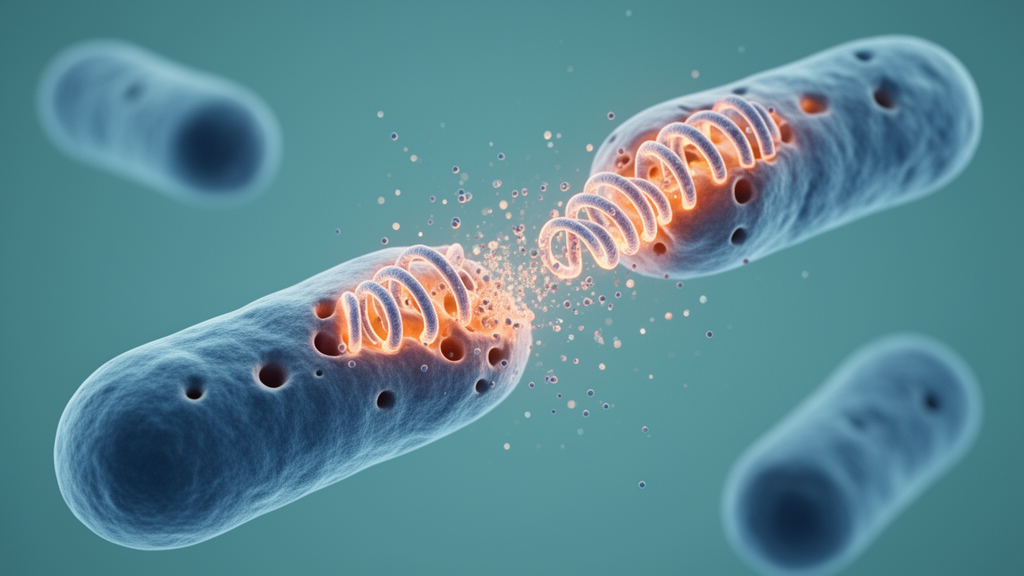
Scientists probing how bacteriophage K kills its bacterial hosts have found that the membrane-destroying power of its holin protein depends on a partnership between two parts of the molecule: the transmembrane domain that anchors it in the bacterial membrane and an extended C-terminal region whose role had remained poorly defined. The study, published in BMC Biotechnology, combined structural predictions, molecular dynamics simulations, recombinant protein expression and synthetic peptide testing to dissect which segments of the holin actually drive antibacterial activity. The results point to a coordinated mechanism rather than a single active region, an insight the authors say could guide the design of phage-derived antimicrobials at a time when drug-resistant bacteria continue to limit treatment options.
Holins are membrane-active proteins that play a central role in bacterial lysis during the phage life cycle. In the new work, the research team set out to determine what the extended C-terminal region of the phage K holin contributes to that activity. Because the contribution of individual structural domains to antibacterial function had not been clearly mapped, the group engineered a set of recombinant derivatives and synthetic peptides representing the transmembrane domain and various C-terminal segments, then evaluated each construct both when expressed inside bacterial cells and when applied externally to bacterial cultures.
The experiments showed that recombinant full-length Holin and the recombinant transmembrane domain alone, designated rTMD, both disrupted bacterial growth and induced membrane lysis in the intracellular expression assays as well as in external application assays. Growth inhibition measurements and membrane integrity analyses tracked the loss of bacterial viability and the breakdown of the cell envelope, while computational simulations provided a molecular-level view of how the proteins interact with the lipid bilayer.
The synthetic peptides told a different story. Among the C-terminal-derived peptides tested, only one, pIII, showed any activity when applied externally, and even that was minimal, with a minimum inhibitory concentration of 1000 micrograms per milliliter. The authors interpret this weak standalone performance as evidence that the C-terminal segments cannot lyse bacteria effectively on their own and instead depend on the transmembrane domain core for lytic function.
Among the recombinant derivatives, one construct stood out. rTMD-pI, which pairs the transmembrane domain with a specific C-terminal segment, showed the most favorable antibacterial profile of the set, with activity in the range of 20 to 40 micrograms per milliliter. That concentration range places the engineered protein well ahead of the synthetic peptide in potency and suggests that fusing the C-terminal segment to the membrane-spanning core creates a construct with practical antibacterial characteristics.
Molecular modeling added a mechanistic layer to the experimental findings. The simulations suggested that interactions involving the C-terminal region promote conformational rearrangements in the protein and localized destabilization of the surrounding membrane, changes that would facilitate pore formation through the bacterial envelope. The key points reported with the article note that the molecular dynamics simulations revealed local membrane thinning and perturbations driven by C-terminal folding, providing a structural explanation for why the two regions need each other to exert full lytic effect.
The consistent message across the growth assays, membrane integrity tests and simulations was that antibacterial activity depends on the coordinated action of the transmembrane domain and the C-terminal regions rather than on the C-terminus alone. This division of labor has implications for anyone attempting to engineer holin-based antimicrobials: truncating the protein down to a single domain, or isolating C-terminal peptides as free molecules, is unlikely to reproduce the potency of the intact or fused constructs.
Safety considerations were addressed in parallel with the efficacy work. The researchers observed low cytotoxicity toward human fibroblast cells within the tested concentration range, an early indicator that the active constructs might discriminate between bacterial and human cell membranes. The article’s key points also state that the rHolin derivatives showed selective activity against Staphylococcus aureus with low human cytotoxicity, framing the constructs as candidates for further development against this Gram-positive pathogen.
The study also surfaced a practical complication for bioproduction. Recombinant Holin expression triggered early bacterial lysis in the production host, which limits the yields of the protein that can be harvested. That observation underscores the double-edged nature of holin engineering: the same membrane-destroying activity that makes the protein an attractive antimicrobial candidate makes it difficult to manufacture in bacterial expression systems, since the producing cells succumb to their own product.
Overall, the authors position the findings as new insights into the structure-function relationships underlying holin-mediated antibacterial activity. By separating the contributions of the transmembrane core and the C-terminal region, and by demonstrating that potency emerges from their cooperation, the work offers a template for rational design of phage-derived antimicrobials in which domain combinations can be tuned for activity, selectivity and manufacturability.
Subject of Research: Structure-function relationships of the bacteriophage K holin protein and its C-terminal region in phage-derived antimicrobial design
Article Title: C-terminal–mediated modulation of Holin function from bacteriophage K: implications for phage-derived antimicrobial design
Article References: Hancer, H., Eraydin, N., Coksu, I., Yilmaz, E. S., Ozbil, M., Topuzogullari, M., Acar, S., & Ozbek, T. (2026). C-terminal–mediated modulation of Holin function from bacteriophage K: implications for phage-derived antimicrobial design. BMC Biotechnology. https://doi.org/10.1186/s12896-026-01219-w
Image Credits: AI Generated
DOI: 10.1186/s12896-026-01219-w
Keywords: bacteriophage K, holin, antimicrobial peptides, transmembrane domain, molecular dynamics simulations, Staphylococcus aureus, membrane lysis, synthetic peptides, recombinant proteins, cytotoxicity, phage-derived antimicrobials, BMC Biotechnology
News Source: Gregory Coleman. (October 30, 2026). Phage K Holin’s C-Terminal Region Shapes Antibacterial Activity, Study Finds. Scienmag.



