


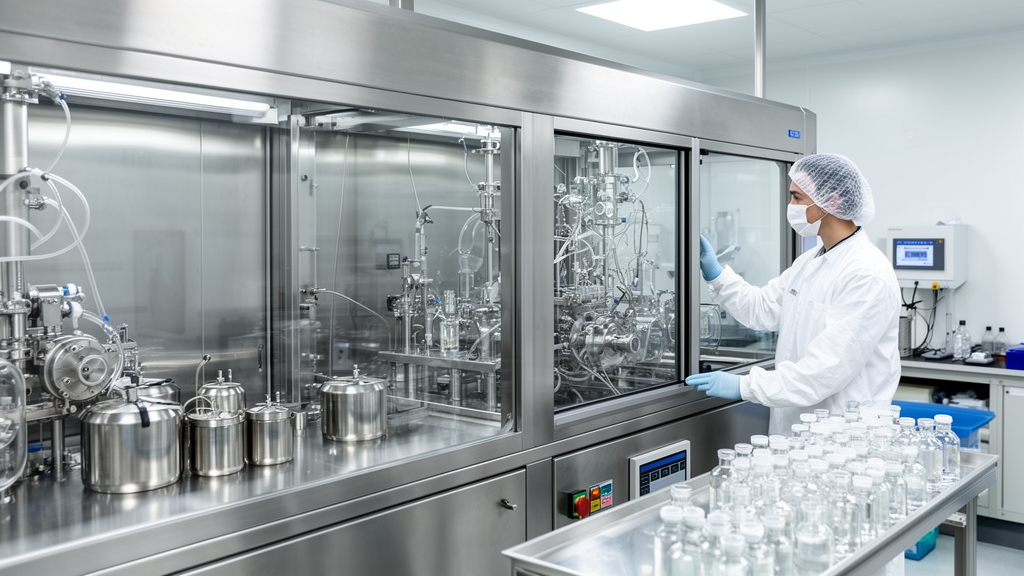
Researchers have developed, automated, and validated a fully cGMP-compliant method for producing the PET radioligand [11C]NOP-1A, a high-affinity tracer for imaging the nociceptin/orphanin FQ peptide (NOP) receptor in the living human brain. The work, published in EJNMMI Radiopharmacy and Chemistry, demonstrates reliable routine synthesis on a commercially available GE TRACERlab FXC Pro module, with all quality control parameters meeting predefined acceptance criteria for human administration under an approved investigational new drug application.
In vivo human studies of the NOP receptor have long been limited by the availability and reliable production of suitable radioligands. [11C]NOP-1A binds the NOP receptor with high affinity, reporting a inhibition constant of 0.15 nanomolar, and has appropriate lipophilicity for brain imaging. It has already been used in PET studies of alcohol use disorder, cocaine use disorder, stress responses, and post-traumatic stress disorder. Yet producing it reproducibly at clinical scale remained a bottleneck, and the new method aims to remove that obstacle for broader clinical and translational investigation.
The NOP receptor itself occupies an unusual position in opioid biology. Nociceptin, also called orphanin FQ, is a 17-amino-acid peptide discovered as the endogenous ligand for a fourth opioid-like receptor identified in 1994, alongside the mu, delta, and kappa receptors. Although the NOP system shares fundamental features with the classical opioid receptors, it behaves as a distinct receptor-ligand class: N/OFQ has far lower affinity for the kappa receptor than for NOP, no quantifiable affinity for the mu or delta receptors, and the NOP receptor does not bind classical opioid ligands.
NOP receptors are found in numerous organs, including the brain, and participate in processes such as stress regulation, learning, pain, and neuroendocrine control. Because of this function and neuroanatomical localization, the receptor system has been implicated in the pathophysiology of several neuropsychiatric conditions, including pain, anxiety, depression, anorexia, obesity, and drug abuse. A dependable PET ligand therefore opens a molecular window onto these disorders in living patients.
The synthesis challenge centered on the radiomethylation step. In the previously reported approach, the commercially available (S)-FPSPPA precursor was labeled with carbon-11 methyl iodide in the presence of potassium hydroxide as base and dimethylsulfoxide as solvent, using a reactor method at 80 degrees Celsius for five minutes. When the team attempted to reproduce that chemistry on their TRACERlab FXC Pro HPLC loop platform, they could not reliably make the expected product. Corrected radiochemical yields of only 3 to 5 percent fell short of the requested 370 to 555 megabecquerel dose, and an unusually less polar radiomethylated by-product appeared under the KOH conditions.
A systematic optimization program followed, varying the base, the solvent, the precursor preparation under inert versus benchtop atmosphere, and the reaction configuration between HPLC loop and reactor. Both KOH and sodium hydride could deprotonate the amide position of the precursor and produce the N-methylation product, but NaH in dimethylformamide clearly outperformed the original conditions, delivering a radiochemical conversion of 60 percent by HPLC compared with 48 percent for KOH in DMSO. The authors suggest that NaH’s advantage likely reflects more efficient deprotonation under anhydrous conditions, facilitating N-methylation, even though the reagent’s sensitivity to air demands more careful handling.
The optimized production runs entirely on the automated module. One milligram of precursor in 120 microliters of DMF is prepared with freshly added NaH, carbon-11 methyl iodide is trapped in the HPLC loop at 20 to 25 degrees Celsius, and the reaction proceeds at room temperature, a contrast with the 80-degree reactor method of the original report. Semi-preparative reverse-phase HPLC purifies the product, which elutes at roughly 14 minutes, before formulation through C-18 solid-phase extraction, elution with ethanol and saline, and sterile filtration into vented sterile vials. The carbon-11 radionuclide itself is produced on a GE PETtrace 880 cyclotron by proton bombardment of a 1 percent oxygen-in-nitrogen target gas.
Validation for human use involved three consecutive production batches assessed against United States Food and Drug Administration and United States Pharmacopeia requirements. Radiochemical purity ranged from 97.5 to 99.6 percent, molar activity spanned 79.4 to 162.9 gigabecquerels per micromole at end of synthesis, and product yields of 1.93 to 2.83 gigabecquerels corresponded to a corrected radiochemical yield of 13 plus or minus 2.5 percent relative to starting carbon-11 carbon dioxide. The formulated product maintained stability, clarity, and a pH of 5.5 over one hour, and all batches met criteria for radionuclidic identity, sterility, endotoxin content, residual solvents, sterile filter integrity, and visual inspection.
Reproducibility extended beyond the formal validation.
The authors argue that automation on a widely available commercial synthesizer minimizes operator-dependent variability, improves reproducibility, and eases cGMP compliance, making multicenter studies of the NOP receptor more feasible. Reliable access to [11C]NOP-1A is framed as particularly timely given growing interest in the nociceptin/orphanin FQ system in neuropsychiatric disorders. As with any validation study, the reported figures describe this specific production platform and process, and the method’s value for future clinical research will depend on its adoption and performance at other production sites.
Subject of Research: Development and cGMP validation of an automated radiosynthesis method for the NOP receptor PET radioligand [11C]NOP-1A for human use
Article Title: Optimization, automation and validation of NOP receptor PET radiopharmaceutical, [11C]NOP-1A for human use
Article References: Yokell, D. L., Dhaynaut, M., Neelamegam, R., Rice, P. A., Noel, J., Normandin, M. D., Pizzagalli, D. A., & El Fakhri, G. (2026). Optimization, automation and validation of NOP receptor PET radiopharmaceutical, [11C]NOP-1A for human use. EJNMMI Radiopharmacy and Chemistry, 11(1), Article 65. https://doi.org/10.1186/s41181-026-00479-3
Image Credits: AI Generated
DOI: 10.1186/s41181-026-00479-3
Keywords: PET radioligand, [11C]NOP-1A, NOP receptor, nociceptin/orphanin FQ, radiopharmaceutical production, cGMP validation, radiomethylation, GE TRACERlab FXC Pro, carbon-11, neuropsychiatric imaging, FDA, USP
News Source: Bethany Barker. (October 29, 2026). Automated cGMP Production of [11C]NOP-1A PET Radioligand Validated for Human Use. Scienmag.



