


Researchers working within the “Dr. Laser” project at Extreme Light Infrastructure–Nuclear Physics (ELI-NP) evaluated three target materials—amorphous metallic boron with 95% purity, crystalline metallic boron with 98% purity, and boron nitride with 98% purity—to identify the optimal route for generating the isotope that underpins PET scans in neurology, oncology and cardiology.
The conventional method for making carbon-11 relies on the 14N(p,α)11C nuclear reaction inside gaseous targets, a technique that is well established at cyclotron facilities. The team instead focused on the 11B(p,n)11C reaction, which they consider the most promising pathway for future production using protons accelerated by high-power lasers. Because laser-driven acceleration is not yet routine for isotope supply, the researchers first characterized the reaction using a conventional accelerator: the TR-19 cyclotron at the Horia Hulubei National Institute for Physics and Nuclear Engineering (IFIN-HH) in Romania.
A key step was determining exactly what proton energy the targets actually experienced. Although the cyclotron extracted a 15 MeV proton beam, the beam passes through an aluminium window, a helium cooling layer and a sealing foil before reaching the boron. Using the SRIM/TRIM code, which models how ions slow down and stop in matter, the team calculated that the effective energy arriving at the target surface was 14 MeV.
That 14 MeV figure proved crucial. By correlating it with simulated excitation functions—the curves describing how the reaction cross-section varies with energy—computed with the TALYS nuclear model code, the researchers demonstrated that the energy sits squarely in the optimal region of the excitation function for maximizing reaction yield. In other words, the experimental configuration was tuned to extract the highest possible production rate from the 11B(p,n)11C reaction.
The irradiations delivered measurable results. Corrected to end of bombardment (EOB), the produced activities were 7.77 GBq for the amorphous metallic boron target, 10.87 GBq for crystalline metallic boron, and 12.37 GBq for boron nitride. Expressed as yields, the three targets produced 3.11 GBq/µAh, 4.35 GBq/µAh and 4.95 GBq/µAh respectively, establishing boron nitride as the clear front-runner.
The measurements ran slightly below theory: the experimental values were 11.90% to 14.54% lower than the theoretical predictions. The authors characterize this gap as small and expected, and note that the data nonetheless showed a strong correlation with the mathematical model.
Quality control reinforced the practical value of the solid-target route. Gamma spectrometry of the samples confirmed radionuclide purity exceeding 99.9% for all three target materials, a level the researchers state complies with the requirements of the European Pharmacopoeia.
Why did boron nitride outperform the metallic boron targets? The study attributes its higher activity and yield to two factors: a greater apparent density, which puts more atoms in the beam’s path, and the contribution of additional nuclear reactions on nitrogen atoms that also generate carbon-11. This means the nitrogen component of the compound target is not inert—it actively participates in isotope production.
The team’s conclusion is that the 11B(p,n)11C reaction at a proton energy on target of 14 MeV is optimal for carbon-11 production using solid natural boron targets. The authors state that these results are to be implemented in the laser-driven nuclear reaction simulations and experiments within the ELI-NP project.
Subject of Research: Validation of carbon-11 production via the 11B(p,n)11C reaction on natural boron targets
Article Title: From simulation to experiment: multi-code modelling and validation of carbon-11 production using natural boron targets
Article References: Necsoiu, A., Cocioabă, D., Leonte, R., Crăciun, L., Florea, N., Radu, A., Jipa, A., Balabanski, D. L., Ur, C. A., & Niculae, D. (2026). From simulation to experiment: multi-code modelling and validation of carbon-11 production using natural boron targets. EJNMMI Radiopharmacy and Chemistry. https://doi.org/10.1186/s41181-026-00490-8
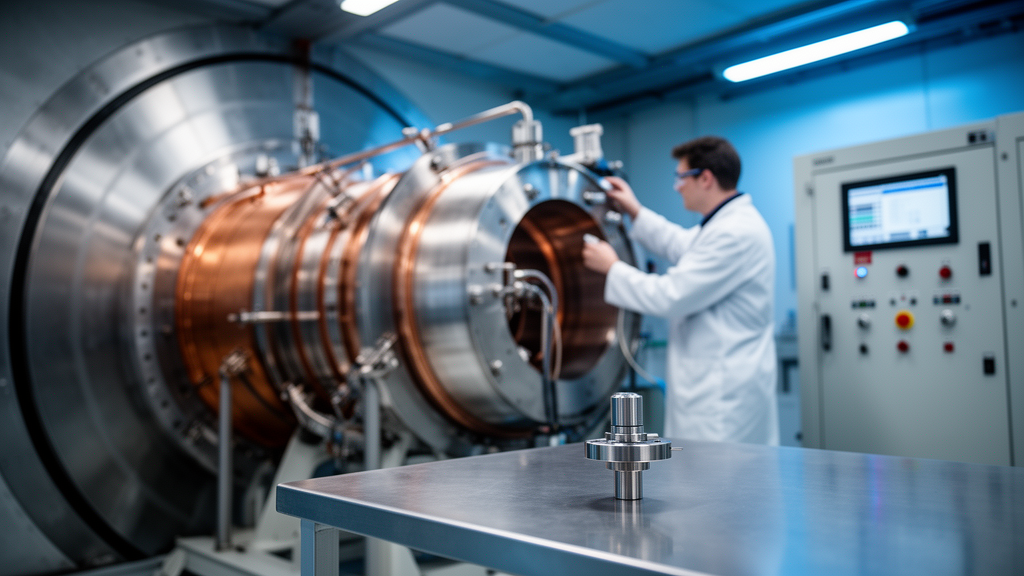
Image Credits: AI Generated
DOI: 10.1186/s41181-026-00490-8
Keywords: carbon-11, PET radiotracers, boron nitride target, cyclotron, TALYS, SRIM/TRIM, ELI-NP, laser-driven acceleration, radionuclide purity, nuclear reaction cross-sections, simulation, experiment
News Source: Bethany Barker. (October 29, 2026). Cyclotron Tests Validate Carbon-11 Production on Natural Boron Targets. Scienmag.



