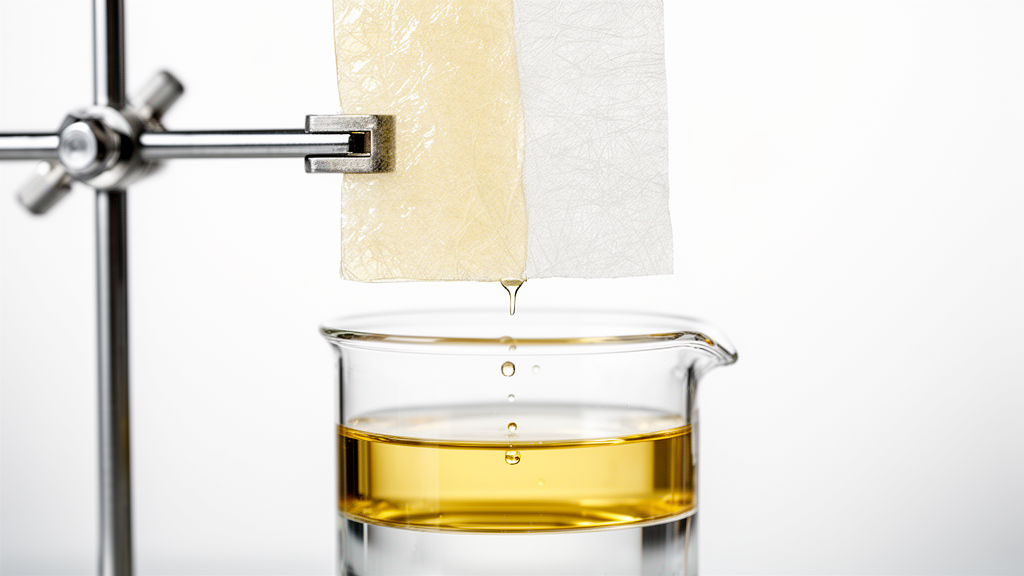
A single sheet of regenerated cellulose, engineered so that one face repels water while the other drinks it in, has been shown to separate oil from water using nothing more than gravity. The membrane, described in Bioresources and Bioprocessing, was fabricated from cellulose acetate through a phase-separation process, converted to pure cellulose by alkaline hydrolysis, and then chemically modified on only one side with a silane treatment. In gravity-driven tests, it achieved permeation fluxes of roughly 3300 to 5527 liters per square meter per hour for peanut oil and water mixtures, with an apparent volumetric oil-retention efficiency of up to 95 percent, while retaining its mechanical integrity through rolling, compression, and bending without cracking or delamination.
According to the authors, existing Janus membranes are typically built by modifying preformed substrates or stacking multiple layers, approaches that can suffer from weak interfacial adhesion, delamination under pressure or shear, progressive degradation of functional layers, and complex manufacturing. Many reported fabrication routes also depend on hazardous solvents such as N,N-dimethylformamide, chloroform, dichloromethane, or dimethylacetamide, or on fluorinated agents, raising environmental and regulatory concerns. The new membrane, by contrast, is monolithic: its two faces arise from selective chemical treatment of a single continuous material rather than from glued-together layers.
The fabrication begins with a casting solution of cellulose acetate dissolved in dimethyl sulfoxide, with acetone added to improve miscibility and a small measured amount of water introduced as a non-solvent additive. The researchers cast this solution onto a glass plate with a doctor blade set to 200 micrometers, exposed the film to air for 20 seconds to allow partial solvent evaporation, and then immersed it in an ultrapure water bath at 25 degrees Celsius for thirty minutes. This immersion triggers non-solvent-induced phase separation, or NIPS, in which the exchange of solvent and water drives the polymer solution to demix into a porous solid. The team reports that the water additive and a controlled pre-evaporation step allowed fine adjustment of the phase-separation kinetics and, with it, the final pore morphology.
The cellulose acetate membrane was then deacetylated by immersion in a 0.5 molar sodium hydroxide solution in a 70:30 ethanol-water mixture at 30 degrees Celsius for two hours. This alkaline hydrolysis converts the acetate into regenerated cellulose, a substrate that is intrinsically hydrophilic and chemically reactive. The final and decisive step was unilateral silanization. The researchers masked one face of the hydrated membrane with an ethanol-resistant PTFE tape and contacted the exposed face with a sol-gel solution containing tetraethyl orthosilicate (TEOS) and methyltrimethoxysilane (MTES) in ethanol, with water to initiate hydrolysis and ammonium hydroxide as a base catalyst at a pH of 9 to 11. TEOS forms the silica network, while MTES introduces methyl groups that lower surface energy and confer hydrophobicity.
Characterization confirmed that the treatment worked as intended and stayed where it was put. Scanning electron microscopy showed that the pristine regenerated cellulose surface was smooth, compact, and continuous, with no visible open pores even at 20,000-fold magnification, while the silanized surface became rougher and covered with granular, nodular features attributed to a siloxane-based coating. Atomic force microscopy over a 1 by 1 micrometer scan area revealed an average roughness of 19.9 nanometers and a developed surface area 25.7 percent greater than the projected area. Energy-dispersive X-ray spectroscopy showed silicon rising from a trace 1.05 weight percent on the unmodified membrane to 23.42 weight percent on the treated face, while the protected face held only 6.13 weight percent, indicating that silanization was mainly localized on the exposed surface with limited migration toward the masked side. A cross-sectional line scan showed the silicon signal highest near the silane-treated side and lower toward the protected side.
Infrared spectroscopy added chemical corroboration. Both membranes retained the characteristic cellulose bands near 1430, 1366, 1157, and 1030 reciprocal centimeters, corresponding to CH2 bending, C-H deformation, glycosidic C-O-C stretching, and C-O stretching, showing that the cellulose backbone survived the treatment. The modified membrane additionally displayed bands near 1271 reciprocal centimeters assigned to Si-CH3 deformation, a strong contribution between 1100 and 1035 reciprocal centimeters attributed to asymmetric Si-O-Si stretching, and a more pronounced band at 775 to 780 reciprocal centimeters associated with Si-C and Si-CH3 vibrations, together confirming formation of a siloxane network through hydrolysis and condensation of the two silane precursors.
Textural analysis traced how the modification reshaped the pore network. Nitrogen adsorption measured at 77 kelvin showed the Janus-like membrane adsorbing 33.85 cubic centimeters per gram at a relative pressure near 0.99, compared with a maximum of 6.77 for the pristine membrane, and its BET specific surface area rose roughly six-fold, from 4.06 to 26.92 square meters per gram. Barrett-Joyner-Halenda analysis showed the main pore-distribution peak shifting toward the nanoscale at 9.15 nanometers, with greater contributions from mesopores between 5.5 and 7.54 nanometers, and cumulative pore volume increasing five-fold from 0.00982 to 0.0535 cubic centimeters per gram. The authors note that because silanization was localized on the exposed surface, these changes likely reflect altered nitrogen-accessible properties of the siloxane-containing surface layer rather than transformation of the whole cellulose matrix. The average pore diameter fell from 15.6 nanometers in the pristine membrane to 7.2 nanometers after modification.
The two faces behaved as designed in wettability tests. The silanized side showed a static water contact angle of 91 degrees, placing it just over the hydrophobic threshold, while the unmodified side spread water instantly, with a contact angle close to 0 degrees. When the pre-wetted hydrophobic side contacted an oil droplet underwater, it rapidly absorbed the oil while repelling the aqueous phase, and the hydrophilic side promoted water permeation while rejecting oil. In gravity-driven filtration through an effective membrane area of 19.35 square centimeters, with the hydrophobic side facing the feed, five consecutive water and peanut oil tests with oil volumes rising from 10 to 50 milliliters yielded fluxes from 3300.83 to 5526.68 liters per square meter per hour and oil-retention efficiency that stayed above 93.5 percent. For water and hexane over 12 consecutive cycles, average flux was 3950.2 liters per square meter per hour with 96.93 percent retention. Water and dichloromethane proved harder: over seven cycles the average flux was 2620.78 liters per square meter per hour with only 70.14 percent retention, a difference the authors attribute to the high density and low viscosity of dichloromethane, which facilitates partial breakthrough under hydrostatic pressure. As a reference, the unmodified membrane separated oil and water at a high flux of 5590 liters per square meter per hour but retained only 72.5 percent of the oil, underscoring the contribution of the surface functionalization.
The proposed mechanism is qualitative and rests on capillary asymmetry. Because the silanized surface’s contact angle slightly exceeds 90 degrees, the Young-Laplace relation implies that spontaneous water intrusion is unfavorable there and a capillary entry barrier must be overcome at pore entrances. Before each separation the membrane was pre-wetted, saturating the mesoporous channels with water, so transport is governed by the difference in capillary pressure across the two faces rather than by initial pore infiltration: the hydrophilic side favors water imbibition through capillary suction while the hydrophobic side resists water entry, and oil transport is expected to be restricted by the water-filled pore network and capillary resistance within the nanoscale pores. Reuse testing showed oil-phase-dependent fouling. For water and hexane, recovered flux fell from 4070.00 to 3265.31 liters per square meter per hour over 12 cycles, a flux recovery ratio of 80.23 percent, with retention remaining above 95 percent. For dichloromethane, flux fell from 3224.81 to 2016.74 over seven cycles, a recovery ratio of 62.54 percent, likely because the denser solvent penetrates or accumulates in pores under hydrostatic pressure. Mechanically, the modified membrane reached a tensile strength of 3.50 megapascals with a breaking force of 5.23 newtons, tested in the water-wet state, slightly above the pristine membrane’s 3.13 megapascals and 4.70 newtons, and it withstood axial rolling, conical deformation, bending, and bidirectional bending with no visible cracking, delamination, or macroscopic failure. The authors position the membrane as a laboratory demonstration with a simplified, energy-efficient fabrication route that they argue could be scaled toward industrial production, while the reported separation figures remain apparent volumetric efficiencies from small-scale gravity tests on specific oil-water pairs rather than performance guarantees for real oily wastewater.
Subject of Research: A monolithic cellulose Janus-like membrane with asymmetric wettability for gravity-driven oil/water separation
Article Title: Design of a monolithic cellulose Janus-like membrane for oil/water separation
Article References: Souare, M., Dong, C., Hu, X., Xue, J., & Zhang, J. (2026). Design of a monolithic cellulose Janus-like membrane for oil/water separation. Bioresources and Bioprocessing, 13(1), Article 148. https://doi.org/10.1186/s40643-026-01142-0
Image Credits: AI Generated
DOI: 10.1186/s40643-026-01142-0
Keywords: Janus membrane, cellulose, oil/water separation, non-solvent-induced phase separation, silanization, asymmetric wettability, gravity-driven filtration, regenerated cellulose, mesoporous structure, flux, fouling resistance, biomaterials
News Source: Gregory Coleman. (October 29, 2026). Cellulose Membrane With Two Faces Splits Oil and Water Under Gravity Alone. Scienmag.