


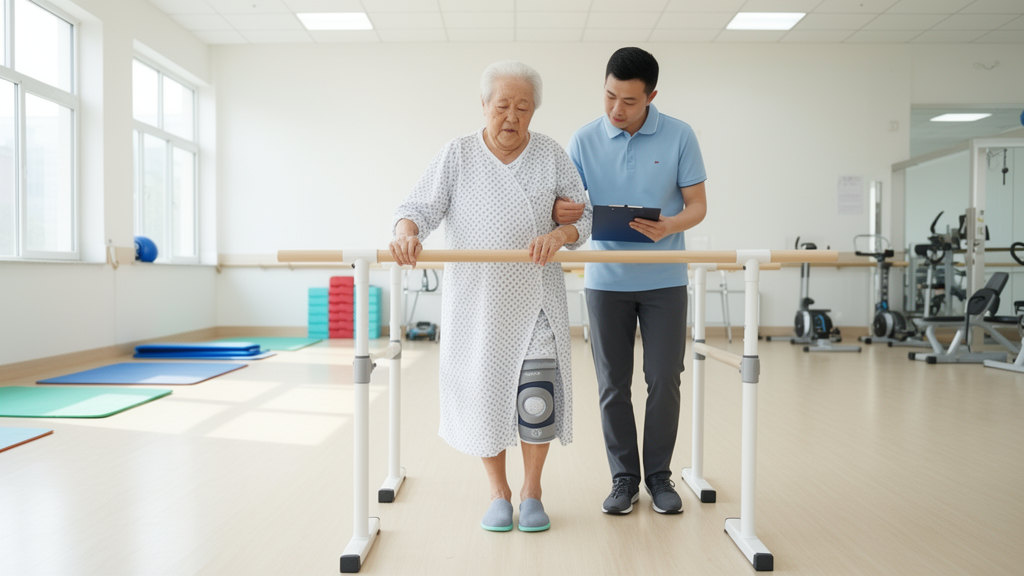
Patients recovering from knee replacement surgery in Beijing spent a median of 25 days in inpatient rehabilitation, and the single factor that best predicted how long they stayed was not their age, their comorbidities, or their level of physical function — it was the type of medical insurance they carried. That is the central finding of a retrospective study conducted at a tertiary rehabilitation hospital in Beijing, published in Frontiers in Epidemiology.
The study, led by researchers at Beijing Xiaotangshan Hospital together with a colleague from Beijing Jishuitan Hospital Affiliated to Capital Medical University, consecutively enrolled patients admitted for inpatient rehabilitation after primary total or unicompartmental knee arthroplasty between 2023 and 2026. Because it is a retrospective, single-center study, its results describe the patterns observed in this one hospital’s records rather than testing an intervention or establishing causal effects.
In total, the analysis covered 103 admissions. Of these, 60 admissions, or 58.3 percent, were covered by Beijing local medical insurance, while 43 admissions, or 41.7 percent, involved patients with off-site medical insurance from outside the capital.
The timing of rehabilitation was strikingly rapid. The median interval between the primary knee surgery and admission to the rehabilitation center was just 5 days, suggesting that early transfer into post-acute rehabilitation is already routine practice for many patients in this system. Once admitted, patients remained for a median of 25 days, a figure that captures the typical inpatient rehabilitation episode for knee arthroplasty at this institution.
The cost of that care was substantial. The median total rehabilitation hospitalization cost was 28,337.1 Chinese Yuan, equivalent to 3,987.1 US dollars. Rehabilitation training expenses accounted for 49.23 percent of that total, meaning nearly half of every hospital bill went directly to therapeutic exercise and rehabilitation services rather than to accommodation, medication, or other hospital charges.
After adjusting for confounding factors, only one variable emerged as an independent influencing factor of length of hospital stay: the type of medical insurance, with a P value below 0.05. In other words, within this cohort, whether a patient’s care was funded through Beijing local insurance or through off-site coverage carried more statistical weight in explaining stay duration than the clinical and demographic variables the authors examined.
The authors caution against over-interpretation and frame their conclusion carefully: the study implies that orthopedic hierarchical care and integrated rehabilitation models may help optimize rehabilitation length of stay and ease patients’ economic burden. They also note that further investigation of cross-institutional rapid referral pathways is needed before such models can be refined or generalized.
Why might insurance type matter?
For readers, the takeaway is a measured one. In this single Beijing rehabilitation center, knee arthroplasty patients moved quickly into post-surgical rehabilitation, stayed a median of 25 days, and incurred costs of which roughly half were rehabilitation training fees. The duration of those stays tracked with insurance type rather than the clinical factors measured here. As the authors emphasize, confirming and explaining this pattern — and testing whether integrated referral systems can shorten stays and reduce costs — will require further research beyond this retrospective cohort.
Subject of Research: Retrospective analysis of rehabilitation length of stay and its influencing factors among inpatients after knee arthroplasty in Beijing, China.
Article Title: Epidemiological characteristics and influencing factors of rehabilitation length of stay among hospitalized patients after knee arthroplasty in Beijing, China: a retrospective study
Article References: Liu, J., Wang, Y., Jin, S., & He, J. (2026). Epidemiological characteristics and influencing factors of rehabilitation length of stay among hospitalized patients after knee arthroplasty in Beijing, China: a retrospective study. Frontiers in Epidemiology, 6, 1919766. https://doi.org/10.3389/fepid.2026.1919766
Image Credits: AI Generated
DOI: 10.3389/fepid.2026.1919766
Keywords: knee arthroplasty, rehabilitation, length of stay, epidemiology, medical insurance, Beijing, retrospective study, hospitalization costs, Modified Barthel Index, hierarchical care, Epidemiological, characteristics
News Source: Ophelia Keating. (October 29, 2026). Insurance Type, Not Illness, Predicted Rehab Stay Length After Knee Surgery in Beijing. Scienmag.



