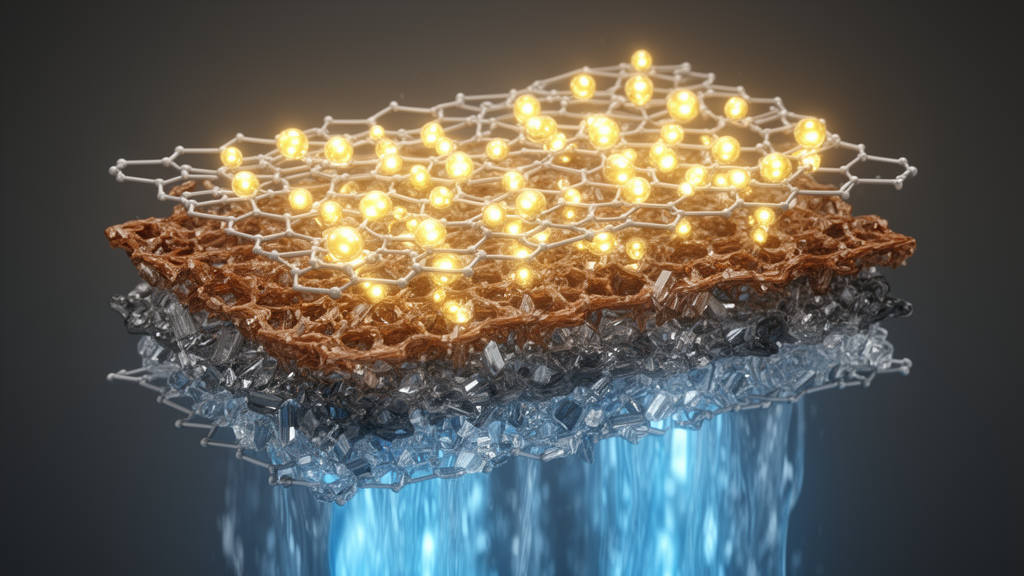
Europium is classified as a critical element, and a research team has now reported a nanocomposite photocatalyst designed to recover it from synthetic wastewater. In a study published in BMC Chemistry, Soumya Mishra, Naresh Kumar Sahoo and colleagues describe a Sm-BiVO4-ZnWO4-SrGO nanocomposite, synthesized by a hydrothermal method, that removed 81.3% of Eu(III) from a starting concentration of 50 mg/L within 240 minutes. The result is presented as an early-release, peer-reviewed accepted manuscript carrying a permanent DOI, subject to further edits before the final version of record.
The performance of the combined material stands out when compared with its individual parts. In the same tests, Sm-BiVO4 alone removed 31% of the Eu(III), ZnWO4 alone removed 28%, and SrGO alone removed 21%. The authors attribute the superior performance of the ternary composite to improved charge separation, superior surface activity, increased electron mobility, and more favorable reaction kinetics within the photocatalytic system, in which the Sm-modified BiVO4-ZnWO4 Z-scheme heterojunction works synergistically with sulfur-doped reduced graphene oxide.
Before the removal experiments, the synthesized nanocomposite was characterized using a suite of analytical techniques: X-ray diffraction, FT-IR spectroscopy, field-emission scanning electron microscopy, energy-dispersive X-ray analysis, Raman spectroscopy, photoluminescence spectroscopy, UV diffuse reflectance spectroscopy, and Mott-Schottky analysis. These methods were used to establish the structural, chemical, and optical properties of the material that underpin its photocatalytic behavior.
The kinetic analysis of the removal data followed the Langmuir-Hinshelwood model, yielding a correlation coefficient of R² = 0.97. The fitted parameters included a photocatalytic rate constant of 0.259 min⁻¹, described in the study as superior, and a comparatively low Langmuir-Rideal adsorption constant of 0.060 mg/L. Together, these values characterize how quickly and how strongly the composite interacts with Eu(III) in solution during the photocatalytic process.
Reusability is a key consideration for any water-treatment material, and the study reports that the nanocomposite remained effective across four reductive sorption cycles, which the authors describe as strong reusability. The work is framed around sustainability: because europium is listed as a critical element, the authors argue that eco-friendly and sustainable recovery techniques are crucial for circular economy processes. The reported findings concern a synthetic wastewater system at a defined starting concentration of 50 mg/L, and the removal efficiency figures come from the laboratory experiments described in the accepted manuscript. As with any early-release article, the results will be finalized in the eventual version of record, but the study offers a documented example of how a Z-scheme heterojunction combined with sulfur-doped reduced graphene oxide can be engineered to enhance the photocatalytic removal of a critical rare-earth element from water.
Subject of Research: Photocatalytic recovery of europium(III) from synthetic wastewater using a Sm-BiVO4-ZnWO4 Z-scheme heterojunction combined with S-doped reduced graphene oxide.
Article Title: Photocatalytic removal of Eu (III) using the synergistic effect between novel Sm-BiVO₄-ZnWO₄ Z-scheme heterojunction and S-doped rGO
Article References: Mishra, S., Sahoo, N. K., Sahoo, S., Panda, A., Tabasum, M., Pradhan, S., Naik, B., & Sarma, S. J. (2026). Photocatalytic removal of Eu (III) using the synergistic effect between novel Sm-BiVO₄-ZnWO₄ Z-scheme heterojunction and S-doped rGO. BMC Chemistry. https://doi.org/10.1186/s13065-026-01940-9
Image Credits: AI Generated
DOI: 10.1186/s13065-026-01940-9
Keywords: europium recovery, photocatalysis, Z-scheme heterojunction, S-doped rGO, BiVO4, ZnWO4, water treatment, critical elements, Langmuir-Hinshelwood kinetics, nanocomposite, hydrothermal synthesis, circular economy
News Source: Bethany Barker. (October 29, 2026). Sm-BiVO4-ZnWO4 Z-scheme heterojunction with S-doped rGO removes 81.3% of Eu(III) from synthetic wastewater. Scienmag.