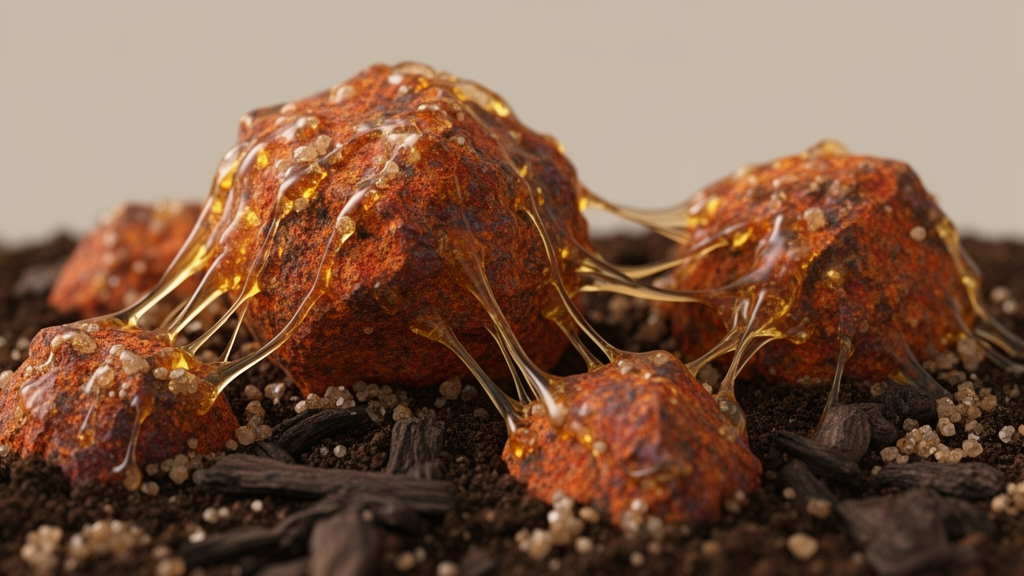
Bacteria in soil are wrapped in a sticky layer of molecules known as extracellular polymeric substances, or EPS. These biopolymers, made mostly of polysaccharides, proteins and nucleic acids, make up more than ninety percent of the dry mass of a biofilm and serve as the main interface through which microbes interact with their surroundings. Because EPS form a substantial component of soil organic matter, understanding what happens to them after they enter the soil has direct consequences for how long carbon stays locked away from the atmosphere. A new study published in Carbon Research shows that the fate of bacterial EPS in soil is governed less by simple surface attachment than by active microbial processing, and that iron (oxyhydr)oxides emerge as the decisive minerals for preserving the organic molecules that remain.
A team led by researchers including Chenchen Qu and Qiaoyun Huang isolated EPS from Bacillus subtilis, a widespread and representative soil bacterium, and followed its journey in three agriculturally important Chinese soils: Mollisol from Heilongjiang, Alfisol from Henan and Ultisol from Hunan. These soils span cold temperate, warm temperate and subtropical climates and differ sharply in mineral composition, pH and iron oxide content. The researchers first allowed the EPS to adsorb onto the soils and onto purified clay minerals, kaolinite, montmorillonite and the iron oxide goethite, and then incubated soil-EPS mixtures for forty days at 28 degrees Celsius. They tracked the resulting chemical changes with synchrotron-based X-ray absorption near-edge structure spectroscopy, solid-state carbon-13 nuclear magnetic resonance spectroscopy and synchrotron infrared microspectroscopy.
The central surprise of the study is a reversal of the researchers’ initial hypothesis. They had expected that direct adsorption of EPS onto mineral surfaces would cause larger shifts in soil organic matter composition than subsequent biological activity. The opposite proved true. Incubation induced roughly twice the change in carbon and sulfur speciation compared with surface adsorption alone. On average, EPS adsorption shifted organic carbon speciation by about 18.3 percent, whereas the following forty days of incubation pushed compositional changes to an average of 26.9 percent, even though the total soil organic carbon concentration fell back to its starting level. Reduced sulfur forms, which are characteristic of microbial proteins such as those containing cysteine and methionine, increased by 14.7 percent after adsorption but by 44.5 percent after incubation.
The explanation lies in what soil scientists call a priming effect. Rather than simply sitting on mineral surfaces, the labile EPS stimulated native soil microbes, which accelerated the decomposition of the soil’s own organic matter. The authors estimate, based on the compositional shifts and on earlier isotope-labeling studies showing that 54 to 65 percent of microbial-derived organic carbon is mineralized during incubation, that approximately half of the added EPS was degraded. That degraded fraction fueled microbial activity, and the resulting accumulation of microbially derived organic carbon was roughly twice what the measured compositional changes would require from adsorption alone. In other words, EPS participates in soil organic matter turnover primarily by feeding the microbial carbon pump, not by acting as a passive, protected coating on minerals.
The spectroscopic data reveal a consistent chemical signature of this microbial reworking. Across all three soils, incubation with EPS increased carboxylic carbon, by 8.3 percent in Mollisol, 36.2 percent in Alfisol and 3.2 percent in Ultisol, while aromatic carbon declined by 30.0 percent overall. Nitrogen speciation shifted toward imines and amides, with increases of 10 to 120 percent, pointing to an accumulation of proteins and amino sugars. The nuclear magnetic resonance measurements corroborated these trends: alkyl carbon, indicative of lipids, rose by 3.3 percent in Mollisol, 12.2 percent in Alfisol and 11.9 percent in Ultisol, while aryl, O-alkyl and methoxyl carbon decreased. A calculated recalcitrance index rose by 3.6 to 8.3 percent in Alfisol and Ultisol, indicating that the organic matter remaining after microbial processing is chemically more resistant.
Where does this reworked organic matter end up? The microscale infrared mapping provides a clear answer: bound to iron. After incubation, the spatial correlation between iron oxide signatures and organic functional groups increased by an average of 90 percent relative to untreated soils. Carboxyl and aliphatic groups showed particularly strong gains, with correlation coefficients rising by 125 to 207 percent, while correlations for polysaccharides and proteins were statistically unchanged. By contrast, associations between organic matter and phyllosilicate clays reverted to baseline levels in Mollisol and Ultisol, and the clay-EPS associations actually disintegrated under the iron-rich, acidic conditions characteristic of those soils. Only in Alfisol, where higher pH and much lower amorphous iron oxide content limit iron-mediated binding, did phyllosilicate associations persist and strengthen.
Pure mineral experiments explain the selectivity behind these patterns. When EPS was adsorbed onto goethite, the iron oxide enriched alkyl and carboxyl carbon peaks by 57 and 35 percent respectively. The phyllosilicates behaved in the opposite way: adsorption onto montmorillonite and kaolinite reduced alkyl and carboxyl carbon peaks by about 14 percent each while increasing aromatic carbon more than fourfold. Infrared mapping of the mineral-EPS composites confirmed that iron oxides correlate strongly with proteinaceous, aliphatic and carboxyl groups, whereas clays favor aromatic and aliphatic carbon and bind carboxyl groups only weakly. This molecular fractionation means that different minerals stabilize different organic compounds: iron oxides preferentially lock up carboxyl-rich molecules, while clay minerals favor aromatics and lipids.
The soil-specific results show how mineralogy and pH jointly determine which stabilization pathway dominates. Alfisol contains four to five times less amorphous iron oxide than the other soils and has a pH roughly 1.5 units higher, conditions that keep EPS mobile and bioavailable while providing fewer iron binding sites. Consequently, phyllosilicates took over the stabilizing role in Alfisol, evidenced by strengthened clay-organic correlations during incubation. Ultisol, despite having the lowest microbial biomass and soil organic carbon content, showed the slowest EPS degradation kinetics, with a degradation rate 22 percent lower than in Mollisol and Alfisol. Notably, total nitrogen was retained more effectively than carbon in all three soils, ending the incubation 17 percent higher in Mollisol, 19 percent higher in Alfisol and 4 percent higher in Ultisol relative to unamended controls.
The authors propose a dual mechanism for how EPS ultimately stabilizes soil organic matter. First, EPS boosts microbial activity, which decomposes native organic matter into higher-reactivity molecules enriched in carboxyl groups. Second, these microbially derived, carboxyl-rich lipids and proteins form strong surface complexes with iron oxides, strengthening organo-mineral associations and promoting a more protected carbon pool. Phyllosilicates provide a secondary stabilization route only when iron oxides are scarce or soil organic carbon concentrations are high enough to saturate iron binding sites. The study thus reframes the role of bacterial EPS in soils: rather than being preserved directly through adsorption, EPS acts as a biological catalyst that transforms the existing organic matter pool and channels it toward iron-oxide-associated persistence.
The researchers acknowledge limitations that shape how far these findings can be generalized. They applied a single pulse of EPS, which mimics substantial organic inputs such as manure or fertilizer application, whereas natural soils experience gradual, continuous EPS synthesis and release; turnover under slow-release conditions remains unexplored. Inferring EPS transformation from changes in molecular composition is indirect, and the team notes that future experiments using carbon-13 and nitrogen-15 labeled EPS, combined with nanoscale secondary ion mass spectrometry, could quantify precisely how much EPS is decomposed, how much enters microbial biomass, and how the remainder associates with minerals. Even with these caveats, the study delivers a clear message for soil carbon science: the minerals that matter most for keeping microbially processed carbon in the ground are the iron oxides, and the microbes doing the processing are the gatekeepers deciding which molecules those minerals get to keep.
Subject of Research: How iron oxides and microbial activity control the persistence of bacterial extracellular polymeric substances in soils
Article Title: Adsorption and incubation show iron (oxyhydr)oxides control the persistence of bacterial extracellular polymeric substances in soils
Article References: Qu, C., Zhao, J., Yang, S., Bahadori, M., Chen, C., Song, X., Dai, K., Zhang, M., Wu, Y., Cai, P., Chen, W., & Huang, Q. (2026). Adsorption and incubation show iron (oxyhydr)oxides control the persistence of bacterial extracellular polymeric substances in soils. Carbon Research, 5(1), Article 46. https://doi.org/10.1007/s44246-026-00278-0
Image Credits: AI Generated
DOI: 10.1007/s44246-026-00278-0
Keywords: soil organic matter, extracellular polymeric substances, iron oxides, microbial carbon pump, priming effect, mineral-organic associations, XANES spectroscopy, FTIR spectroscopy, carbon sequestration, clay minerals, Bacillus subtilis, soil incubation
News Source: Bethany Barker. (October 30, 2026). Iron Oxides Control How Bacterial Slime Persists in Soils. Scienmag.