The material is a fluorine–silicon modified acrylate resin synthesized by radical copolymerization of hexafluorobutyl methacrylate (HFBMA) and silane coupling agents with common acrylate monomers in ethanol.
The research team, based at Shaanxi University of Science and Technology together with the Xi’an Aerospace Composites Research Institute, framed the work around a familiar weakness. Conventional starch and polyvinyl alcohol sizing agents reinforce paper mainly through hydrogen bonds with cellulose fibers, but those bonds are sensitive to environmental temperature and humidity, which limits long-term durability. Native starch also suffers from poor sizing efficiency and high solution viscosity, while polyvinyl alcohol, despite excellent film formation, raises environmental concerns because of its poor biodegradability. Acrylate polymers offer strong adhesion to cellulose and tunable properties, yet unmodified polyacrylates absorb water because of hydrophilic ester groups in their chains, which is why the authors turned to fluorine- and silicon-containing monomers.
The synthesis route was deliberately simple compared with sol–gel approaches used in earlier fluorosilicone systems. Fluorinated acrylate copolymers were built from methyl methacrylate, butyl acrylate, hydroxypropyl acrylate, and HFBMA, with benzoyl peroxide as initiator, diethylene glycol dimethyl ether as solvent, and absolute ethanol as dispersing agent. The monomer mixture was added dropwise to a flask held at 110–120 °C over 2.5–3 hours and then held at 120 °C for one hour before ethanol dilution. Five formulations were prepared with HFBMA mass fractions of 0%, 10%, 20%, 30%, and 40%, designated F0 through F4. Rheological testing showed shear-thinning behavior, with viscosity first decreasing and then increasing as HFBMA content rose, reaching its lowest value at 30 wt%. Water uptake of the free films followed a similar logic: the unmodified F0 film absorbed the most water at 17.6% over 24 hours, while absorption stabilized near 2.6% at 30 wt% HFBMA. Because further fluorination brought only marginal gains at added cost, the team fixed HFBMA at 30 wt% for subsequent experiments.
Structural characterization supported the chemistry. Fourier transform infrared spectra of the fluorinated copolymers showed the ester carbonyl band at 1734 cm⁻¹, methylene bands at 1454 and 1388 cm⁻¹, and characteristic C–F absorptions at 690, 1284, and 1214 cm⁻¹, confirming that fluoroalkyl groups had been incorporated. The absence of any carbon–carbon double bond peak indicated that all monomers had polymerized. Thermogravimetric analysis showed that adding HFBMA shifted degradation curves toward higher temperatures, an effect attributed to the high bond energy of C–F bonds protecting the polymer backbone.
Two silane coupling agents were then grafted onto the optimized F3 resin by different routes. KH570, 3-methacryloxypropyltrimethoxysilane, copolymerized through its carbon–carbon double bond; KH560, 3-glycidyloxypropyl trimethoxysilane, was added after monomer addition was complete so that its epoxy groups and silanol groups could react with hydroxyl groups in the polymer chains. The KH570 route produced very broad molecular weight distributions, with polydispersity indices reaching 21.56 at 1.5 wt% loading, and sharp viscosity increases that led toward gelation, suggesting a heterogeneous population of low- and high-molecular-weight species. Water absorption of the KH560-modified films dropped to a minimum of about 1.3% at 5 wt% loading, attributed to the denser crosslinked network and to enrichment of C–F bonds and Si–O–Si segments at the film surface.
Paper preparation followed standard laboratory practice. Bleached kraft pulp was disintegrated at 6000 rpm, mixed with a waterborne acrylic binder, and formed into handsheets by the Rapid-Köthen method, which yields nearly isotropic sheets without inherent machine or cross direction. The sizing agent, adjusted to 20% solids, was applied by spray coating at a nozzle distance of 3.0 ± 0.5 cm, with alternating front and back passes and total coating amount kept below 2 wt% of oven-dry pulp mass. Samples were dried at 50 °C for 4 hours and conditioned at 23 °C ± 1 °C for 24 hours before testing. Tensile specimens were cut into dumbbell shapes and pulled at 50 mm min⁻¹, with three measurements per sample reported as means with standard deviations.
The mechanical results separated the two silane chemistries clearly. In the dry state, base paper showed an ultimate tensile strength of 28.1 MPa, rising to 42.9 MPa with F3 sizing, 47.8 MPa with 5% Si560-F3, and only 35.7 MPa with 0.5% Si570-F3. Apparent Young’s modulus increased from 16.59 MPa for base paper to 23.81 MPa for F3, 29.38 MPa for 5% Si560-F3, and 30.56 MPa for 0.5% Si570-F3. Notably, the KH570-modified sample had the highest stiffness but the lowest ultimate strength among the sized papers, showing that higher initial stiffness does not guarantee higher strength. The authors attribute the superior performance of the KH560 system to more effective interfacial bonding through epoxy-related interactions, which restrict fiber slippage and maintain stress transfer at larger deformations. After 24 hours of water immersion, all samples weakened markedly, but 5% Si560-F3 retained the highest wet modulus (6.54 MPa) and wet tensile strength (32.8 MPa), with modulus retention of about 22.3% compared with roughly 6.4% for 0.5% Si570-F3.
Microscopy and elemental mapping helped explain where the reinforcement comes from. Scanning electron micrographs of unsized base paper showed abundant voids between loosely bonded fibers, while sized papers displayed polymer resin deposited on fiber surfaces and adhesive bridges connecting neighboring fibers, indicating penetration into the porous matrix. Cross-sectional imaging of the 5% Si560-F3 and 0.5% Si570-F3 samples revealed a compact, continuous polymer-rich layer near the surface that adhered tightly to the upper fiber network, with sizing agent also migrating into gaps between fibers. Energy-dispersive X-ray mapping showed even distributions of carbon, oxygen, fluorine, and silicon across sized surfaces. The authors conclude that reinforcement arises mainly from modification of fiber surfaces and fiber–fiber interfaces rather than from changes in the intrinsic mechanical properties of the cellulose fibers themselves.
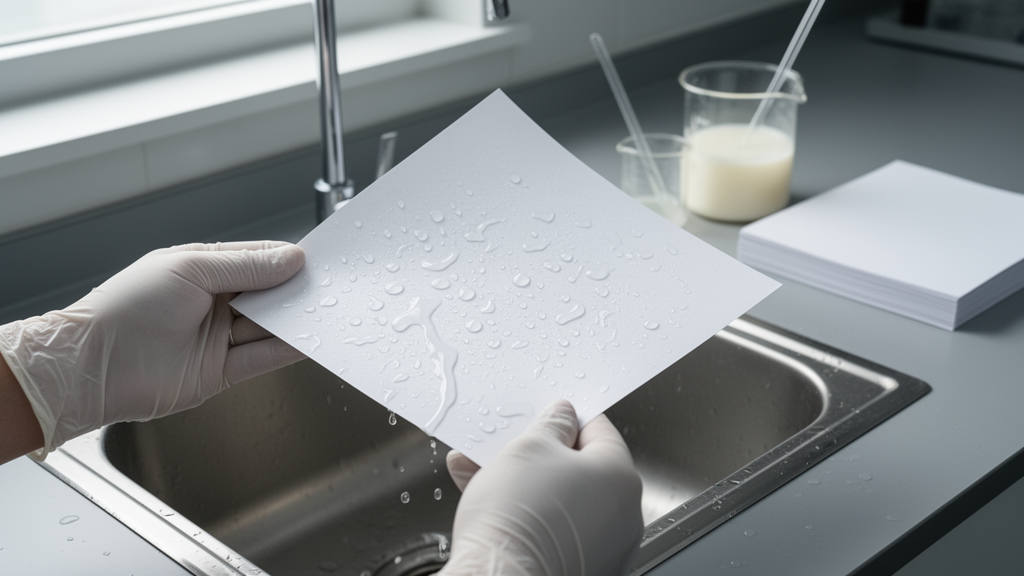
Water resistance measurements reinforced the same picture. All sized papers absorbed far less water than the unsized base paper, whose 24-hour uptake was 29.1%. In the KH570 series, absorption fell steadily to a minimum of 6.90%; in the KH560 series, it reached a distinct minimum of 5.50% at 5% loading before rising slightly at higher silane contents, a trend the authors link to cooperative effects between KH560 and C–F segments forming a moderately crosslinked Si–O–Si network on the paper surface. Contact angles rose with increasing loading in all three systems, and sized paper consistently outperformed the corresponding free films, an effect ascribed to the paper’s intrinsic surface roughness working together with low surface energy. After immersion, angles dropped modestly, from 118° to 95° for F3-sized paper and from 121° to 98° for the Si560-F3 system, attributed to fiber swelling and increased surface polarity upon water uptake.
The proposed mechanism ties the observations together. HFBMA supplies C–F bonds whose surface segregation lowers surface energy, while silane components form Si–O–Si crosslinking sites and reactive silanol groups that strengthen hydrogen bonding among polymer chains and with cellulose fibers. Upon curing, fluorinated segments migrate to the paper surface and assemble into a low-surface-energy hydrophobic layer, while the sizing agent penetrates interfiber voids and obstructs water transport. Hydrogen bonds, covalent crosslinks, and intermolecular forces together form a three-dimensional network that raises the mechanical performance of the cured film. The authors position the solvent-based route as more compatible with conventional paper sizing processes than sol–gel alternatives, and they acknowledge that the contact angle of about 122° remains below that of highly hydrophobic textile coatings reported elsewhere, which can exceed 134°.
Subject of Research: Development of a fluorine–silicon modified acrylate surface sizing agent that improves the mechanical strength and water resistance of specialty paper
Article Title: Preparation of solvent-based fluorine–silicon modified acrylate and its application in specialty paper
Article References: Yang, C., Li, S., Qiao, Y., Yu, X., Yang, X., Zhao, M., Xie, P., Fei, G., & Wang, H. (2026). Preparation of solvent-based fluorine–silicon modified acrylate and its application in specialty paper. Frontiers in Chemistry, 14, 1943305. https://doi.org/10.3389/fchem.2026.1943305
Image Credits: AI Generated
DOI: 10.3389/fchem.2026.1943305
Keywords: fluorine–silicon modified acrylate, surface sizing agent, specialty paper, hexafluorobutyl methacrylate, silane coupling agent, KH560, KH570, water resistance, tensile strength, hydrophobic barrier, radical copolymerization, cellulose fibers
News Source: Bethany Barker. (October 30, 2026). Fluorine–silicon acrylate sizing agent boosts specialty paper strength and water resistance. Scienmag.