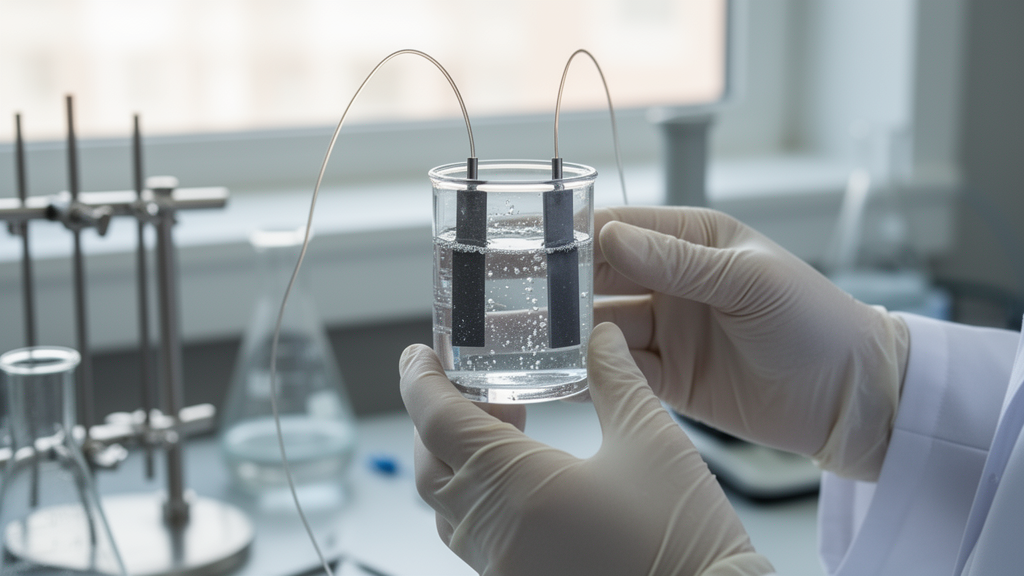
A manganese-iron phosphide catalyst made through a simple sol-gel route has delivered some of the most striking oxygen evolution numbers reported for phosphide-based electrocatalysts, according to a study published in the Springer Nature journal Discover Catalysis. The material, labeled MnFeP-500 because it was annealed at 500 degrees Celsius, needed an overpotential of just 115 millivolts to drive a current density of 10 milliamperes per square centimeter in alkaline solution, and 498 millivolts to reach a demanding 150 milliamperes per square centimeter. For a catalyst built entirely from earth-abundant metals rather than precious iridium or ruthenium, those figures represent a serious entry into the race to make green hydrogen affordable.
The oxygen evolution reaction, or OER, is the slow half of water electrolysis. Splitting water into hydrogen and oxygen requires a multi-step proton-coupled electron transfer and the formation of a strong oxygen-oxygen double bond, which together produce sluggish kinetics and a large overpotential that wastes energy. The benchmark catalysts for this step contain noble metals such as ruthenium and iridium, but their high cost and poor long-term stability have kept them out of large-scale electrolyzers. That gap has pushed researchers toward transition metal oxides, hydroxides, nitrides, sulfides, phosphides and selenides, and within that crowded field, transition metal phosphides have attracted particular attention because phosphorus is more electronegative than most transition metals.
That electronegativity matters in a specific way. In a metal phosphide, the negatively charged phosphorus helps dissociate water molecules into hydrogen and hydroxide species, while also improving corrosion resistance and electrical conductivity, which boosts electron transfer efficiency during water splitting. Yet phosphide catalysts carry a well-known weakness: during alkaline oxygen evolution, their surfaces inevitably transform into oxides or hydroxides, and many studies have glossed over this structural and morphological reconstruction. The authors of the new work, Alok Pratap Singh and Susanta Ghosh, set out to develop a bimetallic manganese-iron phosphide, a composition they describe as underexplored, and to track what happens to it during sustained electrolysis.
The synthesis is deliberately straightforward. The researchers dissolved 1 millimole of ammonium iron sulfate hexahydrate, 1 millimole of manganese chloride tetrahydrate, 6 millimoles of citric acid and 2 millimoles of sodium hypophosphite monohydrate in 20 milliliters of deionized water, heated the solution at 80 degrees Celsius until a gel formed, then annealed that gel under argon for two hours at temperatures of 400, 500, 600 or 700 degrees Celsius, yielding MnFeP-400 through MnFeP-700. Monometallic FeP-500 and MnP-500 counterparts were prepared the same way for comparison. After performance testing, the 500-degree sample emerged as the clear winner, and the working electrodes were made by drop-casting a slurry of catalyst, carbon black, Nafion and 2-propanol onto nickel foam, with an active catalyst loading of about 17.15 milligrams per square centimeter.
X-ray diffraction explained why the 500-degree treatment mattered. FeP-500, MnP-500, MnFeP-600 and MnFeP-700 showed sharp, distinct peaks characteristic of highly crystalline orthorhombic phases, but MnFeP-400 and MnFeP-500 displayed noticeably broader and less intense peaks, signaling lower crystallinity. The MnFeP-500 powder, with its more disordered crystal structure, carries a higher density of pores and structural defects, features the authors identify as active sites that facilitate oxygen adsorption and desorption and enlarge the surface available for electrochemical oxygen conversion. Fourier transform infrared spectroscopy detected metal oxide bonds at 416 and 542 wavenumbers, phosphorus-oxygen vibrations at 610 and 936, and phosphide bending at 1060 across the samples, while field-emission scanning electron microscopy revealed coarse, irregularly shaped particles with varied pore sizes.
X-ray photoelectron spectroscopy filled in the surface chemistry. The manganese 2p spectrum showed Mn2+, Mn3+ and Mn4+ states, with the Mn2+ 2p3/2 peak at 641.29 electronvolts and Mn4+ components near 646 and 657. The iron 2p spectrum split into Fe2+ peaks at 710.65 and 723.58 electronvolts and Fe3+ peaks at 712.78 and 725.04, flanked by satellites. Phosphorus appeared both as metal phosphide bonds at 132.85 and 133.74 electronvolts and as phosphorus-oxygen species at 138.37 and 139.14, and carbon 1s revealed carbon-carbon, carbon-phosphorus and carbon-oxygen bonds. Energy-dispersive X-ray mapping confirmed a uniform distribution of manganese, iron, phosphorus and carbon, with atomic percentages of 5.29, 4.72, 3.64 and 86.36 respectively, the carbon coming from the synthesis chemistry.
Electrochemically, the gap between MnFeP-500 and everything else was wide. At 10 milliamperes per square centimeter, MnFeP-400 needed 120 millivolts, MnFeP-600 needed 137, MnFeP-700 needed 122, MnP-500 needed 134, FeP-500 needed 169 and bare nickel foam needed 352. At 150 milliamperes per square centimeter the ordering held, with MnFeP-500 at 498 millivolts against 542 for MnFeP-400, 562 for MnFeP-600, 606 for MnFeP-700, 659 for MnP-500, 615 for FeP-500 and 711 for bare nickel foam. The authors attribute the advantage to a synergy in which phosphorus acts as a bridge between manganese and iron, improving charge transfer and electron transport within the material.
Kinetic measurements reinforced the picture, though with a caveat worth noting: the Tafel slope of 268.58 millivolts per decade for MnFeP-500, measured above the nickel oxidation potential, is low relative to its competitors, which ranged from 312.34 for MnFeP-400 up to 602.10 for MnP-500, but it remains high by absolute standards for the oxygen evolution reaction. Electrochemical impedance spectroscopy in 1 molar potassium hydroxide, run between 0.1 hertz and 100 kilohertz without iR compensation, showed MnFeP-500 with the lowest charge transfer resistance of the series at 3.40 ohms, far below MnFeP-400 at 25.2 ohms, MnFeP-600 at 35.5, MnFeP-700 at 776, MnP-500 at 26.5 and FeP-500 at 444. The Nyquist plots indicated the charge transfer process is highly diffusion controlled, with a constant phase element modeling the porous, non-ideal capacitive behavior of the electrode.
The active surface area told a similar story. Cyclic voltammetry in the non-faradaic window between 1.095 and 1.147 volts versus reversible hydrogen electrode, at scan rates from 5 to 50 millivolts per second, gave a double-layer capacitance of 2.21 millifarads per square centimeter. Dividing by the theoretical specific capacitance of 0.040 millifarads per square centimeter in 1 molar potassium hydroxide yielded an electrochemically active surface area of 55.25 square centimeters, a large electrochemical footprint consistent with the defect-rich, porous structure seen in the diffraction data.
Durability is where many phosphide catalysts falter, and this is where the study offers its most instructive detail. In chronoamperometry held at 0.5 volts versus saturated calomel electrode, MnFeP-500 ran for 15 hours with negligible degradation, and linear sweep voltammograms taken after the test showed no change in overpotential compared with the initial performance. Post-stability microscopy found the overall morphology largely retained, but energy-dispersive X-ray analysis revealed a decrease in phosphorus concentration, while manganese and iron ratios stayed close to their initial values. X-ray diffraction after the test showed new peak positions assigned to metal oxyhydroxides, confirming the surface had transformed from phosphide to oxyhydroxide species. The authors interpret this surface oxidation, with phosphorus gradually replaced by oxide and hydroxide groups during prolonged electrolysis, as the formation of the actual active species, one that offers additional active sites rather than fatal degradation. The study was published as an open-access article on 4 January 2026, and the authors suggest future work should target longer-term stability and scalability for real-world renewable energy systems.
Subject of Research: Development of a low-crystalline manganese-iron phosphide electrocatalyst for the oxygen evolution reaction in alkaline water electrolysis
Article Title: Sol-gel derived low crystalline manganese-iron phosphide: a stable and efficient electrocatalyst for oxygen evolution reaction
Article References: Singh, A. P., & Ghosh, S. (2026). Sol-gel derived low crystalline manganese-iron phosphide: a stable and efficient electrocatalyst for oxygen evolution reaction. Discover Catalysis, 3(1), Article 1. https://doi.org/10.1007/s44344-025-00032-5
Image Credits: AI Generated
DOI: 10.1007/s44344-025-00032-5
Keywords: oxygen evolution reaction, water electrolysis, manganese-iron phosphide, sol-gel synthesis, electrocatalyst, transition metal phosphides, alkaline medium, surface reconstruction, nickel foam, overpotential, green hydrogen, Tafel slope
News Source: Bethany Barker. (October 30, 2026). Low-Crystalline Manganese-Iron Phosphide Catalyst Slashes Overpotential in Alkaline Water Splitting. Scienmag.