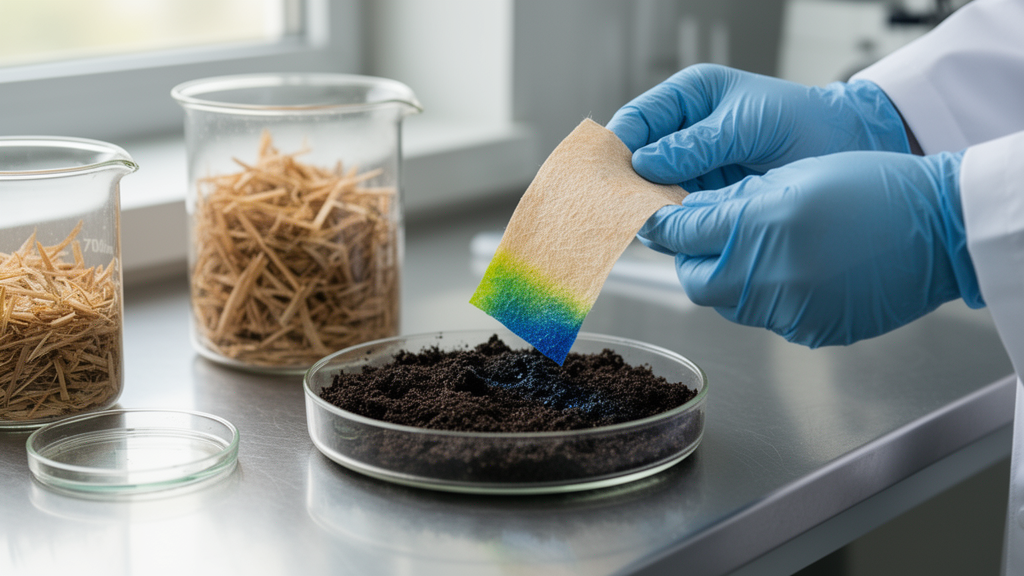
Soil pH decides how well crops take up nutrients, yet the standard tool for measuring it remains a bulky glass electrode that cracks easily and resists miniaturization. Researchers now report an alternative built from an agricultural waste stream: cellulose nanocrystals extracted from sugarcane bagasse, chemically modified so they respond directly to protons. In a study published in BMC Chemistry, the team demonstrated a solid-state electrochemical sensor in which these TEMPO-oxidized cellulose nanocrystals, abbreviated TOCNCs, serve as the proton-sensitive layer on a glassy carbon electrode.
The fabrication route is deliberately simple. The researchers first prepared the nanocrystals through TEMPO-mediated oxidation, a well-established reaction that converts primary hydroxyl groups on the cellulose surface into carboxyl groups. They then loaded the oxidized nanocrystals onto the glassy carbon electrode by drop-casting, forming the sensing interface without elaborate device engineering. Because the active material comes from sugarcane bagasse, a fibrous residue left after juice extraction, the platform is described as cheap and environmentally benign compared with conventional glass probes.
Before testing sensing performance, the team characterized the material thoroughly. X-ray diffraction, Fourier-transform infrared spectroscopy, X-ray photoelectron spectroscopy, transmission and scanning electron microscopy, ultraviolet-visible spectroscopy, and BET surface area analysis were used to confirm the chemical state and oxidation structure of the nanocrystals. A key structural finding was that TEMPO oxidation did not alter cellulose I, the native crystalline form of cellulose, meaning the oxidation modified surface chemistry while preserving the underlying crystal lattice.
The sensing mechanism relies on those newly introduced surface carboxyl groups. According to the study, reversible protonation and deprotonation at these sites produces an open-circuit potential that shifts with the acidity of the surrounding solution. The electrode showed a linear open-circuit potential response across the wide pH range from 3 to 12, with a sensitivity of −47.98 mV per pH unit and a coefficient of determination of R² = 0.93541. That slope sits close to the theoretical Nernstian value of about −59 mV per pH unit at room temperature, which the authors present as evidence of a well-behaved potentiometric response.
Repeatability and reproducibility were assessed at three points spanning the working range. The repeatability relative standard deviations were 2.14 percent at pH 3, 1.19 percent at pH 7, and 2.95 percent at pH 11, while the reproducibility values were 1.40, 1.08, and 3.79 percent at the same pH levels. The sensor also showed high selectivity for hydrogen ions over the interferents typically present in soils, including sodium, potassium, calcium, magnesium, and ammonium cations, chloride, nitrate, sulfate, hydrogen phosphate, bicarbonate anions, and humic acid. Stored over 30 days, the device maintained a stable sensing response, suggesting the drop-cast nanocrystal layer does not degrade quickly under normal handling.
The most practically important test involved real soil samples. The proposed sensor analysed actual soils, and the pH values it measured agreed well with those obtained using a standard commercial glass pH electrode. This agreement matters because laboratory buffer solutions are far simpler matrices than soil, which contains dissolved salts, organic matter, and suspended particles that can foul or interfere with sensing surfaces. The reported selectivity panel was chosen specifically to reflect ions found in soils, and the results indicate the carboxyl-rich cellulose interface tolerates them.
The motivation behind the work connects to precision agriculture and sustainable soil management. Accurate pH measurement is critical for developing precision agriculture, assessing environmental impact, and supporting sustainable soil management, the authors write. Glass electrodes, although widely used, are mechanically vulnerable and ill-suited to miniaturized sensing platforms, which limits their use in distributed or embedded monitoring schemes. A solid-state device whose active layer is a renewable biopolymer derivative could, in principle, be produced more cheaply and integrated into compact probes or field-deployable units.
Several caveats temper the enthusiasm. The reported linearity, sensitivity, and selectivity figures come from the authors’ own characterization experiments, and the coefficient of determination of 0.93541, while serviceable, leaves some scatter in the calibration curve. The article is being shared early as a peer-reviewed accepted manuscript that is citable and carries a permanent DOI but remains subject to further edits before the final version of record appears. The soil comparison, while encouraging, is described as agreement between two measurement methods rather than a large-scale field validation across many soil types, seasons, or laboratories.
Even with those limitations, the study adds a concrete data point to the growing effort to replace fragile glass with functional bio-derived materials. Sugarcane bagasse is abundant in major sugar-producing regions and is often treated as low-value residue, so converting it into a proton-responsive sensing layer links waste valorization with agricultural diagnostics. The authors position the TOCNC platform as having strong potential to replace the glass pH electrode, at least in applications where a robust, low-cost, solid-state probe is more valuable than the absolute precision of laboratory instrumentation. Whether such cellulose-based sensors can match glass electrodes across the full diversity of real-world soils will be the question for the larger field trials that this proof of concept now invites.
Subject of Research: A bio-derived solid-state electrochemical pH sensor built from sugarcane bagasse cellulose nanocrystals for soil monitoring.
Article Title: Bio-derived TEMPO-oxidized cellulose nanocrystal (TOCNC) based green solid-state sensor for soil pH monitoring
Article References: Vigneshwar, J., Lakshmi Priya, G., & Selvamuthukumaran, T. (2026). Bio-derived TEMPO-oxidized cellulose nanocrystal (TOCNC) based green solid-state sensor for soil pH monitoring. BMC Chemistry. https://doi.org/10.1186/s13065-026-01925-8
Image Credits: AI Generated
DOI: 10.1186/s13065-026-01925-8
Keywords: soil pH, cellulose nanocrystals, TEMPO oxidation, sugarcane bagasse, solid-state sensor, potentiometric sensing, precision agriculture, green chemistry, glassy carbon electrode, open-circuit potential, Bio-derived, TEMPO-oxidized
News Source: Bethany Barker. (October 30, 2026). Sugarcane waste cellulose turns into a green solid-state sensor for soil pH. Scienmag.