


Stainless steel 310 (SS310) and Inconel 625 (IN625) were continuously exposed to hydrogen gas at 450 °C and 900 °C for up to 33 days in a laboratory study. The results, reported by researchers at the Colorado School of Mines and the National Laboratory of the Rockies, show modest changes in strength and ductility at 450 °C but pronounced degradation at 900 °C.
The team exposed stainless steel 310 (SS310) and Inconel 625 (IN625) to hydrogen at 450 °C and 900 °C, periodically examining the materials with tensile, Charpy impact, and three-point bend tests. Microstructure was assessed using electron microscopy and X-ray diffraction. The study was designed to address knowledge gaps about the stability of stainless steel and Inconel alloys under continuous high-temperature hydrogen exposure.
At 450 °C, both alloys came through remarkably well. The researchers report that the materials exhibit resilience to hydrogen ingress, with tensile, impact, and bend tests showing only modest changes in strength and ductility. The researchers report that at 450 °C both materials exhibit resilience to hydrogen ingress, with tensile, impact, and bend tests showing only modest changes in strength and ductility.
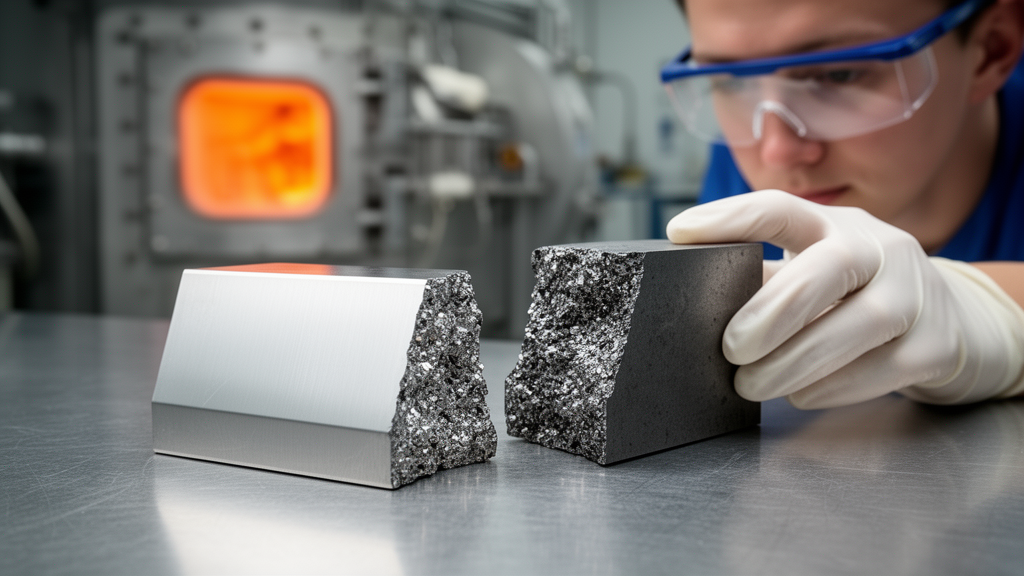
The picture changed dramatically at 900 °C. Both alloys underwent pronounced degradation, with sharp losses in toughness and intergranular fracture features visible in the tested material. X-ray diffraction also revealed evolving lattice parameters, indicating that the crystal structure itself was changing during exposure.
The authors compare these observed responses with previously presented mechanisms of high-temperature hydrogen degradation, placing their measurements in the context of what is already known about how hydrogen attacks metals at elevated temperature. The work is published as an original research article in Frontiers in Energy Research, in the section on Process and Energy Systems Engineering, with Carolina Herradon and Neal Sullivan serving as corresponding authors.
The study provides direct mechanical measurements on the two alloys after continuous hydrogen exposure lasting up to 33 days, with properties examined periodically through tensile, Charpy impact, and three-point bend tests.
In the tests reported, both alloys showed only modest changes in strength and ductility at 450 °C, while at 900 °C both underwent pronounced degradation with sharp losses in toughness and intergranular fracture features. The intergranular fracture features and evolving lattice parameters observed at 900 °C point to the pronounced degradation seen at that temperature, in contrast to the modest changes recorded at 450 °C.
As with any laboratory study, the results describe the specific test conditions used: two alloys, two temperatures, exposure durations up to 33 days, and the mechanical test methods applied. The authors note that their observations are compared against previously reported mechanisms rather than establishing new ones. In this study, temperature was the decisive variable: the two alloys showed only modest property changes at 450 °C but pronounced degradation with sharp toughness losses at 900 °C.
Subject of Research: Mechanical stability of stainless steel 310 and Inconel 625 after continuous high-temperature hydrogen exposure
Article Title: Mechanical properties of SS310 and IN625 following high-temperature hydrogen exposure
Article References: Herradon, C., Wu, A., Pu, X., Lidor, A., Zhao, Y., Hommer, G., & Sullivan, N. (2026). Mechanical properties of SS310 and IN625 following high-temperature hydrogen exposure. Frontiers in Energy Research, 14, 1914099. https://doi.org/10.3389/fenrg.2026.1914099
Image Credits: AI Generated
DOI: 10.3389/fenrg.2026.1914099
Keywords: hydrogen embrittlement, SS310, Inconel 625, high temperature, mechanical testing, toughness, intergranular fracture, X-ray diffraction, tensile testing, hydrogen energy, Mechanical, properties
News Source: Denise Maddox. (October 30, 2026). Stainless steel and Inconel alloys lose toughness after 33 days in hot hydrogen. Scienmag.



