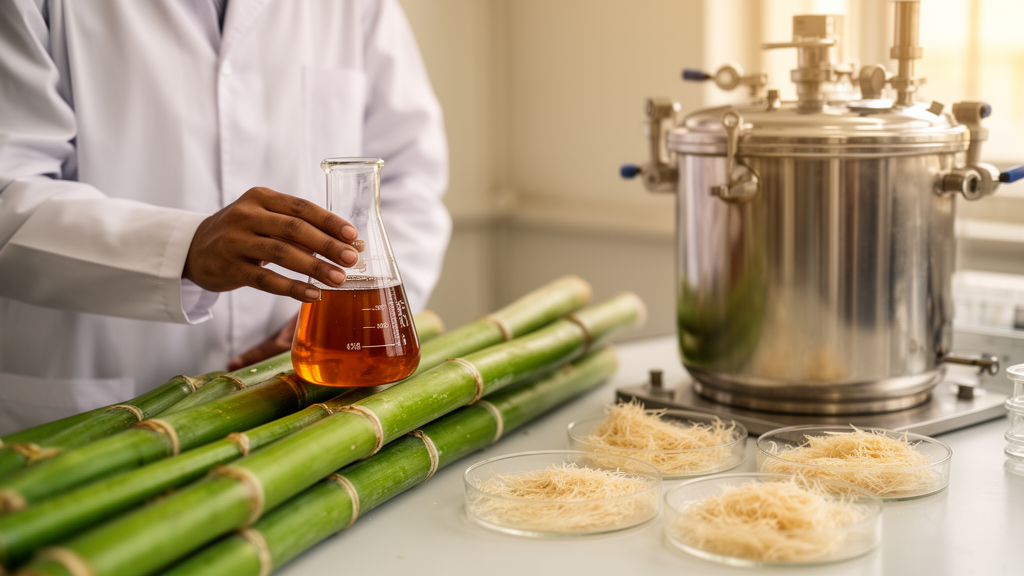
Lignin is the aromatic biopolymer that gives woody plants their rigidity, and for the pulp and paper industry it is mostly a byproduct that ends up dissolved in spent cooking liquor. A new open-access study turns that byproduct into a subject of careful chemical scrutiny, reporting the first detailed structural characterization of lignin isolated from Melocanna baccifera, the bamboo species known locally in Bangladesh as “Muli.” The work, published in Discover Polymers, compares a native-like dioxane lignin extracted directly from the plant with a technical soda lignin recovered from black liquor, and it documents precisely how industrial pulping reshapes the lignin macromolecule.
Bamboo has long been a major raw material for the pulp and paper industry in Bangladesh. The authors note that the Karnaphuli Paper Mills historically consumed local Bambusa tulda and Melocanna baccifera, and that roughly 33 indigenous and 10 exotic bamboo species grow in the country, concentrated in the Chittagong Hill Tracts, Sylhet and the Sal forests. Despite this industrial heritage, the structural characteristics of lignin from Bangladeshi bamboo remained largely unexplored, which is the gap the study set out to fill.
The researchers collected bamboo from the Kaptai forest in the Hill Tracts, chipped it, extracted waxes and fats with a toluene-ethanol mixture in a Soxhlet apparatus, and then split the material into two isolation routes. One portion was refluxed with acidic dioxane under nitrogen to yield a native-like dioxane lignin. The other was pulped with 18% sodium hydroxide at 170 °C for 120 minutes, after which soda lignin was precipitated from the black liquor by acidifying to pH 2 with dilute sulfuric acid. Both lignins were purified by dissolution in dioxane-water and reprecipitation into ether, then dried over phosphorus pentoxide under vacuum.
Elemental analysis and methoxyl determination produced empirical C9 formulas of C9H8.65O4.73(OCH3)1.21 for the dioxane lignin and C9H8.23O2.36(OCH3)0.94 for the soda lignin. The methoxyl content fell from 16.3% to 15.96%, which the authors attribute to demethylation during pulping. For context, the methoxyl content per C9 unit of dioxane lignin from other bamboo species has been reported at 1.38 to 1.49, and the value of 1.21 measured here sits close to the 1.24 reported for milled wood lignin from Phyllostachys makinoi, suggesting the Bangladeshi material behaves like other grass-derived lignins.
Molecular weight measurements by gel permeation chromatography of acetylated samples told a similar story of pulping-induced change. The weight-average molecular weight of soda lignin was 7002, lower than the 9647 of dioxane lignin, a difference the authors link to the harsh cooking conditions of alkaline pulping, where high alkali charge and high temperature cleave the abundant and relatively labile β-O-4′ ether linkages and break the large polymer into smaller fragments. Polydispersity followed the same trend, at 2.27 for dioxane lignin and 1.51 for soda lignin, consistent with prior observations that lower molecular weight lignin fractions exhibit smaller polydispersity values.
Fourier-transform infrared spectroscopy confirmed the fundamental lignin skeleton in both samples. The broad band at 3276 cm−1 corresponds to hydroxyl stretching, benzene ring vibrations appeared at 1590, 1501 and 1419 cm−1, and a conjugated carbonyl stretch appeared at 1705 to 1717 cm−1. Peaks at 830, 1117 and a shoulder at 1155 cm−1 indicated the presence of all three lignin monomers, syringyl, guaiacyl and p-hydroxyphenyl, and the authors state that the 1117 and 830 cm−1 peaks dominate as unambiguous signals for HGS lignin, proving the bamboo lignin is typical grass lignin. The shoulder at 1155 cm−1 was also attributed to an ester bond vibration, suggesting that some monomers are interconnected via ester linkages.
Two-dimensional HSQC NMR provided the most detailed structural picture, though the authors caution that HSQC gives semi-quantitative information because signal response factors and relaxation behavior differ, so the calculated S/G/H ratios represent relative trends rather than absolute values. In the side-chain region, β-O-4 aryl ether linkages were the most abundant correlations in bamboo dioxane lignin, and their reduced prominence in soda lignin indicated more cleavage during pulping. Resinol (β-β) and phenylcoumaran (β-5) linkages appeared as minor but consistent features, and signals for p-coumaric acid and ferulate moieties, ester-linked hydroxycinnamates characteristic of grass cell walls, were clearly observed, further confirming the grass-type character of the bamboo lignin.
Quantitative integration of the aromatic region showed that syringyl units made up 50.9% of dioxane lignin and guaiacyl units 34.34%, while alkaline pulping reduced the syringyl proportion to 38.33% with guaiacyl nearly constant at 34.46% and p-hydroxyphenyl units rising from 14.77% to 27.21%. The S/G ratio fell from 1.48 in dioxane lignin to 1.11 in soda lignin. The authors note that the S/G ratio is theoretically positively related to the content of β-O-4′ substructures, so the decline in both values after pulping is internally consistent.
Quantitative 31P NMR quantified the hydroxyl groups that govern lignin reactivity. Aliphatic hydroxyl content decreased in soda lignin, which the authors suggest reflects oxidation or modification of those structures during pulping, while total phenolic hydroxyl groups increased, indicating cleavage of a certain number of β-O-4 linkages during delignification. The S, G and H phenolic hydroxyls were 0.60, 0.59 and 0.48 mmol/g in dioxane lignin and 1.61, 0.84 and 0.69 mmol/g in soda lignin. Total hydroxyl content rose from 6.05 mmol/g to 7.32 mmol/g. The conclusion section summarizes the phenolic hydroxyl increase as from 1.67 to 3.13 mmol/g, and the authors state that the higher phenolic content makes the lignin well-suited for phenolic substitutions in applications such as phenolic resins.
The authors are careful about the limits of their reference material, noting that the acidic dioxane method, although widely used for isolating representative native-like lignin, may induce partial structural modifications, including cleavage of labile β-O-4′ bonds and possible condensation, so the dioxane lignin is treated as a comparative reference rather than an absolute representation of in situ lignin. With that caveat in place, the study establishes a foundational structural database for Bangladeshi bamboo lignin and demonstrates that the soda pulping process, by lowering molecular weight, reducing methoxyl content and enriching phenolic hydroxyl groups, produces a more reactive lignin that the authors argue is suitable for targeted biorefinery applications such as phenolic resins, copolymerization and value-added aromatic chemicals.
Subject of Research: Structural characterization of lignin isolated from Bangladeshi bamboo (Melocanna baccifera) and the structural changes induced by soda pulping.
Article Title: Structural characteristics of lignin derived from bamboo (Melocanna baccifera)
Article References: Likhon, M. N. A., Rahman, M. M., Jiang, B., Jin, Y., & Jahan, M. S. (2026). Structural characteristics of lignin derived from bamboo (Melocanna baccifera). Discover Polymers, 3(1), Article 13. https://doi.org/10.1007/s44347-026-00051-x
Image Credits: AI Generated
DOI: 10.1007/s44347-026-00051-x
Keywords: lignin, bamboo, Melocanna baccifera, soda pulping, HSQC NMR, 31P NMR, phenolic hydroxyl, biorefinery, grass lignin, molecular weight, methoxyl content, Bangladesh
News Source: Bethany Barker. (October 30, 2026). Bamboo Lignin From Bangladesh Reveals Grass-Type Structure Tuned by Soda Pulping. Scienmag.