


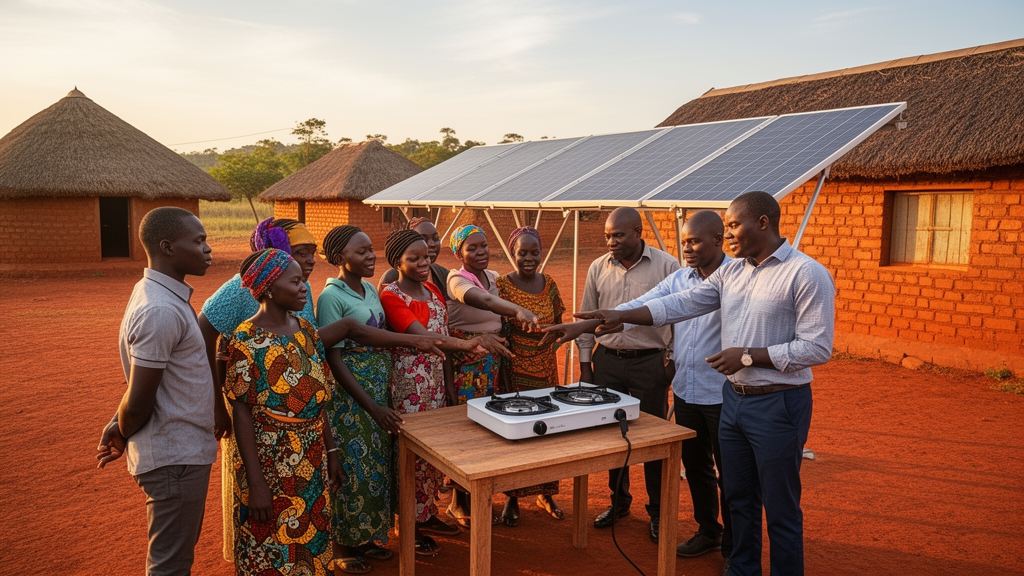
A co-design project in the Bondo community of Southern Malawi has shown how rural residents can reshape an existing mini-grid to fit their own priorities, even when the outcome departs sharply from the original plan. The case study, published in Energy, Sustainability and Society, focused on the Bondo mini-grid operated by the Mulanje Electricity Generation Agency and set out to explore whether community-driven co-design could strengthen both local resilience and the energy system itself.
The researchers, Vincent Mwale, Richard Nkhoma, Tiyamike Ngonda and Long Seng To, worked with community members and project stakeholders through semi-structured key informant interviews, focus group discussions and three iterative co-design workshops. This combination of methods allowed participants to identify, prioritise and refine interventions that they judged locally appropriate, rather than having solutions imposed from outside.
The context matters. Rural communities in Malawi remain highly vulnerable to livelihood shocks because of limited access to reliable and affordable energy. The study’s framing argues that strengthening energy resilience requires participatory approaches that integrate technical, social and economic dimensions, rather than treating electrification as a purely engineering problem.
The co-design process generated a wide range of ideas linking energy use to improved livelihoods. When the community ranked its priorities, two stood out: increasing the mini-grid’s power generation capacity and establishing a fruit-processing factory that would raise incomes and create productive use for the electricity the system already supplied.
What happened next is the most instructive part of the case. Because of feasibility problems, financial constraints and overlap with existing development projects, the initiative shifted away from both expanded generation and the fruit-processing factory. Instead, the community turned to clean cooking interventions, particularly the distribution of electric pressure cookers, appliances that were entirely new to local households.
The authors are candid about the trade-offs. Electric cooking would bring limited direct economic benefits compared with the factory the community first wanted.
The case also surfaced social friction that participatory projects often leave unexamined. According to the study, the process exposed underlying tensions between personal and collective interests, underscoring the importance of transparent and inclusive participation if co-design is to work in practice.
In their conclusions, the researchers report that participatory, community-led processes can generate realistic, context-specific energy solutions that improve both livelihoods and energy-system sustainability. They emphasise that although not all proposed interventions were implemented, the process met its research objective by demonstrating how co-design can be applied to improve an existing mini-grid while deepening community engagement and resilience.
The findings also point to conditions for success elsewhere. The authors conclude that successful co-design requires iterative learning, equitable collaboration between developers and communities, and a clear link among energy access, socioeconomic development and resilience.
Subject of Research: Community co-design of interventions for an existing solar-hydro mini-grid in Bondo, Southern Malawi
Article Title: Co-designing community energy resilience: insights from a Bondo mini-grid in Southern Malawi
Article References: Mwale, V., Nkhoma, R., Ngonda, T., & To, L. S. (2026). Co-designing community energy resilience: insights from a Bondo mini-grid in Southern Malawi. Energy, Sustainability and Society. https://doi.org/10.1186/s13705-026-00601-y
Image Credits: AI Generated
DOI: 10.1186/s13705-026-00601-y
Keywords: Malawi, mini-grid, community energy, co-design, energy resilience, clean cooking, electric pressure cookers, rural electrification, productive use, deforestation, participatory research, Co-designing
News Source: Denise Maddox. (October 30, 2026). Community co-design reshapes a Malawi mini-grid toward clean cooking. Scienmag.



