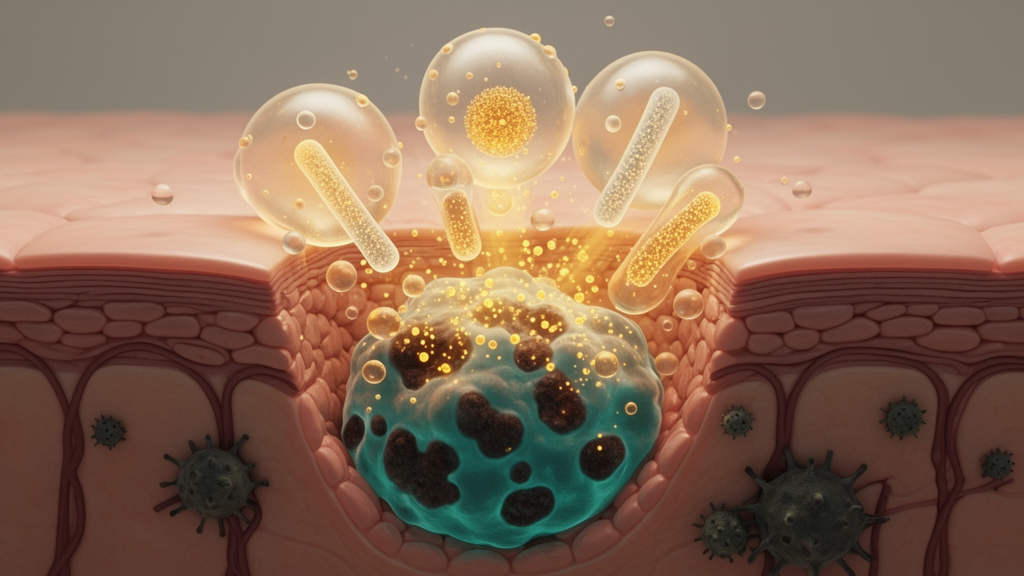
Basal cell carcinoma and squamous cell carcinoma, the two most common non-melanoma skin cancers, are an increasing global health burden, and a review published in Discover Nano argues that a lipid vesicle called the ethosome could become a non-invasive therapeutic platform for treating them. Written by Madhavi Porwal, Rishabha Malviya and colleagues, the review critically analyses how ethosomal drug delivery systems might achieve precision targeting of tumour tissue and reprogramming of the tumour microenvironment through transdermal delivery. The authors conclude that ethosomes are an attractive concept supported by preclinical evidence, but they stress that additional clinical validation and regulatory standardisation are needed before the technology can be translated into routine clinical use.
Ethosomes are lipid-based vesicular carriers composed mainly of phospholipids, water and high concentrations of ethanol, typically between 20 and 45 per cent. That ethanol content is what sets them apart from conventional vesicles such as liposomes. According to the review, ethanol increases vesicle fluidity and deformability and interferes with the organisation of the lipids in the stratum corneum, the outermost layer of the skin and the primary barrier to drug penetration. This dual action softens the vesicle membrane while disrupting the tightly packed lipid lamellae of the skin, allowing the vesicles to slip through narrow intercellular spaces and deliver encapsulated drugs into the deeper epidermis and upper dermis, where early non-invasive skin tumours are typically located.
The case for such carriers rests on the shortcomings of existing treatments. Surgery, cryotherapy, photodynamic therapy and topical chemotherapeutics all carry limitations, including scarring, poor penetration into the skin, non-specific drug delivery and tumour reappearance. Topical agents frequently fail to reach therapeutic concentrations in tumour tissue because the stratum corneum resists diffusion, particularly for molecules with high polarity or high molecular weight. Systemic medicines can achieve higher drug levels but bring systemic adverse effects and off-target toxicity. The review frames the central challenge as obtaining high local concentrations of anticancer drugs at the lesion while minimising exposure of the rest of the body, a goal that conventional creams, gels and ointments cannot reliably meet.
Compared with other vesicular systems, the authors argue that ethosomes offer distinct advantages. Liposomes, built from phospholipid bilayers, lack sufficient flexibility and penetration capacity for effective transdermal delivery. Niosomes, formed from non-ionic surfactants, provide improved stability and cost-effectiveness but still struggle to cross intact stratum corneum. Transfersomes, which incorporate edge activators, show enhanced deformability, yet their performance often depends on external hydration gradients. Ethosomes, by contrast, use ethanol-induced lipid fluidisation to penetrate deeper skin layers and deliver drugs more efficiently, and they can accommodate both hydrophilic and lipophilic payloads, from chemotherapeutic agents to immunomodulators and gene therapy vectors. The review also notes variants: classical ethosomes, binary ethosomes containing additional penetration enhancers such as propylene glycol, and transethosomes that combine ethosomal features with ultra-deformable transferosome characteristics.
A substantial portion of the review is devoted to the tumour microenvironment, the complex ecosystem of malignant cells, cancer-associated fibroblasts, endothelial cells, pericytes and immune infiltrates that controls tumour invasion, growth and treatment response. Tumour-associated macrophages in an M2-like phenotype suppress cytotoxic immunity, while fibroblasts release extracellular matrix components and signalling molecules that drive proliferation and metastasis. Hypoxia stabilises hypoxia-inducible factors that promote angiogenesis, metabolic reprogramming toward glycolysis and immunological regulation, and pro-inflammatory cytokines such as IL-6 and TNF-α further enhance tumour progression. Immunosuppressive cell types including regulatory T cells and myeloid-derived suppressor cells secrete IL-10, TGF-β and arginase, and hypoxia-driven vascular endothelial growth factor fuels angiogenesis that supports tumour growth and metastasis.
The review proposes that ethosomes could intervene in this microenvironment in several ways. By extending drug residence time in deeper epidermal and dermal layers, they could suppress cytokine-mediated signalling and break the feedback loop between cancer cells and inflammatory stromal cells, converting a tumour-promoting local environment into a tumour-suppressive one without immunosuppressing the whole body. The authors also describe how ethosomal systems could deliver immune checkpoint modulators or TLR agonists into the cutaneous microenvironment to skew it from immunosuppressive to immuno-responsive, and how they might encapsulate siRNA or miRNA to silence pro-tumourigenic genes locally.
Precision targeting is another theme. Ethosomes can achieve passive targeting simply by penetrating deep skin layers and accumulating in the epidermis and dermis, and research cited in the review associates ethosomal carriers with higher permeation flux, deeper drug penetration and dermal retention than traditional vesicles. Active targeting goes further: surface modification with ligands such as RGD peptides, folate, antibodies or hyaluronic acid allows the vesicles to recognise tumour-associated receptors overexpressed on cancer cells. Because tumour cells display altered membrane fluidity and overexpressed surface receptors compared with normal keratinocytes, ethosomes adhere to and are taken up by malignant cells more readily, and pH-sensitive ligands can exploit the slightly acidic tumour microenvironment for additional selectivity.
Once inside tumour cells, ethosomes release their payload through intracellular mechanisms. Endocytosis, primarily through clathrin-mediated, caveolae-mediated and macropinocytosis pathways, brings the vesicles into the cell, where the acidic pH and enzymatic activity of endosomes and lysosomes degrade the phospholipid bilayer and release the drug. Ethanol-induced membrane destabilisation may also facilitate endosomal escape, helping drugs reach cytosolic and nuclear destinations. Released anticancer compounds can then induce apoptosis, inhibit angiogenic signalling and modify the inflammatory microenvironment. The review links this controlled intracellular release to reduced off-target toxicity and to the delivery of agents that modulate hypoxia, oxidative stress or immune signalling within the tumour.
The potential clinical relevance is framed around basal cell carcinoma and squamous cell carcinoma in their early, non-invasive stages, which remain localised to the epidermal and superficial dermal layers and are therefore receptive to transdermal approaches. Ethosomal therapy could also offer advantages over surgical and ablative approaches by avoiding scarring and tissue trauma, allowing repeated dosing for multifocal or recurrent lesions, and preserving skin architecture for better cosmetic outcomes.
Yet the review is candid about the obstacles. Ethosomes are physicochemically unstable because their high ethanol content can cause vesicle rupture, drug leakage and shortened shelf life. Higher ethanol concentrations can also lead to skin irritation, erythema and barrier disruption, raising safety and compliance concerns for long-term use. Mass production is difficult because formulation parameters are sensitive, producing batch-to-batch variability, and the absence of clearly established clinical evidence in humans remains a significant gap. Long-term dermatotoxicity research is needed to determine whether repeated ethanol exposure is safe, and nanotoxicological questions about non-target cellular uptake and biodegradation remain unresolved. The authors conclude that future research must focus on formulation stability, reduced side effects, large-scale clinical trials, scalable manufacturing and regulatory standardisation before ethosomal systems can move from the laboratory into clinical practice.
Subject of Research: Ethosome-based transdermal drug delivery for precision targeting and tumour microenvironment reprogramming in non-invasive skin cancer
Article Title: Ethosome-based drug delivery system for precision targeting and tumour microenvironment reprogramming in non-invasive skin cancer therapy
Article References: Porwal, M., Sridhar, S. B., Shareef, J., Wadhwa, T., Balusamy, B., Chandra, P., & Malviya, R. (2026). Ethosome-based drug delivery system for precision targeting and tumour microenvironment reprogramming in non-invasive skin cancer therapy. Discover Nano, 21(1), Article 549. https://doi.org/10.1186/s11671-026-04738-9
Image Credits: AI Generated
DOI: 10.1186/s11671-026-04738-9
Keywords: ethosomes, drug delivery, skin cancer, tumour microenvironment, nanocarriers, transdermal, basal cell carcinoma, squamous cell carcinoma, immunomodulation, photodynamic therapy, precision targeting, clinical translation
News Source: Nathaniel Bowman. (October 30, 2026). Ethosomal nanocarriers aim to reprogram skin cancer microenvironment through transdermal drug delivery. Scienmag.