


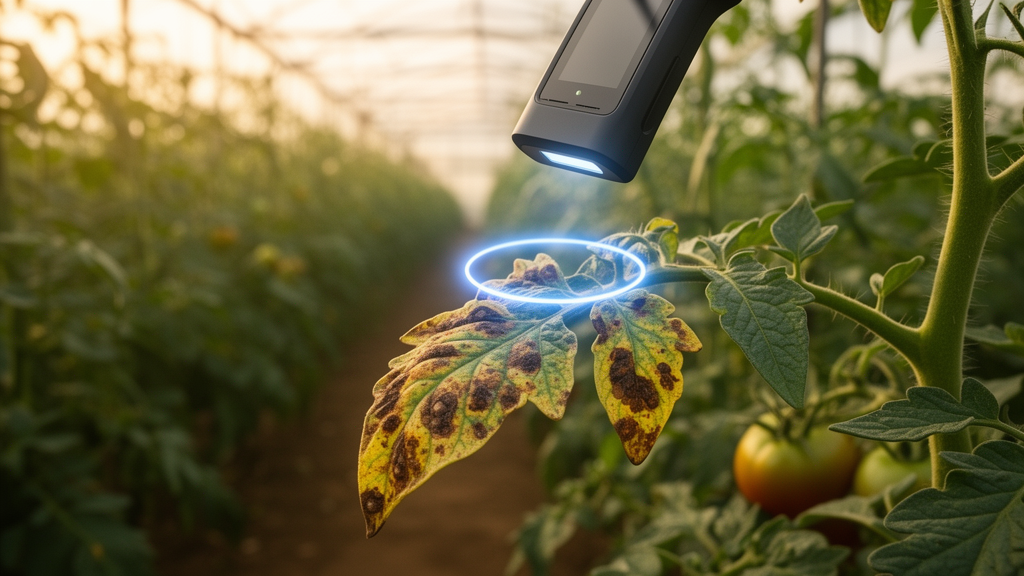
Deep learning models can identify tomato leaf diseases with impressive accuracy on curated image benchmarks, but most of these systems share a hidden weakness: they assume every image they encounter belongs to a category they were trained on. In a real field, a diagnostic tool will inevitably meet symptoms, crops, backgrounds or damage types that were never part of its training set, and a closed-set classifier will confidently mislabel them. A new study addresses this gap with PEOS-Net, a Prototype-Energy Open-Set Network designed to recognize when an image falls outside its known classes rather than forcing it into one of them.
The architecture, described in a paper accepted by Frontiers in Artificial Intelligence, is built on a frozen EfficientNet-B0 backbone equipped with a Convolutional Block Attention Module, or CBAM, which directs the network’s attention to the most informative regions of a leaf image. On top of this shared representation sit two parameter-distinct heads. The first is an exponential moving average prototype memory that maintains a per-class reference point and drives classification. The second is a classifier-head branch that produces a free-energy score, a signal that tends to rise when an input is out of distribution. The two scores are then fused into a single hybrid open-set score.
Crucially, the fusion is not arbitrary. The normalization ranges, the fusion weight and the rejection threshold are all selected on a held-out calibration split and never on the final test partition, a design choice meant to prevent the model from quietly tuning itself to the very data it will be judged on. The researchers evaluated the system on an eight-class tomato subset of PlantVillage, a widely used plant disease benchmark, with two disease classes deliberately held out as unknowns so that the model could be tested on its ability to reject inputs it had never seen.
On the closed-set task, where every test image does belong to a known class, PEOS-Net reached 93.87 percent accuracy with a weighted F1 score of 0.9392. The open-set results are where the method distinguishes itself. Averaged over five random seeds, the model achieved an area under the receiver operating characteristic curve of 0.8695 plus or minus 0.0202, an area under the precision-recall curve of 0.8723 plus or minus 0.0192, an open-set classification rate of 0.8363 plus or minus 0.0142 and a false-positive rate at 95 percent true-positive rate of 0.4853 plus or minus 0.0645. It outperformed three established baselines, maximum softmax probability, ODIN and OpenMax, on every open-set metric, even though those baselines achieved higher closed-set accuracy of 96.5 percent.
That trade-off is the point. A classifier that is slightly less accurate when the world matches its expectations but far better at flagging when it does not is more useful in a deployment setting than one that is confidently wrong about unfamiliar inputs. The authors report that in a same-model ablation, the hybrid score reached an AUROC of 0.8610, exceeding the distance-only score at 0.7208 and the energy-only score at 0.8413. A paired bootstrap analysis estimated the gain over the energy-only variant at 0.0198, with a 95 percent confidence interval of 0.0134 to 0.0262, indicating the improvement is unlikely to be a statistical fluke.
The two heads also appear to carry genuinely different information. The study reports weak correlation between the prototype-distance score and the free-energy score, with an absolute correlation below 0.06, and low overlap in their errors. In practical terms, an image that fools one branch is often caught by the other, which is why fusing them yields a stronger detector than either alone. This complementarity is what the prototype-energy design is meant to exploit: the prototype branch measures how close an input sits to learned class references, while the energy branch measures how the classifier itself reacts to the input’s underlying statistics.
The work sits within a broader effort to move agricultural AI beyond the closed-world assumption. Plant disease recognition models trained on benchmark datasets routinely achieve high accuracy in the lab, yet field conditions introduce lighting variation, background clutter, unseen pathogens and damage from causes other than disease. A system that cannot distinguish between a known disease and an unknown condition risks giving dangerous advice, for example mislabeling an unfamiliar symptom as a common disease it happens to resemble. Open-set recognition, the task of both classifying known classes and rejecting unknown ones, is therefore considered a prerequisite for trustworthy automated crop-advisory tools.
The authors are careful about the limits of what they have shown. Because the unknown classes in their evaluation come from the same PlantVillage source as the training data, the results support a controlled open-set study rather than validated field deployment. Real-world images would introduce distribution shifts far more varied than two held-out disease classes from the same curated collection. The reported metrics, including the false-positive rate at 95 percent true-positive rate of roughly 0.49, also indicate that the model still rejects a substantial number of known-class images incorrectly, leaving room for refinement before such a system could be relied upon in practice.
Even with those caveats, the study offers a concrete template for how agricultural diagnostic models might be built to fail safely. By combining a prototype-based memory with an energy-based uncertainty signal, calibrating the fusion on data separate from the test set, and validating the improvement with statistical tests, PEOS-Net demonstrates that a single network can be both an accurate classifier and a cautious gatekeeper. For crop-advisory systems intended to operate outside the laboratory, that combination may matter more than raw benchmark accuracy.
Subject of Research: Open-set recognition for tomato leaf disease classification using a prototype-energy neural network
Article Title: PEOS-Net: a Prototype-Energy Open-Set Network for robust tomato leaf disease recognition beyond the closed-world assumption
Article References: Jansi, E., & B. R., K. (2026). PEOS-Net: a Prototype-Energy Open-Set Network for robust tomato leaf disease recognition beyond the closed-world assumption. Frontiers in Artificial Intelligence, 9, 1938398. https://doi.org/10.3389/frai.2026.1938398
Image Credits: AI Generated
DOI: 10.3389/frai.2026.1938398
Keywords: open-set recognition, tomato leaf disease, PlantVillage, prototype learning, free-energy score, EfficientNet-B0, CBAM, out-of-distribution detection, agricultural AI, crop diagnostics, deep learning, PlantVillage benchmark
News Source: Alan Morgan. (October 30, 2026). AI Learns to Say I Don’t Know: New Network Flags Unseen Tomato Diseases It Was Never Taught. Scienmag.



