


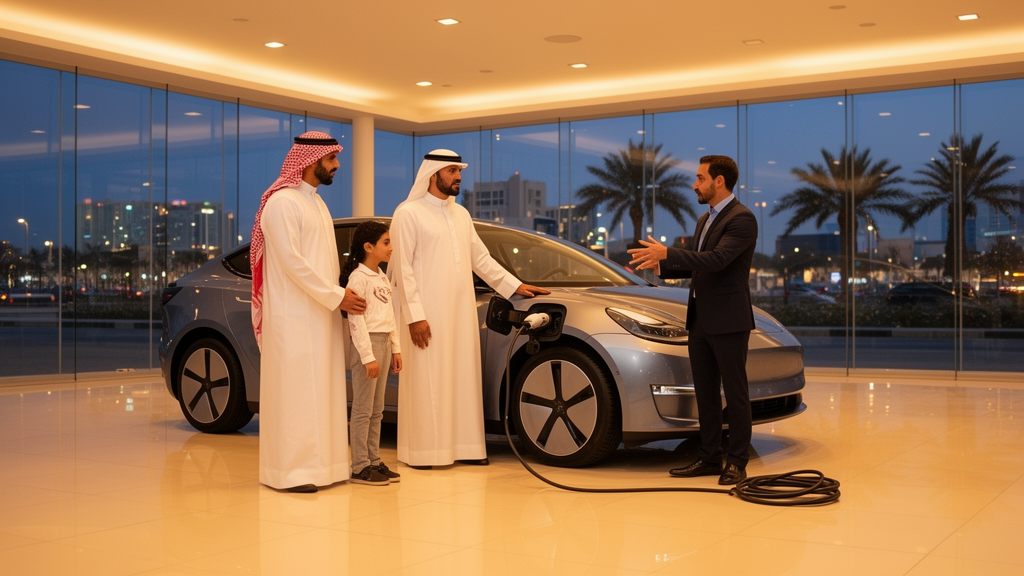
A survey of 366 consumers in Bahrain has found that the road to buying an electric vehicle runs less through price tags and driving range than through attitude. Using the Theory of Planned Behavior as its framework, researchers at the American University of Bahrain and the University of Manchester tested how seven distinct beliefs, spanning economics, performance and environmental values, translate into an overall attitude toward electric vehicles and, from there, into purchase intention. Their analysis, published in Frontiers in Sustainable Cities, shows that attitude acts as a selective transmission mechanism rather than a universal conduit for every belief a consumer holds.
The team collected cross-sectional survey data and analyzed 366 valid responses with partial least squares structural equation modeling, running 10,000 bootstrap resamples to test the stability of their estimates. The model integrated three economic evaluations, price, perceived economic benefits and policy incentives, three functional-performance evaluations, driving range, acceleration and charging time sensitivity, and a measure of environmental values. Each of these was examined both for its direct link to purchase intention and for its indirect pathway through attitude.
The results split cleanly into two groups. Policy incentives, acceleration, environmental values and consumer attitudes each showed a positive and significant direct relationship with EV purchase intention. Perceived economic benefits, by contrast, worked almost entirely through attitude: it had no significant direct effect on intention, but a significant indirect one. The authors describe this as indirect-only mediation, meaning the belief matters for purchase intent only insofar as it shapes how consumers feel about the technology overall.
For policy incentives, acceleration, charging time sensitivity and environmental values, attitude played a different role. Here the mediation was complementary and partial, meaning both the direct path from belief to intention and the indirect path through attitude were significant. Attitude amplified these beliefs rather than replacing them. Notably, the mediation pattern was selective rather than universal: price and driving range showed no significant mediation through attitude at all, a finding that challenges the assumption that attitude is the common funnel through which all EV beliefs pass.
Three results that initially appeared contradictory were clarified by additional robustness analyses. Price was negatively associated with intention in a simple model, but became small and positive once the model simultaneously adjusted for correlated determinants. Driving range was positively associated with intention at the simple level but lost its unique significance in the full model. Charging time sensitivity was interpreted according to its reverse-coded measurement, distinguishing weaker endorsement of faster charging as an adoption inducement from any preference for longer charging durations.
The significance pattern held across a battery of robustness checks. It remained stable when the researchers used alternative composite-score estimations, when they tested both inclusive and restrictive measurement specifications, when they restricted the analysis to a subsample of respondents who did not own an EV, when they added demographic controls, and when they ran an independent bootstrap mediation analysis. This consistency suggests the findings are not artifacts of a single modeling choice.
The study’s central contribution is conceptual. Rather than treating attitude as a universal mediator that converts every belief into intention, the authors show it is a determinant-specific transmission mechanism. Some beliefs, such as the perceived economic benefits of ownership, need attitude to reach intention. Others, such as policy incentives or acceleration, can influence intention directly and also through attitude. Still others, including price and driving range, appear to operate through channels that attitude does not capture in this sample.
For an emerging market like Bahrain, the findings carry practical weight. The authors highlight the importance of policy support, performance communication, charging convenience and environmental value in encouraging EV purchase intentions. Because perceived economic benefits work through attitude, campaigns that simply list cost savings may fall flat unless they first shift how consumers feel about electric vehicles overall. Conversely, incentives and performance attributes can move intention on their own, suggesting policymakers and marketers have multiple levers rather than a single attitudinal one.
The study is a cross-sectional survey in a single country, so it captures associations at one point in time rather than causal changes over time. The sample of 366 valid responses, while sufficient for the structural equation modeling employed, reflects the Bahraini market context specifically. The authors also note that the mediation pattern distinguishes total associations from unique multivariate effects, meaning that what looks like a strong simple relationship can change once other correlated determinants are accounted for. That distinction, they argue, is a methodological lesson for integrated EV adoption models more broadly, particularly in Gulf Cooperation Council markets where electric vehicle diffusion is still in its early stages.
Subject of Research: How consumer attitudes mediate the relationship between economic, performance and environmental beliefs and electric vehicle purchase intention in Bahrain
Article Title: Beyond price and driving range: rethinking electric vehicle adoption in Bahrain through attitudinal mediation
Article References: Butt, E. Q., & Alali, L. (2026). Beyond price and driving range: rethinking electric vehicle adoption in Bahrain through attitudinal mediation. Frontiers in Sustainable Cities, 8, Article 1841053. https://doi.org/10.3389/frsc.2026.1841053
Image Credits: AI Generated
DOI: 10.3389/frsc.2026.1841053
Keywords: electric vehicles, consumer attitudes, purchase intention, Theory of Planned Behavior, Bahrain, PLS-SEM, mediation analysis, policy incentives, driving range, environmental values, sustainable transport, Gulf Cooperation Council
News Source: Denise Maddox. (October 30, 2026). Attitudes steer EV purchase intent in Bahrain more than price or range. Scienmag.



