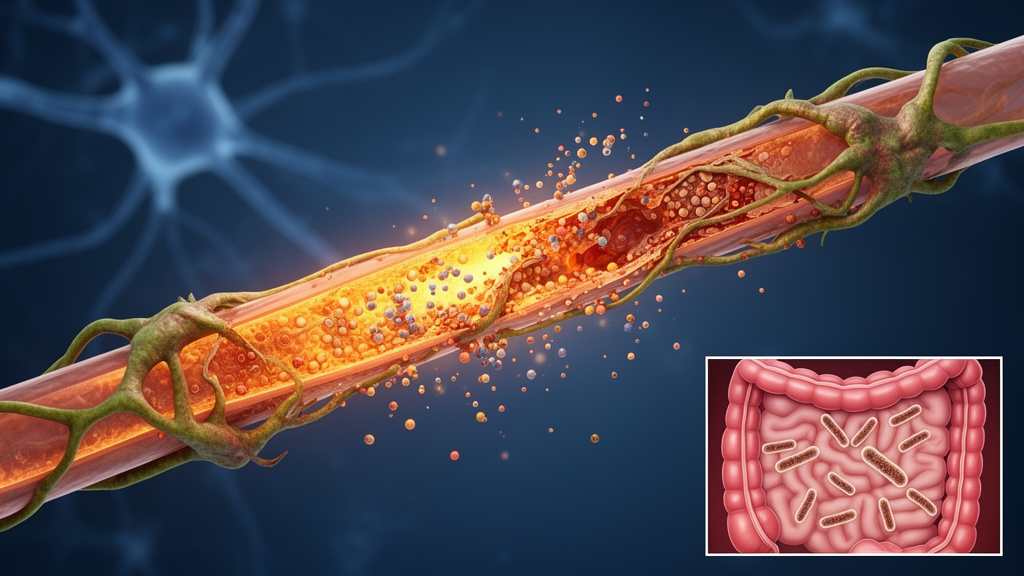
Gut microbiota depletion eased cerebrovascular dysfunction in a mouse model of Alzheimer’s disease, and the benefit appears to run through an immune signaling pathway involving IL-17A, according to a study published in Alzheimer’s Research & Therapy. The work, authored by Fang Li, Xiao-Mei Lu, Hai-Fang Wu and colleagues, used APP/PS1 mice and primary mouse cerebral pericytes to investigate the effects of gut microbiota depletion and IL-17A neutralization on neurovascular dysfunction, in a disease in which cerebrovascular dysfunction is described as an early hallmark of Alzheimer's disease.
In the APP/PS1 mice, depleting the gut microbiota significantly attenuated cerebrovascular rarefaction, restored pericyte coverage, and rescued blood-brain barrier leakage, which the researchers assessed with Evans Blue assays. These vascular improvements were accompanied by marked reductions in systemic IL-17A levels and in the accumulation of meningeal CD4+IL-17A+ T cells, which the team measured using flow cytometry of meningeal immunity. The findings suggest that signals originating from the gut’s microbial community can reach the brain’s vasculature through peripheral immune channels.
According to the study, IL-17A induced pyroptosis-associated pericyte injury through an IL-17RA/Act1 dependent signaling cascade involving the NLRP3 inflammasome. The researchers also found that IL-17A signaling suppressed the CREB/BDNF trophic axis, a survival pathway, further compromising pericyte survival.
Therapeutically, pharmacological neutralization of IL-17A recapitulated the neurovascular and cognitive protection observed with microbiota depletion. Notably, combining the two interventions yielded no additive effects, a result consistent with the two approaches acting on the same IL-17A-centered pathway rather than on independent mechanisms. The authors conclude that gut microbiota-associated IL-17A signaling is a contributor to pyroptosis-associated pericyte injury and neurovascular unit dysfunction in Alzheimer’s disease, and they highlight this pathway as a potential target for early intervention.
The study’s scope is limited to animal and cell models. The experiments were conducted in APP/PS1 mice, a transgenic model of Alzheimer’s disease, and in primary mouse cerebral pericytes, so the results do not establish that the same pathway operates in humans or that microbiota or IL-17A targeting would benefit patients. The article was published as an open-access paper on 29 October 2026 and shared as an accepted manuscript, a version the journal notes is subject to further edits before the final Version of Record.
Subject of Research: Gut microbiota-driven IL-17A signaling causing pericyte injury and cerebrovascular dysfunction in Alzheimer's disease
Article Title: Gut microbiota depletion modulates cerebrovascular dysfunction in Alzheimer’s disease via IL-17 A/Act1-driven pyroptosis-associated pericyte injury
Article References: Li, F., Lu, X.-M., Wu, H.-F., Liu, D.-D., Liu, Y., Liu, X., He, Z.-Y., Yan, T.-F., Tu, J.-L., Zhu, X.-G., & Luo, Q.-H. (2026). Gut microbiota depletion modulates cerebrovascular dysfunction in Alzheimer’s disease via IL-17 A/Act1-driven pyroptosis-associated pericyte injury. Alzheimer's Research & Therapy. https://doi.org/10.1186/s13195-026-02248-5
Image Credits: AI Generated
DOI: 10.1186/s13195-026-02248-5
Keywords: gut microbiota, Alzheimer's disease, IL-17A, pericytes, blood-brain barrier, pyroptosis, NLRP3 inflammasome, Act1, neurovascular unit, APP/PS1 mice, CREB/BDNF, cerebrovascular dysfunction
News Source: Cassandra Pierce. (October 29, 2026). Gut Microbiota Signals Drive Pericyte Injury and Vascular Damage in Alzheimer’s Mice. Scienmag.