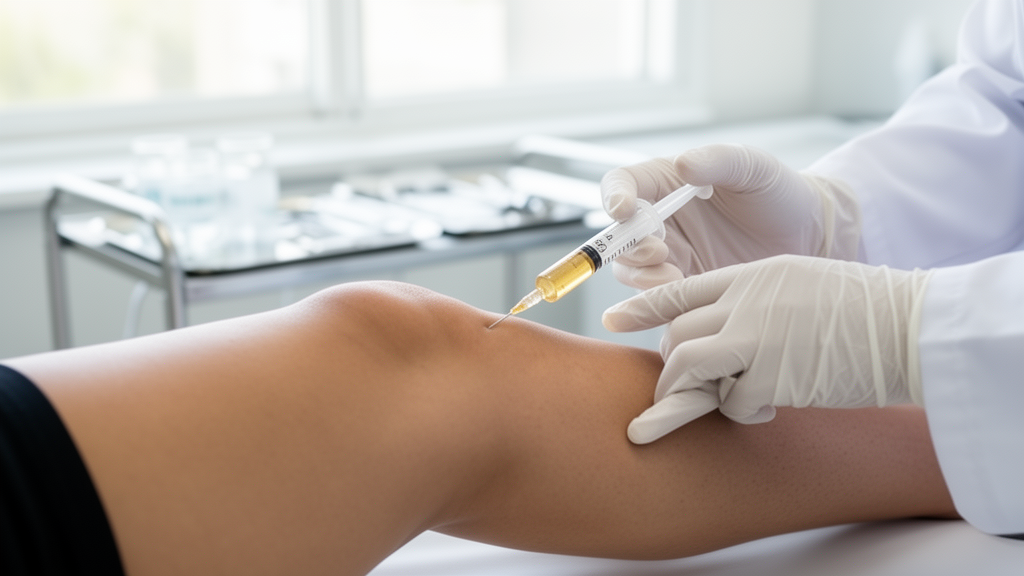
Injections of platelet-rich plasma (PRP) directly into the knee joint were followed by significant improvements in pain and function among patients with mild to moderate knee osteoarthritis, according to a prospective cohort study published in BMC Musculoskeletal Disorders. Over a six-month follow-up period, patients showed statistically significant gains on both the Visual Analogue Scale (VAS) and the Western Ontario and McMaster Universities Osteoarthritis Index (WOMAC), with effect sizes ranging from 1.25 to 2.87 and p-values below 0.001 at every measured time point.
The study enrolled 59 unique participants contributing 61 knees, all diagnosed with Kellgren–Lawrence (KL) grade II or grade III knee osteoarthritis. The evaluations focused on two central clinical goals: relief of pain and improvement in joint function, both of which are key concerns in a condition described as a leading cause of disability worldwide.
The results showed a clear pattern across the follow-up period. Significant improvements in VAS and WOMAC scores were observed at each assessment after the injection, indicating that patients reported both less pain and better function compared with their baseline state. Notably, the magnitude of improvement was not uniform across disease severity: knees with KL grade II osteoarthritis, the milder form included in the study, showed greater improvements during follow-up than knees classified as KL grade III.
Safety findings were limited and largely reassuring within the observation window. Injection-site pain occurred in nine knees from nine participants, and this discomfort resolved with oral paracetamol. Beyond that, the researchers reported no additional local or systemic adverse events during the six months of follow-up, an important consideration for any procedure involving injection into a weight-bearing joint.
The authors themselves place a strong caveat on how these results should be read. Because the study was an uncontrolled prospective cohort study, with no placebo or comparison group, the findings should be interpreted as observed clinical improvements following PRP treatment rather than definitive evidence of treatment efficacy or causation. Without a control arm, it is impossible to separate the effects of the injection from natural symptom fluctuation, regression to the mean, or other concurrent factors.
PRP has attracted attention as a biologic approach to osteoarthritis management, with the idea that concentrated platelets delivered into the joint might enhance cartilage repair and reduce inflammation. The study’s authors frame the treatment within this context, noting that intra-articular PRP injections have gained attention as a potential option for a condition that significantly affects quality of life for millions of people. The current study, however, measured clinical outcomes rather than structural changes in cartilage.
The study’s registration history is also worth noting. It was retrospectively registered at ClinicalTrials.gov under identifier NCT07828561 on 10 September 2026, with registration occurring only after recruitment and data collection had been completed. Retrospective registration means the trial’s design and outcomes were documented publicly after the work was underway or finished, a detail readers should weigh when interpreting the reported results.
The authors conclude that randomized controlled studies with longer follow-up periods and control groups are required to determine the causal effect and comparative effectiveness of PRP in knee osteoarthritis. Until such trials are available, the study adds to the observational evidence base suggesting short-term symptom improvement after PRP injection in patients with KL grade II and III disease, with the strongest gains seen in the less severely affected knees, while leaving open the central question of how much of that improvement the treatment itself causes.
Subject of Research: Short-term clinical outcomes of intra-articular platelet-rich plasma injections in knee osteoarthritis
Article Title: Clinical outcomes of intra-articular platelet-rich plasma injection in knee osteoarthritis
Article References: Bir Bajracharya, G., Shrestha, S., Dahal, S., & Maharjan, S. (2026). Clinical outcomes of intra-articular platelet-rich plasma injection in knee osteoarthritis. BMC Musculoskeletal Disorders. https://doi.org/10.1186/s12891-026-10678-3
Image Credits: AI Generated
DOI: 10.1186/s12891-026-10678-3
Keywords: knee osteoarthritis, platelet-rich plasma, intra-articular injection, WOMAC, VAS pain score, prospective cohort study, KL grade II, KL grade III, adverse events, randomized controlled trials, regenerative medicine, orthopedics
News Source: Ophelia Keating. (October 30, 2026). Platelet-Rich Plasma Knee Injections Show Short-Term Pain and Function Gains. Scienmag.