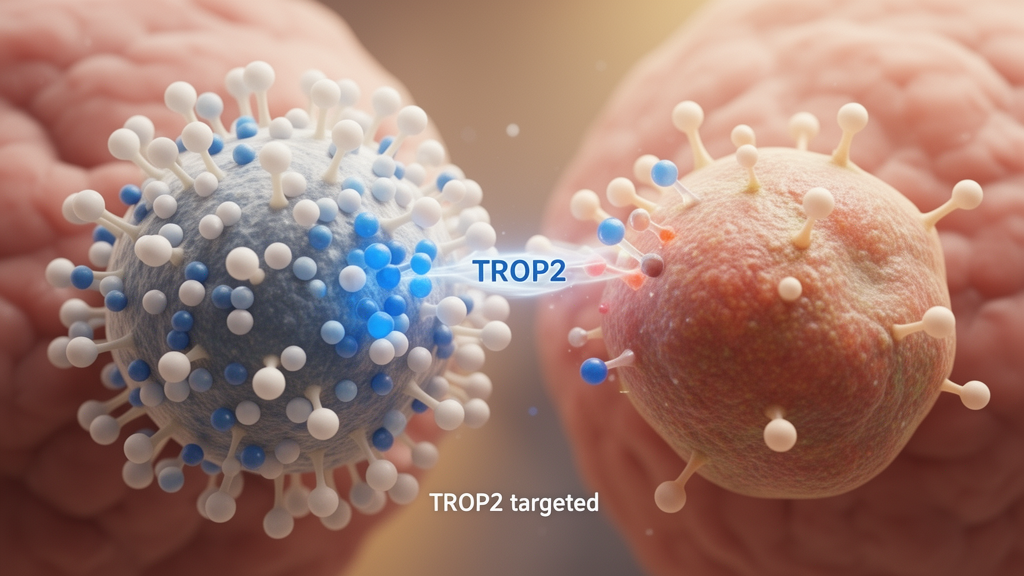
Researchers at Virginia Commonwealth University Massey Comprehensive Cancer Center have received a five-year, $2.5 million R01 grant from the National Cancer Institute to investigate how TROP2-targeted antibody-drug conjugates work in triple-negative breast cancer and pancreatic ductal adenocarcinoma. The project, led by Chuck Harrell, Ph.D., of the Massey Cancer Biology research program and the VCU School of Medicine’s Department of Pathology, will examine the biological features associated with treatment response and resistance. The grant supports laboratory research into potential predictive biomarkers and therapeutic strategies; it is not a clinical trial and will not establish patient outcomes.
The investigators will focus on sacituzumab govitecan, a TROP2-directed antibody-drug conjugate that the announcement describes as having substantial activity in treating triple-negative breast cancer and as having received Orphan Drug Designation for pancreatic cancer studies. The research team aims to determine what enables tumors to respond to this drug and what changes when resistance develops. One objective is to identify proteogenomic biomarkers that predict sensitivity or resistance, with the findings intended to support development of SG-PREDICTOR, a machine-learning tool for clinical prediction of response. Harrell said the longer-term goal is a mechanism for predicting whether a patient is likely to respond to an antibody-drug conjugate before treatment begins, although such a tool would require further development and clinical validation.
The five-year project will use a rigorously characterized panel of patient-derived xenograft and patient-derived xenograft-organoid models representing triple-negative breast cancer and pancreatic ductal adenocarcinoma. These models will be linked with integrated genomic, transcriptomic and proteomic data, and the researchers will combine those multi-omic analyses with high-throughput drug-response measurements. The approach is intended to connect molecular characteristics with observed sensitivity to sacituzumab govitecan, allowing the team to test whether particular biomarkers can distinguish responsive from resistant tumors.
A second major goal is to define cellular and molecular mechanisms of acquired resistance using resistant patient-derived xenograft and organoid models. The researchers will investigate changes in TROP2 expression, internalization of the drug into cells, drug efflux and DNA repair. A third goal is to test therapeutic strategies intended to enhance or prolong sacituzumab govitecan efficacy. These experiments will include rationally selected drug combinations and next-generation antibody-drug-conjugate payloads, with validation in laboratory tests. Because these studies are planned in model systems, they do not demonstrate that any combination or payload will improve survival or provide clinical benefit in people with cancer.
The award brings together investigators with backgrounds in cancer biology, surgical oncology, biostatistics and developmental therapeutics. Co-investigators include Harry Bear, M.D., Ph.D., Mikhail Dozmorov, Ph.D., and Jose Trevino, M.D. The work reflects a precision-oncology approach: identifying markers that may improve patient selection, defining mechanisms that can inform rational clinical-trial design, and testing strategies that could extend treatment effects. The announcement describes breast cancer as the most common cancer among women in the United States after skin cancers and says pancreatic cancer accounts for about 3% of U.S. cancers and about 8% of cancer deaths, citing American Cancer Society figures. Triple-negative breast cancer lacks estrogen receptors, progesterone receptors and excessive HER2 protein, while pancreatic ductal adenocarcinoma is the most common pancreatic cancer and is usually found at an advanced stage because it often does not cause symptoms early. Any clinical application of the project’s biomarkers, prediction tool or combination strategies would need further evidence from appropriately designed clinical studies.
Subject of Research: Laboratory study of TROP2-targeted antibody-drug conjugates in triple-negative breast cancer and pancreatic ductal adenocarcinoma
Article Title: VCU Massey Comprehensive Cancer Center researchers receive $2.5M NIH grant to inform breast, pancreatic cancer care
Article References: VCU Massey Comprehensive Cancer Center researchers receive $2.5M NIH grant to inform breast, pancreatic cancer care. Original publication (Bibliographic details unavailable.)
Image Credits: AI Generated
DOI: Not provided
Keywords: TROP2, antibody-drug conjugates, sacituzumab govitecan, triple-negative breast cancer, pancreatic ductal adenocarcinoma, biomarkers, drug resistance, precision oncology, patient-derived models, National Cancer Institute, Massey, Comprehensive
News Source: Nathaniel Bowman. (October 26, 2026). VCU grant funds study of TROP2-targeted drugs in breast and pancreatic cancers. Scienmag.