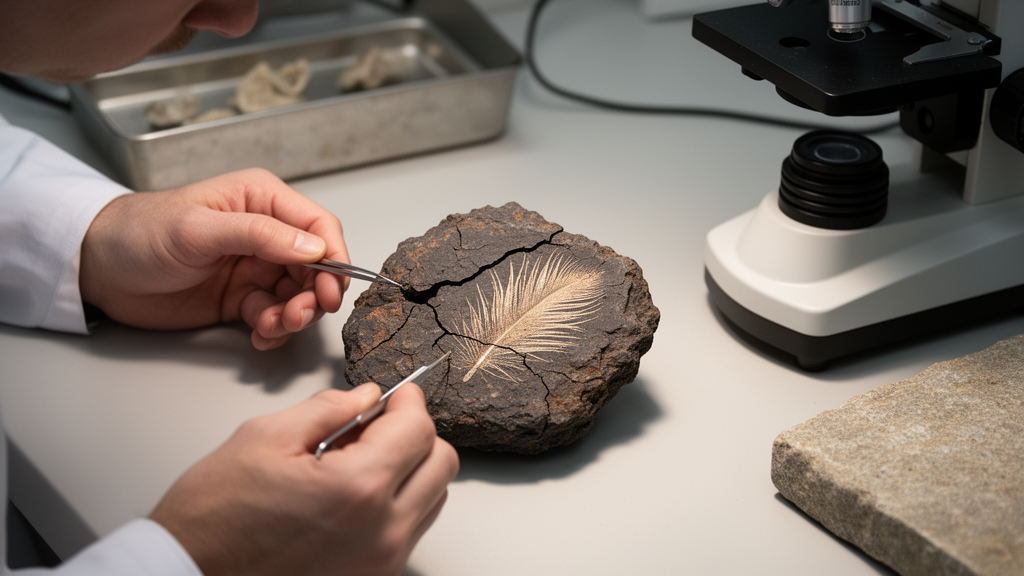
A 66-million-year-old fossilized meal has yielded the first known feathers from a hesperornithiform bird, providing anatomical evidence that may help explain why the lineage leading to living birds survived the end-Cretaceous mass extinction while other aquatic and bird groups did not. The peer-reviewed analysis, published in Current Biology, found multiple feathers preserved with gar-fish scales and leg bones inside a coprolite from Montana’s Hell Creek Formation. Some feathers displayed structures associated with underwater use in living aquatic birds, but the specimen also contained smaller, fuzzy body feathers resembling primitive plumage. The authors propose that differences in feather type, and possibly in how feathers were molted, influenced birds’ ability to withstand the environmental disruption following the asteroid strike. The study did not directly measure insulation or establish feather differences as the cause of survival, making that explanation an important hypothesis rather than a demonstrated result.
The coprolite was discovered in 2016 during fieldwork in northeastern Montana. University of Washington research scientist and Hell Creek Project collections manager David DeMar Jr. was collecting fish fossils when he noticed a dark reddish-brown nodule about half the size of a golf ball in a rocky outcrop. A tiny fossil feather was visible on its surface, prompting cautious optimism because feathers had not previously been found in the Hell Creek Formation despite more than 150 years of prospecting there. In the laboratory, researchers examined the specimen’s mineral composition and obtained CT scans, described as thousands of X-ray images digitally stacked to reveal the three-dimensional contents of the object. The unusual combination of a visible feather on the exterior and abundant internal remains made the nodule a rare opportunity to investigate the anatomy of extinct birds.
As the CT data were processed, the specimen revealed additional feathers, scales and bones in striking three-dimensional detail. The remains included tiny scales from a gar and leg bones from a hesperornithiform bird. Because the coprolite contained both the bird’s bones and feathers, the researchers concluded that the feathers most likely belonged to the consumed bird. The release describing the study says the meal was made by a dinosaur, possibly Tyrannosaurus or Nanotyrannus, but the coprolite itself documents a feeding event rather than securely identifying the predator. Its contents nevertheless offer a rare window into predator-prey interactions at the end of the Cretaceous, linking remains of a prey bird with the digestive remains of a larger animal in a single specimen.
Hesperornithiforms were specialized aquatic birds that lived alongside other dinosaurs during the Cretaceous. Most could not fly and used specialized feet to dive underwater in pursuit of prey such as fish. Ecologically, the researchers described them as similar to living loons. The feathers recovered in the coprolite are the first hesperornithiform feathers ever found, expanding knowledge about a group previously represented primarily by skeletal anatomy. Their structure included adaptations for being underwater that are also seen in living aquatic birds, offering direct anatomical support for the bird’s diving ecology. Because the specimen was a fossilized meal rather than a bird preserved intact, however, its importance lies in showing that predator coprolites can retain soft-tissue details that are rarely preserved with bird fossils.
The feathers also combined features associated with different parts of avian anatomy. Specialized structures in the plumage appeared modern-looking and were associated with underwater use, while smaller, fuzzy body feathers resembled those associated with enantiornithines and other dinosaurs. Body feathers help insulate a bird from the cold, making the mixture potentially relevant to survival during the disruption that followed the asteroid impact. The study’s authors suggest that the primitive feather types retained by hesperornithiforms may not have provided the same thermal protection as the plumaceous feathers of Neornithes. This comparison is a proposed advantage rather than a measured result: the research did not experimentally compare the insulating performance of the fossil plumage and modern feathers. Even so, the specimen shows that specialized aquatic feathers coexisted with more primitive body feathers in an extinct lineage close to the one that survived.
The authors suggest that feather type, or possibly the manner in which feathers were molted, may have been among the underlying causes of the selective nature of the end-Cretaceous extinction. Their interpretation helps distinguish a possible feather-based explanation from the proposal that survival near water alone protected Neornithes. Hesperornithiforms lived by water but became extinct, showing that aquatic habitat by itself does not explain which birds survived. Neornithes, the group from which all living birds descend, possessed what the researchers characterized as modern plumaceous feathers. If these were more effective at insulating their owners, the differences could have helped Neornithes tolerate the “impact winter” after the strike 66 million years ago. The analysis offers a potential mechanism for unequal survival, not direct proof that feather insulation determined the outcome.
The evolutionary placement of the hesperornithiforms makes their plumage especially informative. Enantiornithines were the most common birds alive during the Cretaceous, whereas Neornithes and hesperornithiforms belonged to separate branches. The newly described feathers occupy a middle ground between the plumage of enantiornithines and modern birds: they include underwater adaptations comparable to those in living aquatic birds, but also retain smaller, fuzzy body feathers associated with less derived dinosaurs. Hesperornithiforms were close cousins of the surviving Neornithes, but they were not themselves members of that lineage. Their extinction therefore provides a useful contrast. The study suggests that the combination of ecological specialization and retained primitive feather types may have made them less able to withstand the post-impact environment, while Neornithes survived and eventually gave rise to living species.
The study also demonstrates the potential of coprolites as three-dimensional fossil archives. Conventional fossil-bearing rock can preserve complete skeletons or soft tissues in some specimens, but bird fossils and bird feathers are generally rare. Here, CT processing repeatedly exposed feathers, scales and bones that were not visible when the dark nodule was first found. Researchers had previously relied heavily on feathers preserved in Burmese amber for high-resolution three-dimensional data; the Montana coprolite offered exceptional specimens from a different preservational setting. Because this was the first investigation of feathers preserved in coprolites, the authors argue that more systematic CT scanning could reveal additional information about extinct birds, their ecology and their relationships with predators. That prospect remains a proposed avenue for future research rather than an outcome demonstrated by the current study.
Lead author Jingmai O’Connor, associate curator of fossil reptiles at the Field Museum in Chicago, described the discovery as unusually beautiful, well preserved and scientifically unexpected. The coprolite produced a rare combination of evidence: it preserved the anatomy of an extinct aquatic bird, indicated its dietary encounter with a larger predator and offered a possible clue to the selective survival of the branch that includes every living bird. Greg Wilson Mantilla, a University of Washington professor and curator of vertebrate paleontology, said the rare bird fossils provide important insight into the evolution of feathers, while the specimen offers a window into predator-prey interactions 66 million years ago. The findings do not show that feather insulation alone determined which dinosaurs survived, nor do they establish the identity of the predator. They do reveal a previously unrecognized source of anatomical evidence and a testable way to investigate how feather evolution may have been connected to birds’ unequal survival after the mass extinction.
Subject of Research: Analysis of Late Cretaceous bird feathers preserved in a dinosaur coprolite and their possible relationship to selective survival after the mass extinction.
Article Title: A fossil feather preserved inside dinosaur poop could help explain why birds survived the mass extinction
Article References: A fossil feather preserved inside dinosaur poop could help explain why birds survived the mass extinction. Original publication (Bibliographic details unavailable.)
Image Credits: AI Generated
DOI: Not provided
Keywords: paleontology, dinosaur coprolite, hesperornithiform, fossil feathers, bird evolution, Cretaceous, mass extinction, feather insulation, CT scanning, aquatic adaptation, fossil, feather
News Source: Gavin Prescott. (October 26, 2026). Coprolite study reveals extinct bird feathers linked to extinction survival. Scienmag.