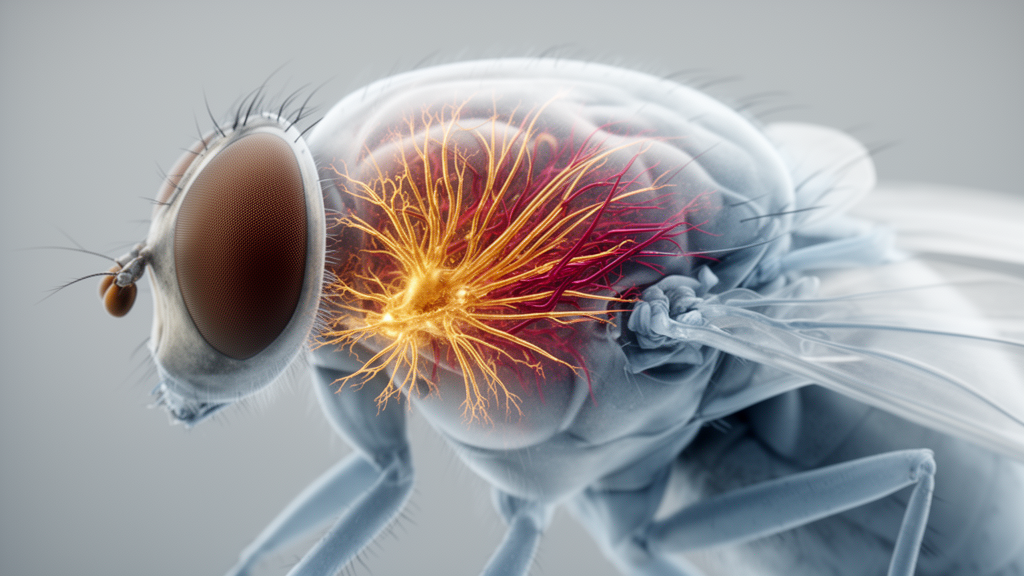
A developmental atlas of 232,251 fruit fly brain cells shows that neuronal identity is not simply carried forward from a parent stem cell in a finished form. Instead, the genetic program that distinguishes one neuron from another is substantially established during a brief period immediately after the final cell division. Researchers at the Stowers Institute for Medical Research combined measurements of gene activity with maps of the regulatory DNA regions, or enhancers, controlling those genes at four stages across the developing Drosophila visual system. The result is the first atlas of this scale to connect active genes with the genomic switches that operate them throughout an entire developing brain region, according to the peer-reviewed study in Proceedings of the National Academy of Sciences.
The project addressed a central problem in developmental neuroscience: how a limited population of dividing neural stem cells can produce many neuron types with distinct shapes, connections and functions. Earlier developmental atlases of the fruit fly brain recorded which genes were expressed, but they did not simultaneously reveal which enhancers were accessible in each cell. Those regulatory regions matter because the same gene can be activated through different DNA switches in different cell types, while the same transcription factor can control different sets of genes depending on its context. By examining both layers together, the team could distinguish cells that expressed the same genes but assembled those expression patterns through distinct regulatory configurations.
Across the four developmental stages, the researchers inferred the gene regulatory networks associated with different neuronal groups and tracked how enhancers were deployed. Many enhancers linked to neuronal identity were closed in the parent stem cell and became accessible only after the daughter neuron had completed its final division. The genome was therefore remodeled during the transition from progenitor to neuron rather than functioning as a passive continuation of the parent cell’s regulatory state. The researchers describe this early post-birth interval as a critical period during which the lasting identity of a neuron is actively rebuilt. The fruit fly results do not establish that every animal nervous system follows the same timetable, but they identify a measurable transition that had been difficult to resolve with gene-expression data alone.
The absence of one universal switch was another major result. The team had expected more consistency in the regulatory factors controlling corresponding genes across neuronal populations, but found that almost every neuron type had its own wiring. A transcription factor might regulate largely different gene sets from one neuron type to another, and a single gene might respond to different transcription factors through separate enhancers in different cells. Neuronal identity instead emerged from modular combinations of regulatory proteins acting through context-specific DNA switches. The collection of accessible enhancers in a particular cell was so distinctive that it could resemble a molecular fingerprint of its neuronal identity.
This architecture adds nuance to the idea that a neuron inherits a complete identity program from its progenitor. The same regulatory protein could be present in both a stem cell and its neuronal descendant, yet operate through entirely different enhancers before and after the final division. In the progenitor, that protein might activate one set of genes; in the neuron, the genome could respond to it in a different way. The study therefore suggests that developmental identity is not merely copied from one cell generation to the next. It is computed through a temporally restricted process in which transcriptional machinery and regulatory DNA are reorganized together.
The technical advance was the joint analysis of two genomic modalities at the transition when a neuron acquires its mature identity. One modality measured gene activity, while the other mapped accessible regulatory regions. Reading them independently could show that two neurons shared a gene or a regulatory protein, but only comparing them within individual cells could reveal whether they used the same route to produce that pattern. That distinction is crucial when the aim is to explain cell identity, because gene expression alone does not identify the regulatory architecture responsible for it. The resulting resource offers a cell-resolved view of when regulatory regions are used and which combinations accompany particular neuronal identities.
The findings also sharpen the role of terminal selectors, transcription factors associated with maintaining the characteristics that distinguish neuronal cell types. Earlier work had mapped many of these identity codes across development of the Drosophila visual system, but the installation of those codes remained unclear. The new data show that installing a lasting identity and inheriting the ingredients for one are not equivalent processes. A progenitor can contain regulatory proteins without using the enhancers that will later sustain the neuronal program. Only by resolving both the factors and their genomic targets could the researchers identify the post-division phase in which many identity-associated enhancers switched from a closed to an accessible state.
For biomedical research, the atlas is a foundation rather than a therapy. Several neurological conditions, including Parkinson’s disease, amyotrophic lateral sclerosis and glaucoma, involve the loss of particular types of neurons, so generating replacements would require the right neuronal identity rather than an unspecified neural cell. The study does not demonstrate that researchers can manufacture disease-relevant human neurons, repair a nervous system or treat any patient. Instead, it provides a more detailed model of the regulatory “recipe” for neuronal differentiation in the fly visual system, including the timing and modularity of enhancer use. That knowledge may help guide later efforts to control cell identity, but translating the fly regulatory logic into human cells will require additional research.
The work was led by Assistant Investigator Neşet Özel, with first author McKenzie Treese and colleagues including Claude Desplan. The investigators view the atlas as a map from which new experiments can begin, particularly experiments on regulatory programs associated with neurodevelopmental disorders in which developmental switches may fail to operate correctly. A companion study from the Özel lab examines one prediction of the atlas in greater detail, but that work was available as a bioRxiv preprint and had not been peer reviewed. The peer-reviewed atlas itself addresses a defined developmental system—the fruit fly visual system—rather than the whole fly brain or a mammalian nervous system. Even with that limitation, its scale and paired view of genes and enhancers provide a detailed developmental reference for testing how neuronal identities are established, maintained and potentially engineered.
Subject of Research: Developmental mapping of gene regulation and enhancer use in the Drosophila visual system
Article Title: A new Stowers Institute brain atlas shows neurons don’t inherit their identity — they build it in their first hours of life
Article References: A new Stowers Institute brain atlas shows neurons don’t inherit their identity — they build it in their first hours of life. Original publication (Bibliographic details unavailable.)
Image Credits: AI Generated
DOI: Not provided
Keywords: fruit fly brain, neuronal identity, single-cell atlas, gene regulation, DNA enhancers, Drosophila, neural development, transcription factors, stem cells, Stowers Institute, Stowers, Institute
News Source: Cassandra Pierce. (October 26, 2026). Fruit fly brain atlas reveals when neurons build their identities. Scienmag.