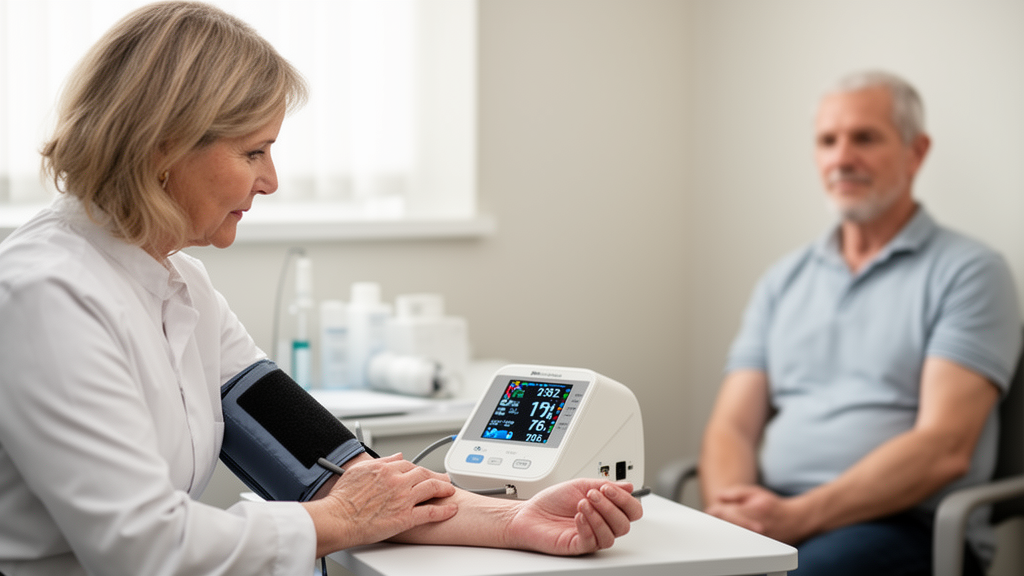
In a long-term analysis of the Framingham Heart Study, women’s pulse pressure reached its lowest point and began shifting from a falling to a rising pattern about a decade earlier than men’s. The transition occurred in women’s late 30s and men’s late 40s. Among women, the timing of menopause—early, typical or late—did not influence the age at that turning point, which occurred as much as two decades before menopause. The observational findings challenge the assumption that the timing of the final menstrual period alone explains the accelerated rise in pulse pressure after midlife, but they do not establish what caused the change or prove that menopause is irrelevant.
Pulse pressure is the gap between the upper, or systolic, and lower, or diastolic, numbers in a blood-pressure reading. It is influenced by the diameter and stiffness of the aorta, the body’s largest blood vessel, which receives oxygen-rich blood from the heart and delivers it to organs throughout the body. Pulse pressure generally falls between early adulthood and midlife as the aorta enlarges and blood flow is eased. After midlife, the aorta’s diameter stops increasing and its walls tend to stiffen, contributing to wider pulse pressure. A wider pulse pressure means the heart is working harder and may contribute to damage in small vessels in organs such as the brain and kidneys.
Women appear to reach this age-related transition earlier than men. According to the study report, women begin life with a smaller volume of elastic fibers in the aorta. With fewer elastic fibers, women have lower pulse pressure than men before midlife; once the aorta stops widening and begins to stiffening, the difference reverses. Pulse pressure increased with age in both men and women after midlife, but the increase was faster in women. As a result, women had a higher average pulse pressure than men after age 60.
The researchers analyzed data from 6,760 adult women who were assessed at three health visits spanning 14 years as part of the Framingham Heart Study. Participants were divided into four groups based on self-reported age at menopause: premenopausal, early menopause, average menopause and late menopause. The premenopausal group had an average age of 33 at the first study visit. Average age at that visit was 53 in the early-menopause group, 54 in the average-menopause group and 57 in the late-menopause group. Reported ages at menopause averaged 44 years for the early group, 51 for the average group and 56 for the late group. Women whose menopause was induced by surgery or medication were excluded from the analysis.
To assess sex differences, the investigators also analyzed data from 3,248 adult male Framingham participants, whose average age at the first study visit was 51. The key finding was not simply that women had higher pulse pressure after midlife, but that the age-related transition from a declining to an increasing profile occurred roughly 10 years earlier in women. The age at the pulse-pressure minimum did not differ meaningfully by whether menopause occurred early, late or at a typical time. The Framingham Heart Study is an ongoing, community-based investigation of risk factors for heart disease that has collected health information from families in Massachusetts across three generations.
“Many people believe that the change in pulse pressure is linked to the hormonal shifts caused by menopause. Here, we are evaluating whether the timing of this change, from falling to rising pulse pressure, is connected to menopause timing in a long-term study,” said Gary F. Mitchell, M.D., the study’s senior author. “To our huge surprise, our results suggest that factors other than the timing of the final menstrual period were likely involved in the accelerated increase in pulse pressure in women after midlife,” he said. His statement was an interpretation of the observed association, not a demonstration of a specific alternative cause.
The findings do not show that menopause has no influence on vascular aging. Samar R. El Khoudary, Ph.D., M.P.H., who chaired an American Heart Association scientific statement on the menopause transition but was not involved in this study, said vascular aging may begin years before menopause and that its trajectory might accelerate as women enter perimenopause. She said cardiovascular health should be considered long before the final menstrual period because vascular changes may already be underway. The analysis therefore distinguishes between the earlier onset of an age-related pulse-pressure transition and the possibility that menopause-related changes could influence its later course.
Wide pulse pressure is described in the study report as an independent risk factor for cardiovascular conditions, dementia and kidney disease. High blood pressure accompanied by a wide pulse pressure may also respond less well to usual treatments. Pulse pressure is not currently included in clinical guidelines for managing blood pressure. Mitchell said clinicians should pay particular attention to pulse pressure in middle-aged and older patients, especially women with high blood pressure, and track it over time. He used 130/70 mm Hg as an example: the difference between 130 and 70 is a pulse pressure of 60 mm Hg.
Several limitations constrain the conclusions. Because the study was observational, it cannot prove cause and effect or determine whether changes in aortic structure caused the age-related pattern in pulse pressure. Menopause timing was based on participants’ self-reports rather than measurements of estrogen levels, limiting the study’s ability to assess hormonal mechanisms directly. Most participants were of white European descent, so the findings may not apply equally to people in other racial or ethnic groups. The analysis also did not directly establish how aortic diameter, wall stiffness and other characteristics contributed to the observed differences. These boundaries mean the results indicate that the timing of the final menstrual period did not explain when women’s pulse pressure began rising, while leaving open the possibility that perimenopausal or other hormonal changes could affect vascular aging later.
Subject of Research: Framingham Heart Study analysis of sex differences in age-related pulse-pressure changes and their relationship to menopause timing
Article Title: Aortic structure may affect midlife rise in pulse pressure, aortic stiffness in women
Article References: Aortic structure may affect midlife rise in pulse pressure, aortic stiffness in women. Original publication (Bibliographic details unavailable.)
Image Credits: AI Generated
DOI: Not provided
Keywords: pulse pressure, menopause timing, aortic stiffness, Framingham Heart Study, blood pressure, vascular aging, cardiovascular risk, hypertension, women’s health, observational study, Aortic, structure
News Source: Beatrice Stafford. (October 26, 2026). Women’s Pulse Pressure Rises Earlier Than Men’s, Framingham Analysis Finds. Scienmag.