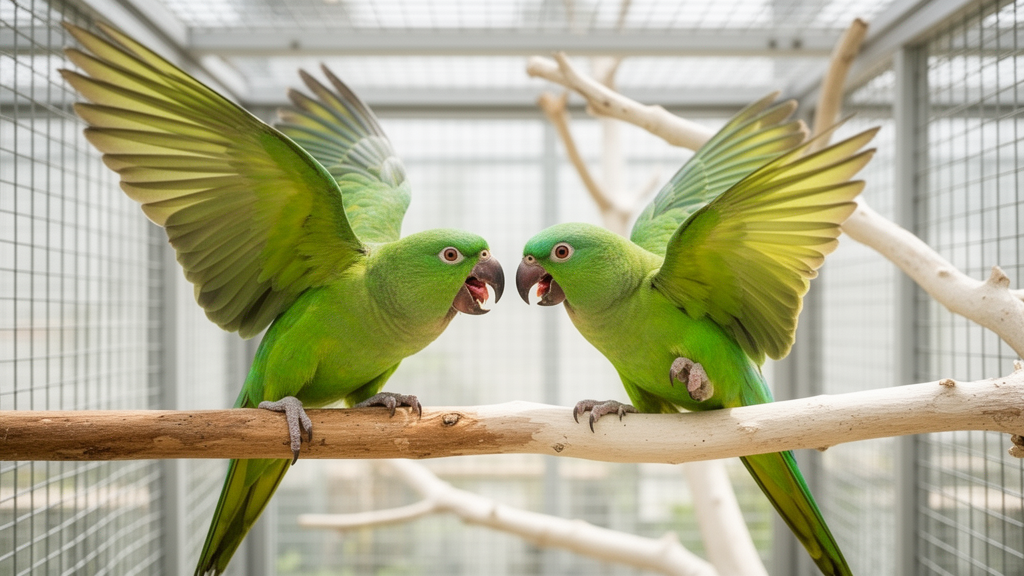
Male and female monk parakeets showed no major differences in their likelihood of initiating fights, being targeted by aggression, or advancing in a social dominance hierarchy, according to a peer-reviewed study by researchers at the University of Cincinnati and Duke University. The findings, published in Integrative and Comparative Biology, indicate that sex did not appear to structure aggression, rank or hierarchy in the observed groups of this gregarious South American bird.
Study lead author Yuchen Chen and co-authors Elizabeth Hobson and Sara Lipshutz examined monk parakeets, which live in social colonies and spend much of their time establishing dominance over one another. Their behavior includes fighting, displacing birds from perches and watching confrontations involving other group members. The study tested whether male and female birds differed in who initiated aggression, who was targeted, and which individuals occupied higher positions in the hierarchy. The researchers found no major sex-based pattern across these measures.
“In a lot of animals, you see differences in aggression and how hierarchies form between females and males. But our new results show that we don’t observe any major differences between female and male aggression or rank in our parakeet groups,” said Hobson, an associate professor of biology at the University of Cincinnati. The result was notable because the researchers had observed an approximately even split between the sexes among the highest-ranked birds in their groups, but the new analysis formally tested that impression rather than relying on preliminary observations alone.
The study also examined whether parakeets gain social information by observing fights between other birds. Chen said the birds are keen observers, and watching who wins and loses can help an individual understand its position in the hierarchy and identify opportunities for improving its standing. Lipshutz noted that group living involves frequent interactions among individuals and that low-stakes squabbles can help establish a social hierarchy capable of preventing more intense and dangerous fights. Injuries during the frequent confrontations are rare. These observations are important for interpreting the sex comparison: the analyzed behavior was part of an ordinary social system involving repeated, relatively low-stakes interactions rather than a series of isolated contests.
Overall, the study’s evidence supports a cautious conclusion about the populations studied: monk parakeet aggression and rank were not strongly differentiated by sex. The authors said this should not be generalized into a claim that sex never affects animal behavior. Instead, their results illustrate why apparently familiar patterns should be tested with collected data. “I think the main takeaway is to not make strong assumptions about animal behavior without collecting data and testing for patterns,” Hobson said. “It’s important to be careful about the kinds of pre-existing notions because they can lead to unsupported biases and wrong conclusions.”
Subject of Research: Sex differences in aggression and social rank among monk parakeets
Article Title: Male, female parakeets equally likely to fight
Article References: Male, female parakeets equally likely to fight. Original publication (Bibliographic details unavailable.)
Image Credits: AI Generated
DOI: Not provided
Keywords: monk parakeets, aggression, dominance hierarchy, sexual dimorphism, social behavior, animal behavior, ornithology, peer-reviewed research, Male, female, parakeets, equally
News Source: Drew Townsend. (October 26, 2026). Monk parakeet aggression shows no major sex-based difference. Scienmag.