Microscopic bdelloid rotifers can pass damaged chromosomes to their offspring while gradually rebuilding the broken genome, according to a peer-reviewed study of the asexual species Adineta vaga published in Science Advances. Researchers found that severely fragmented chromosomes are not always repaired in a single event. Instead, some chromosome fragments are retained through successive generations and progressively reconstructed using intact regions of the homologous chromosome as templates. The authors propose naming the newly identified process “BIHER,” or break-induced homologous extension repair.
The study was led by teams from Université libre de Bruxelles and UCLouvain, with Antoine Houtain of Namur University as first author. Bdelloid rotifers are renowned for their capacity to survive complete desiccation and exceptionally high radiation doses, including exposure exceeding 500 gray, a level described in the research as more than 100 times the dose lethal to humans. Under such conditions, the animals’ chromosomes can be shattered into dozens or even hundreds of pieces. The new findings provide a mechanism that may explain how these organisms retain and transmit genetic information despite extensive chromosome damage.
BIHER differs from the idea that every broken chromosome must be restored immediately. In A. vaga, some fragments apparently persist and move through multiple generations. During that process, the genome can gradually recover missing regions by using intact fragments from the homologous chromosome as templates. The findings indicate that repair may therefore be distributed across generations rather than confined to one cell or one reproductive event. This transgenerational strategy is proposed as the explanation for the gradual reconstruction of a fragmented genome, although the release describes the mechanism as newly identified and the experiments concern one bdelloid rotifer species.
The research builds on more than a decade of work by the collaborating groups of evolutionary and molecular biologists Karine Van Doninck and Bernard Hallet. Earlier studies addressed the unusual biology of Adineta vaga, including its reproduction without males and its survival through both complete desiccation and high doses of ionising radiation. The current study is the third in a series of Science Advances articles arising from that collaboration, following work published in 2021 and 2022. Together, the studies have progressively examined how bdelloid rotifers preserve and transmit their genomes under demanding environmental conditions.
The discovery broadens the known range of biological responses to severe DNA damage. Rather than relying only on rapid, conventional chromosome reconstruction, bdelloid rotifers appear to use a flexible strategy in which damaged material can remain present for extended periods and be repaired over time. The evidence comes from an animal model, so its implications for human biology remain an avenue for future investigation rather than an established clinical benefit. The authors suggest that understanding BIHER could eventually improve knowledge of genome-repair defects involved in diseases such as cancer, but no treatment, preventive measure or clinical recommendation has been demonstrated by the study.
Subject of Research: Transgenerational chromosome repair in the asexual bdelloid rotifer Adineta vaga
Article Title: Chromosome repair passed down from generation to generation
Article References: Chromosome repair passed down from generation to generation. Original publication (Bibliographic details unavailable.)
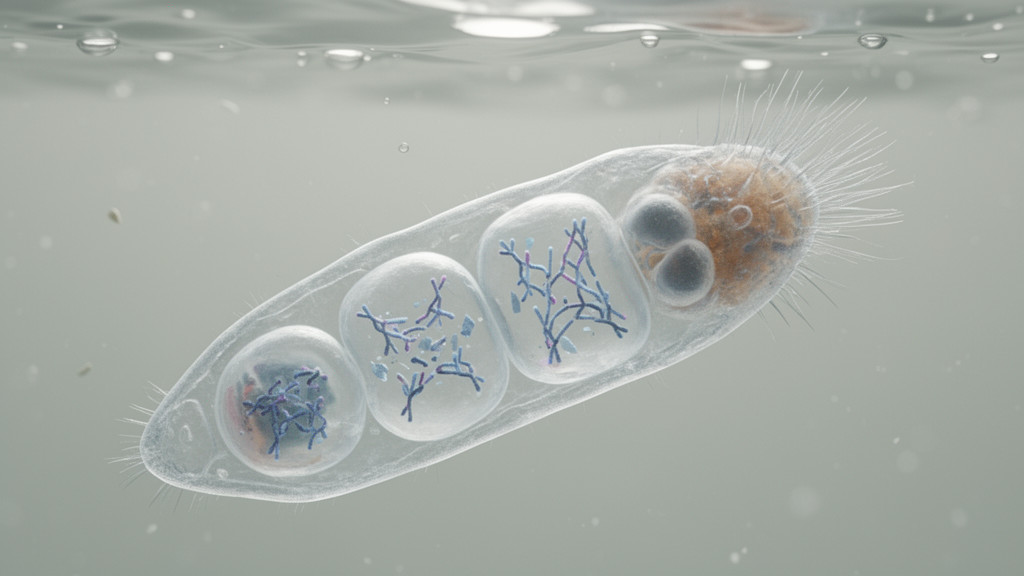
Image Credits: AI Generated
DOI: Not provided
Keywords: bdelloid rotifers, Adineta vaga, chromosome repair, DNA damage, transgenerational inheritance, genome stability, homologous recombination, BIHER, ionising radiation, asexual reproduction, Chromosome, repair
News Source: Juliet Wilcox. (October 26, 2026). Bdelloid rotifers repair chromosomes across generations. Scienmag.