A three-dimensional structure of BRD4, a protein linked to multiple cancers, shows that the protein can attach to chromosome-packaging structures through direct contact with DNA as well as through recognition of chemically modified histones. Researchers at Penn State used cryo-electron microscopy to image the entire BRD4-nucleosome complex and then tested the binding mechanism in additional experiments. Their findings challenge the long-standing view that histone acetylation is always required to recruit BRD4 to a nucleosome, raising new questions about how this family of proteins may operate in cells. The study was published in Molecular Cell as a peer-reviewed investigation of basic protein biology; it did not test a cancer treatment or establish a clinical benefit.
BRD4 belongs to a family of proteins containing bromodomains, structural regions that enable the proteins to recognize particular chemical marks on other molecules. In its role with chromosomes, BRD4 helps regulate when genes are switched on or off. The protein also participates in processes through which cells read, copy and repair DNA and contributes to the development of different cell types. Because BRD4 has been associated with many cancers, it is considered a promising target for future therapeutic development, although the Penn State work was designed first to clarify the protein’s structure and binding behavior rather than to evaluate a drug or intervention in patients.
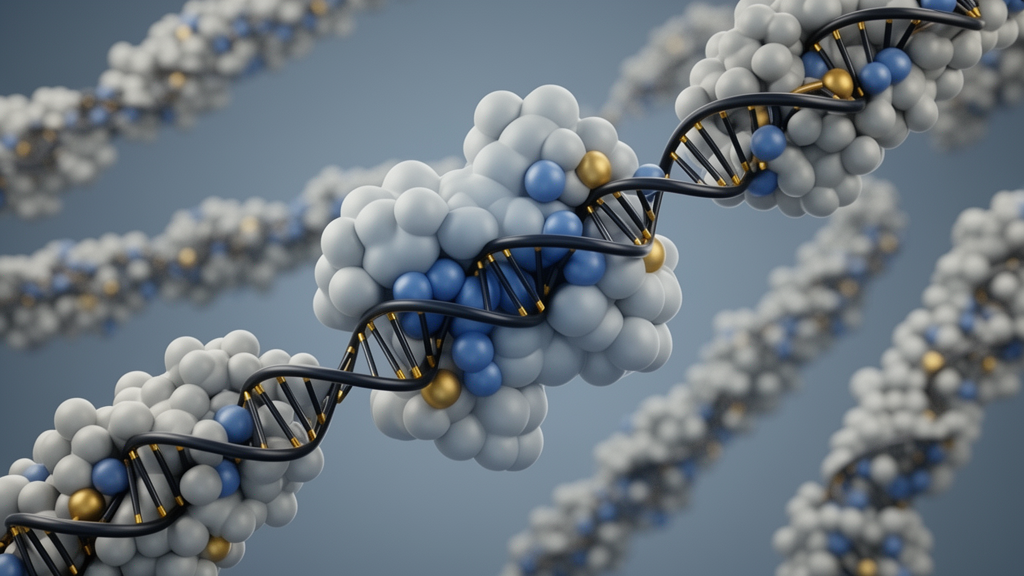
Until the new study, previous structural investigations had examined BRD4 bound to a fragment of a chemically modified histone. That approach established how one of the protein’s bromodomains recognizes a modified amino acid, but it did not show how BRD4 engages with the full chromosome context. The researchers instead imaged BRD4 in the biologically relevant setting of an entire nucleosome, the repeating complex in which DNA is wrapped around histone proteins. Their aim was to determine whether additional contacts made by BRD4 contributed to nucleosome binding and whether the arrangement of the protein created a surface capable of recruiting other molecular partners.
The cryo-electron microscopy structure confirmed the expected interaction involving the protein’s bromodomain and acetyl-lysine, a chemically modified form of lysine on histone H4. It also revealed an unexpected interaction between BRD4 and the DNA within the nucleosome. In the captured complex, one bromodomain could engage the modified histone while another region of BRD4 contacted DNA. The result indicated that BRD4 can use more than one route to associate with the nucleosome, providing a structural explanation for its potentially broader binding than a simple histone-mark-recognition model would predict.
The structure also showed that when a bromodomain binds the modified histone, BRD4 adopts an arrangement that presents a platform for interactions with other proteins. BRD4 works with numerous molecular partners, and the position of the protein within the nucleosome may help organize those contacts in a defined orientation. Co-first author Jiang Zhu, an assistant research professor of biochemistry and molecular biology at Penn State, compared the arrangement to a welcome mat for other interactions. The researchers said this structural view could help them begin to reconstruct precisely how BRD4 functions, but they did not determine the identities, activities or sequence of the additional partners in this particular experiment.
To test the importance of the chemical tags, the team performed further experiments asking whether BRD4 could bind a nucleosome when the histones lacked their modifications. According to the study, BRD4 bound the unmodified histones with nearly the same affinity with which it bound the modified histones. These results suggest that key regions of BRD4 help the protein associate with nucleosomes even when the canonical acetylation signal is absent. The binding measurements were made as part of the laboratory study, and the authors did not establish how often or under what cellular conditions unmodified-histone binding occurs.
Co-first author Erik M. Leith described the result as a surprise because acetylation had been treated as necessary for recruiting a bromodomain to nucleosomes. The new evidence indicates that the chemical tag is not the only possible basis for the interaction. Instead, contacts involving other regions of BRD4 can contribute substantially to binding. Leith emphasized that the researchers do not yet know whether the same behavior occurs in cells. If it does, it could expand the range of biological situations in which BRD4 or related bromodomain proteins act, but the study did not demonstrate such activity in an intact cellular system or show consequences for gene regulation.
The work therefore combines two complementary kinds of evidence. Cryo-electron microscopy provided a near-atomic-scale view of the complete complex, revealing both the familiar recognition of acetylated histone H4 and the additional DNA contact. Separate binding experiments then tested the functional implication of removing the histone modifications and found little difference in BRD4’s affinity under the tested conditions. This progression distinguishes direct structural observation from biochemical measurement, while leaving open important questions about the prevalence and biological importance of the newly identified mode of binding in living cells.
The study was led by Song Tan, Verne M. Willaman Professor of Molecular Biology in the Penn State Eberly College of Science. In addition to Tan, Zhu and Leith, the Penn State team included research technologists Erin N. O’Donnell and Bryan P. Manzano and Jean-Paul Armache, assistant professor of biochemistry and molecular biology. Shwu-Yuan Wu and Cheng-Ming Chiang at the University of Texas Southwestern Medical Center also participated. The work was funded by the U.S. National Institutes of Health, the Chung-Ho Chen Cancer Research Fund, and Pennsylvania Department of Health Tobacco CURE Funds. The authors noted that their immediate focus was the basic biology of BRD4 and bromodomain proteins. Any clues that the structural findings might eventually support more effective cancer treatments remain possibilities for future research rather than demonstrated outcomes of the present study.
Subject of Research: Cryo-EM analysis of BRD4 binding to histone and DNA components of nucleosomes
Article Title: Cancer-linked protein binds to chromosome in unexpected way, study finds
Article References: Cancer-linked protein binds to chromosome in unexpected way, study finds. Original publication (Bibliographic details unavailable.)
Image Credits: AI Generated
DOI: Not provided
Keywords: BRD4, nucleosomes, cryo-electron microscopy, bromodomains, histone acetylation, DNA interactions, chromatin, gene regulation, protein structure, cancer biology, Cancer-linked, protein
News Source: Nathaniel Bowman. (October 26, 2026). Cryo-EM reveals dual DNA and histone binding by cancer-linked BRD4. Scienmag.