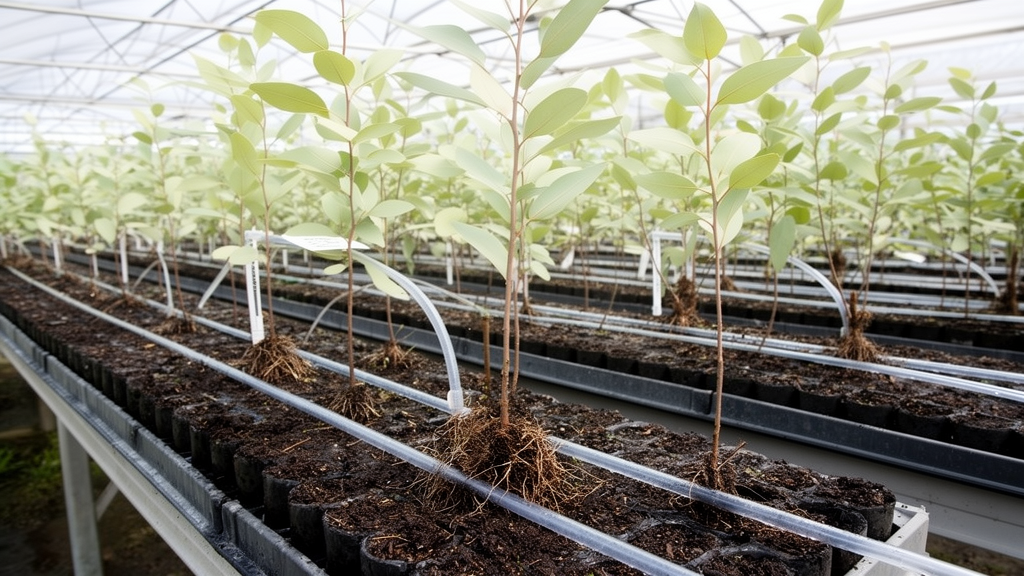
Treated water from onshore oil and gas extraction maintained a 92.8% rooting rate among mini-cuttings from five hybrid Eucalyptus clones in a controlled nursery experiment. Survival was numerically higher with produced water than with an urban water supply—95.2% versus 87.3%—although the study did not statistically confirm that difference. The findings support preliminary compatibility of the tested produced water with Eucalyptus rooting under the experimental conditions, but they do not establish the effluent as a universal irrigation alternative for industrial forestry.
Researchers evaluated clones 13, 14, 30, 104 and 106, testing each genotype separately under produced-water and urban-water irrigation systems. Within each irrigation system, the experiment used a randomized block design with five replicates of 11 mini-cuttings. The researchers assessed rooting percentage, survival, shoot height, stem diameter, root number, root volume, and fresh and dry biomass. The water sources were also characterized for electrical conductivity, sodium adsorption ratio, total oil and grease, metals, nutrients and other physicochemical parameters. This paired assessment connected the plants’ measured performance with the differing chemical composition of the two irrigation sources.
The produced water formed a non-saline but ionically distinct environment compared with the urban supply. Its electrical conductivity was 0.53 dS m−1, its sodium adsorption ratio was 2.34, and its total oil and grease concentration was 2.19 ppm. The researchers reported that these values were below discharge thresholds established by Brazilian environmental standards and consistent with internationally recognized criteria for irrigation-water quality. The reported rooting percentage of 92.8% therefore came from cuttings exposed to the particular batch of treated produced water studied, under controlled nursery conditions, rather than to untreated or compositionally unknown effluent.
Responses were not uniform across the five genetic backgrounds. Clones 104 and 106 displayed greater vigor and biomass under produced-water irrigation, whereas clone 30 responded more favorably to the urban water supply. The study team interpreted these contrasting patterns as evidence of genotype-dependent sensitivity to the ionic composition of the effluent. Exploratory principal component analysis and k-means clustering further supported the presence of differential response patterns among the genotypes, but the central biological differences lay in the observed vigor, biomass and clone-specific performance rather than in a statistically confirmed survival advantage for produced water.
The results come from one controlled nursery experiment involving one produced-water source, a defined group of hybrid Eucalyptus clones and the rooting phase of propagation. The authors identified several requirements before the findings could be generalized: testing additional produced-water batches, conducting chamber-replicated trials and evaluating subsequent growth stages. The experiment therefore does not demonstrate performance across different sites, seasons, effluent chemistries or the later development of rooted cuttings. It also does not show that all Eucalyptus genotypes will respond in the same way. What the measured results do show is that the tested treated effluent can support high rooting in these clones, while clone identity and the chemical characteristics of each water source remain central variables for any broader assessment of nursery use.
Subject of Research: Effects of treated oil and gas produced water on rooting in five hybrid Eucalyptus clones under controlled nursery conditions.
Article Title: Potential use of produced water from oil and gas operations for irrigation during the rooting phase of Eucalyptus spp. mini-cuttings
Article References: da Fonseca, L. R. S., de Souza Ferreira, E., de Oliveira, R. R. A., Quirino, N. I. L., Teixeira, M. I. D. O., de Oliveira, L. S., & Dias-Araujo, P. C. (2026). Potential use of produced water from oil and gas operations for irrigation during the rooting phase of Eucalyptus spp. mini-cuttings. BMC Plant Biology. https://doi.org/10.1186/s12870-026-09834-7
Image Credits: AI Generated
DOI: 10.1186/s12870-026-09834-7
Keywords: Eucalyptus, produced water, oil and gas, nursery irrigation, plant propagation, rooting, water reuse, genotype differences, industrial forestry, Potential, produced, water
News Source: Alan Morgan. (October 26, 2026). Treated oilfield wastewater supports Eucalyptus rooting in nursery trial. Scienmag.