A zinc-based coordination crystal developed in Japan can expand its interlayer structure to capture carbon dioxide at very low pressure and preferentially incorporate benzene, according to an experimental study led by Shibaura Institute of Technology. The material’s interlayer spaces measure about 2.6 angstroms when empty, but suitable guest molecules can trigger the layers to move apart. At 195 K, the researchers observed appreciable carbon dioxide uptake at pressures as low as 2.0 Pa.
At 303 K, the crystal retained carbon dioxide longer than nitrogen and methane under dry and highly humid conditions. In a competitive organic-molecule test, it reached about 97% of its benzene-inclusion capacity from an equimolar benzene–hexafluorobenzene mixture, with no evidence of hexafluorobenzene insertion. The laboratory results demonstrate selective molecular inclusion, but they do not establish performance in an industrial separation unit.
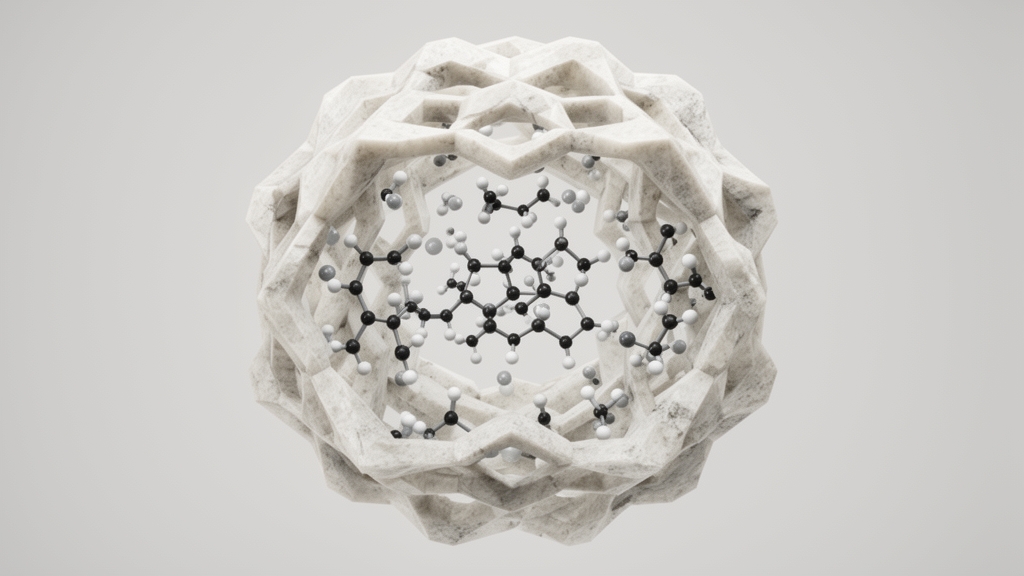
The study, published in Angewandte Chemie International Edition on August 24, 2026, investigated an interlayer adaptive crystal made from fluorinated aromatic zinc(II) coordination sheets. Professor Akiko Hori led the project with graduate students Masahiro Abe and Tomoki Jitsukata at Shibaura Institute of Technology and Professor Ryotaro Matsuda at Nagoya University. In the guest-free material, thin layers are separated by ultramicropores approximately 2.6 Å across.
These openings are too small to function as conventional pathways for carbon dioxide. Instead, they act as triggers: positively polarized regions on the fluorinated surfaces interact with molecules having complementary electrostatic distributions, and the layers then separate to make room. The approach was designed to distinguish guests through electrostatic compatibility rather than relying only on pore dimensions or adsorption strength.
That response was especially pronounced for carbon dioxide. At 195 K, the crystal showed appreciable uptake at 2.0 Pa, rising to about 0.2 molecules per [Zn(L)Py]₂ unit at 26 Pa and approximately 2.0 molecules per unit at 98 kPa. Uptake also remained substantial at room temperature, reaching 0.58 mol mol⁻¹ at 298 K near 98 kPa.
Structural measurements revealed reversible expansion along the crystal’s a-axis when carbon dioxide entered. The measurements indicate that the molecules were accommodated by an adaptive interlayer space rather than by simply filling the original ultramicropores as rigid cavities. The structural change supplies a physical explanation for how a guest can enter a host whose closed interlayer geometry initially presents a much smaller opening.
The crystal also distinguished carbon dioxide from nitrogen and methane in dynamic breakthrough measurements at 303 K. Under dry conditions, carbon dioxide broke through about 60 seconds later than nitrogen and 52 seconds later than methane, consistent with stronger retention by the crystal. The result is relevant to separation processes involving molecules that can be difficult to distinguish with fixed openings. The experiment did not, however, test the material in a full industrial purification unit or measure the energy needed to regenerate it after carbon dioxide capture, so the scale-up implications remain untested.
Selectivity persisted when the experiments were conducted under highly humid conditions. The crystal achieved carbon dioxide uptake of 0.25 mol mol⁻¹ for a carbon dioxide–nitrogen mixture and 0.21 mol mol⁻¹ for a carbon dioxide–methane mixture. These measurements show that the preferred uptake of carbon dioxide was not restricted to dry conditions.
The researchers identified the result as evidence that the material could be useful for gas purification. Other features required for practical assessment—including regeneration energy, cycling stability, synthesis cost and performance during prolonged exposure to contaminants—were not established in the reported work. The present evidence is therefore limited to laboratory measurements of adsorption, breakthrough behavior and humidity tolerance rather than a demonstration of commercial carbon-capture performance.
The adaptive behavior extended to larger organic molecules and provided a second test of the proposed mechanism. Benzene is about 5.9 Å across, more than twice the intrinsic 2.6 Å ultramicropore diameter, yet it entered the expanded interlayer space. When exposed to an equimolar benzene–hexafluorobenzene mixture, the crystal reached about 97% of its benzene-inclusion capacity while no evidence of hexafluorobenzene insertion was observed.
The figure describes the proportion of the crystal’s benzene-inclusion capacity that was attained; it does not mean that 97% of all benzene in the feed was removed. The sharply unequal uptake nevertheless shows that the host responded differently to the two guests, supporting recognition based on their electrostatic relationship with the fluorinated surfaces rather than a simple size-screening mechanism. Competitive experiments with other organic molecules produced a similar pattern.
Benzene was strongly favored over cyclohexane and cyclohexene. The supplied results do not establish a general rule that dimensions are the only important distinction among those alternatives, but the experiments show that benzene inclusion was preferred even when it competed with the two compounds. The authors associated this selectivity with electrostatic complementarity.
The source specifically describes the negative quadrupole moment of carbon dioxide as the property guiding the initial design, while the organic results are presented as preferential recognition through favorable electrostatic distributions. Together, the observations show that the crystal’s response was not limited to admitting molecules that could physically fit through its original ultramicropores. Reversibility was central to the reported mechanism.
Carbon-dioxide inclusion caused expansion along the a-axis, and that expansion could be reversed, supporting inclusion through a temporary structural response rather than irreversible alteration of the lattice. In principle, such a response would permit repeated opening, uptake and closure as suitable guests entered and left. The reported work combines this reversible structural adaptation with the adsorption capacity associated with porous materials and the molecular precision of coordination crystals.
The zinc(II) coordination sheets create localized environments for guest molecules, while the fluorinated aromatic surfaces provide positively polarized regions that can interact with guests having complementary charge distributions. This combination allows the interlayer geometry to change in response to the molecular electronic environment. Several broader applications were proposed by the research team, including carbon dioxide purification, separation of related organic compounds, controlled molecular transport, confined reactions and guest-responsive materials.
These are potential directions rather than demonstrated outcomes of the study. The experiments directly show low-pressure carbon dioxide uptake, selective retention relative to nitrogen and methane, persistence of selectivity under highly humid conditions, preferential benzene inclusion, and reversible interlayer expansion. They do not establish energy savings, long-term operational durability, performance in industrial gas streams, or suitability for reactions inside the crystal.
The authors also declared no conflicts of interest, and the work was supported by a Grant-in-Aids for Scientific Research B, 23K21122, from the Japan Society for the Promotion of Science and the S-SPIRE project at Shibaura Institute of Technology.
Subject of Research: Experimental development of an adaptive zinc(II) coordination crystal for selective CO₂ uptake and benzene recognition
Article Title: Tiny crystal pores trigger selective CO₂ and benzene recognition
Article References: Tiny crystal pores trigger selective CO₂ and benzene recognition. Original publication (Bibliographic details unavailable.)
Image Credits: AI Generated
DOI: Not provided
Keywords: adaptive crystals, carbon dioxide capture, benzene recognition, gas separation, coordination sheets, interlayer expansion, electrostatic complementarity, porous materials, crystal engineering, molecular adsorption, Tiny, crystal
News Source: Bethany Barker. (October 26, 2026). Lab crystal expands to selectively capture CO₂ and benzene. Scienmag.