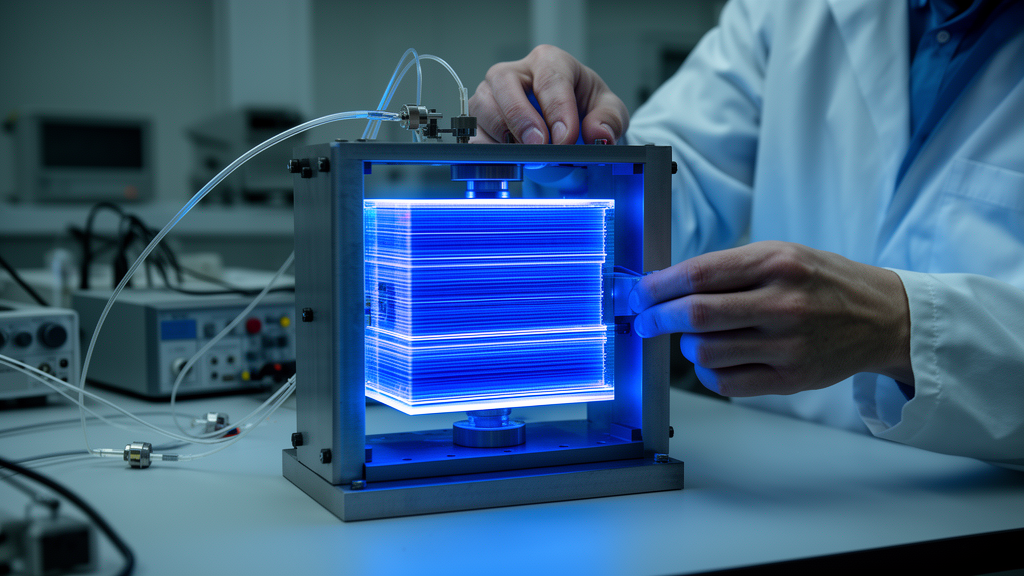
A small change in the brightness of a blue phosphorescent organic light-emitting diode under an applied magnetic field can indicate how long the device will operate, according to a peer-reviewed study led by the Korea Advanced Institute of Science and Technology. Researchers from KAIST, Kyung Hee University, Hanbat National University and ASTA Inc. found that devices showing a weaker initial magnetic-field response maintained their brightness longer during extended operation. The finding offers an early screening method for blue OLED prototypes, but the researchers say it must be analyzed separately when materials or internal designs change.
The study, published online in Nature Communications on September 30, 2026, investigated the relationship between magnetic electroluminescent response and operational lifetime in blue phosphorescent OLEDs. The team tested four types of device made with the same light-emitting material but different internal structures. It operated each device at a constant electrical current, varied the magnetic-field strength with an electromagnet and precisely measured the resulting changes in light emission. A derived evaluation metric was then compared with lifetime measured during long-term operation.
Conventional lifetime assessment requires an OLED to run for tens to hundreds of hours while its declining luminance is monitored. That procedure takes considerable time and also consumes the tested device because its performance degrades as the test proceeds. The magnetic-field method instead obtains information about expected durability from a much shorter measurement of how a device responds to an applied field. The field itself was not used to extend the operating life of the OLEDs. It functioned as a probe for a brightness response associated with the processes that contribute to degradation.
According to Professor Seunghyup Yoo of KAIST’s School of Electrical Engineering, who led the research team, the central result is that the initial brightness response to a magnetic field can serve as an indicator of operational lifetime. Among the four blue phosphorescent OLED types, those with smaller responses retained their initial luminance longer in subsequent long-term tests. The work was conducted jointly with Professor Jang Hyuk Kwon’s team at Kyung Hee University, Professor Jae-Hyun Lee’s team at Hanbat National University and researchers at ASTA Inc. Dr. Jeoungmin Ji was first author, and Yoo served as corresponding author.
The experiments showed that the tested blue phosphorescent OLEDs became slightly brighter when a magnetic field was applied while they operated at constant current. That overall brightness change contained several responses, so the researchers did not treat it as one undifferentiated signal. Instead, they separated the component most closely related to lifetime degradation and converted it into a single evaluation metric. They compared that metric with operational lifetime at two points: LT₇₀, when luminance had declined to 70% of its initial value, and LT₅₀, when it had declined to 50%. Both comparisons showed strong linear correlations between the magnetic-field-based metric and the logarithm of lifetime.
The four device types used the same blue-emitting material but differed in their internal construction. This allowed the researchers to examine whether an early magnetic response could distinguish the subsequent durability of devices made from a common material. The team also recorded the metric for every device in its initial state, before long-term operation, corresponding to the LT₁₀₀ condition. The results indicate that differences visible before extended aging could help identify prototypes that would perform better in later operational tests, potentially allowing developers to focus additional testing on a smaller group of promising structures.
The researchers also examined the physical basis of the measured response through molecular simulations and analysis of the light-emitting process. Over extended use, bonds within the organic molecules inside an OLED can break and form defects that interfere with light emission. The authors explain that these defects can affect the electrical and magnetic processes involved in producing light, allowing the condition of the device to become visible in its brightness response under an applied field. The study therefore connects a device-level measurement with molecular degradation, rather than presenting the magnetic response only as an empirical way to rank prototypes.
OLEDs emit light when electrically charged particles meet and recombine, and the blue phosphorescent devices examined here use electrical energy efficiently to produce blue light. A display produces a broad range of colors by combining red, green and blue emission, as used in products such as smartphone and television screens. Long operating life is an important development goal alongside efficiency, but lengthy aging tests can consume time and wear down the prototypes being evaluated. The proposed magnetic-field analysis is intended to give developers an early, non-destructive way to screen materials and device structures before they commit every candidate to long-duration testing.
The evidence supports a promising but bounded conclusion for the specific devices examined. The study demonstrated strong linear correlations between the magnetic-field metric and the logarithm of operational lifetime for the tested blue phosphorescent OLEDs. It did not show that the method could be applied unchanged to every OLED material or architecture. Because the factors governing the magnetic response may change when the materials or internal structure change, the researchers caution that each device type requires its own analysis. Further validation under varied conditions is needed before broader application. Yoo said that, with that additional validation, the technique may help select long-lived materials and structures early in OLED development and support the creation of efficient, durable blue displays.
Subject of Research: Magnetic-field prediction of operational lifetime in blue phosphorescent OLEDs
Article Title: KAIST predicts the lifetime of blue OLEDs by measuring how their light responds to a magnetic field
Article References: KAIST predicts the lifetime of blue OLEDs by measuring how their light responds to a magnetic field. Original publication (Bibliographic details unavailable.)
Image Credits: AI Generated
DOI: Not provided
Keywords: blue phosphorescent OLEDs, magnetic-field measurement, operational lifetime, electroluminescence, display technology, molecular degradation, device screening, non-destructive testing, KAIST, Nature Communications, predicts, lifetime
News Source: Denise Maddox. (October 26, 2026). Magnetic-field test predicts lifetime of blue phosphorescent OLEDs. Scienmag.