Researchers at Pusan National University in South Korea have developed an artificial-intelligence tool that predicts where microRNAs may bind within complete circular RNA isoforms. The system, named circMAC, assigns a binding probability to each nucleotide while accounting for the circular structure of the RNA and the identity of the particular microRNA being analyzed. In peer-reviewed testing, the model achieved an F1-macro score of 0.762, an area under the receiver operating characteristic curve of 0.902 and an area under the precision-recall curve of 0.545 in a 1,000-nucleotide evaluation performed with base-pairing-prediction pretraining. These computational results indicate strong performance for prioritizing candidate binding regions, but they do not establish functional interactions or clinical applications.
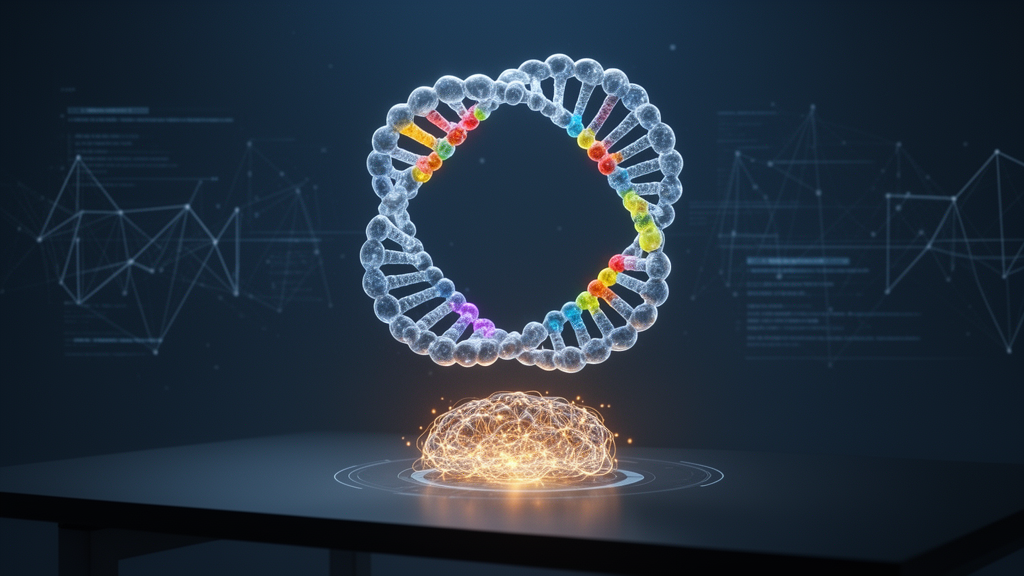
CircMAC was designed to address a problem created by the organization of circular RNA. Circular RNAs are loop-shaped RNA molecules that can participate in gene regulation through microRNA interactions. Their back-splice junction connects the two ends of the molecule, making the sequence continuous around that junction rather than linear. A circRNA can also occur as different full-length isoforms, and a computational method that treats an isoform as a conventional linear transcript may omit or misrepresent sequence information near the back-splice junction. CircMAC instead takes a full-length circRNA isoform and a mature microRNA as inputs and produces a nucleotide-level prediction map, shifting the objective from determining whether a molecule pair might interact to locating where a candidate interaction could occur.
The tool combines three sequence-modeling approaches for this task. Attention identifies relationships among positions across the circRNA, while a Mamba architecture models sequential dependencies. A one-dimensional convolutional neural network detects shorter local sequence patterns associated with binding sites. Circular padding in the convolutional branch allows the model to treat patterns spanning the back-splice junction as continuous rather than breaking them at the sequence boundary. CircMAC also applies cross-attention so that each circRNA position is evaluated in the context of the specific microRNA supplied by the user. Before the binding-site task, the researchers used structure-aware pretraining based on predicting base pairing in RNA. Together, these components are intended to preserve both full-length sequence context and microRNA-specific information during prediction.
The researchers evaluated the framework with full-length circRNA isoforms supported by AGO-CLIP binding-site annotations. The main pair-disjoint dataset included 19,674 training pairs and 7,838 test pairs, with 5.7% of nucleotide positions labeled as binding sites. At the 1,000-nucleotide setting, the version of circMAC with base-pairing-prediction pretraining outperformed the evaluated pretrained RNA language models. It also produced the strongest overall performance among the evaluated full-length models under isoform-disjoint and back-splice-junction-disjoint tests, which are designed to assess generalization across RNA isoforms and across the circular junction. In an illustrative analysis, the tool concentrated prediction signals near an annotated back-splice-junction region of circCDYL2.
Because AGO-CLIP-supported benchmark data and computational comparisons cannot by themselves confirm that every predicted site produces a meaningful biological interaction, the results should be interpreted as a prioritization method for follow-up research. The developers said that circMAC could help computational biologists identify candidate microRNA-binding regions for more targeted experimental validation. Independent datasets and biological experiments would be needed to assess how reliably the predictions reflect actual interactions and whether the framework can support broader biological uses. The study was led by Professor Giltae Song and colleagues in the School of Computer Science and Engineering at Pusan National University. Its findings were published online on 9 September 2026 in Briefings in Bioinformatics, Volume 27, Issue 5.
Subject of Research: Nucleotide-level prediction of microRNA-binding sites on circular RNA isoforms using artificial intelligence.
Article Title: Pusan National University researchers develop AI tool to map microRNA binding dites on circular RNAs
Article References: Pusan National University researchers develop AI tool to map microRNA binding dites on circular RNAs. Original publication (Bibliographic details unavailable.)
Image Credits: AI Generated
DOI: Not provided
Keywords: circular RNA, microRNA, artificial intelligence, RNA binding sites, circMAC, computational biology, RNA structure, bioinformatics, Pusan, National, University, researchers
News Source: Juliet Wilcox. (October 26, 2026). AI tool maps candidate microRNA sites on circular RNAs. Scienmag.