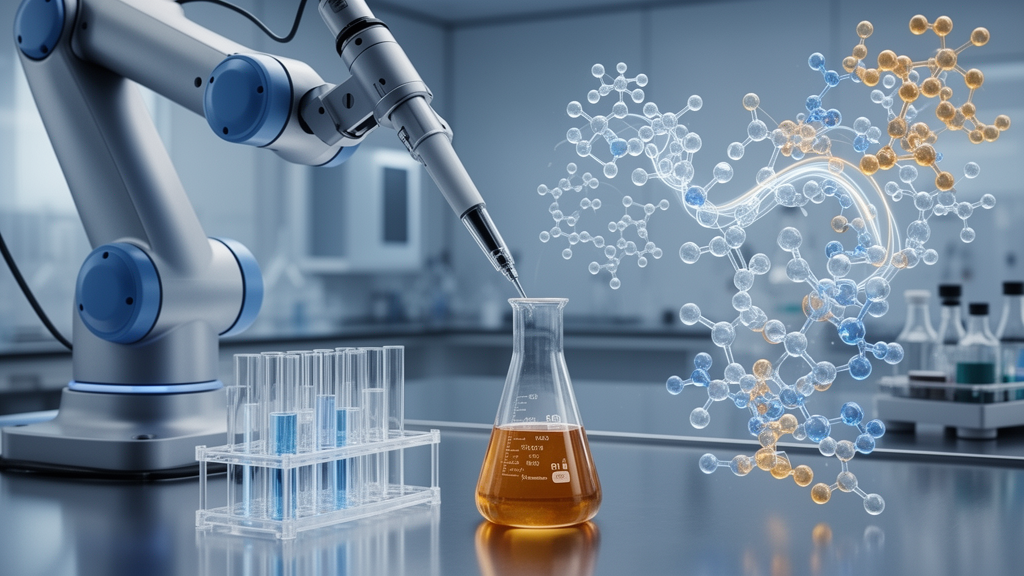
A robotic platform combined with chemical artificial intelligence has uncovered a previously unknown pathway in the Biginelli reaction, a multicomponent transformation first reported in 1891. Researchers led by Prof. Bartosz A. Grzybowski of the Institute for Basic Science tested 960 sets of reaction conditions and found a branch that produces complex bicyclic structures unlike the reaction’s conventional products. The peer-reviewed experimental study, published in Nature Synthesis, shows how systematic exploration of reaction “hyperspace” can reveal unexpected chemistry even in reactions studied for more than a century.
The researchers deliberately avoided treating the automated system simply as a tool for improving the yield of a predetermined molecule. Instead, they used it to survey a broad range of conditions and identify the different products and pathways available within the reaction space. This was a substantial change from conventional automated chemistry, which is often used to optimize an established outcome. By allowing unexpected structures and transformations to emerge from the experimental search, the platform helped reveal a branch of the Biginelli reaction that manual exploration had not identified.
Mechanistic analysis supported by chemical AI indicated that the unexpected pathway is a pseudo-seven-component transformation: seven molecules of the starting components ultimately contribute to the formation of one complex product. Guided by the reconstructed reaction network, the researchers redesigned the synthesis and produced a family of related molecules, including structures approaching the architectural complexity of some natural products. The evidence concerns the synthesized compounds and the Biginelli reaction under the tested conditions; it does not establish that the new pathway is widespread across other reactions or that the compounds have biological or clinical uses.
The newly produced molecules also showed unusual supramolecular behavior, meaning that individual molecules organized into larger assemblies. Some compounds spontaneously assembled in ways that depended on concentration and temperature, while others selectively bound metal ions, particularly barium and zinc. These observations suggest possible uses in selective metal sensing, responsive materials and molecular recognition, but the study did not demonstrate a commercial sensor or other practical device. The reported result is a set of molecular properties that could provide a basis for further development rather than an established application.
One compound exhibited an especially unusual form of chiral self-sorting. Molecules can exist as mirror-image forms called enantiomers, and the forms do not always interact in the same way. In the absence of metal ions, the compound showed different preferences for assembling with molecules of the same or opposite handedness depending on whether it was examined in the solid state or in solution. Zinc ions favored association among molecules with the same chirality, whereas barium ions favored assembly between opposite enantiomers. The researchers described metal-programmable chiral sorting of this kind as extremely rare. It may be relevant to enantioselective sensing, responsive materials and molecular recognition, although its broader utility remains unproven.
The broader significance of the study lies in the discovery method rather than in a single optimized synthesis. Robotic experimentation mapped an extensive reaction network, chemical AI assisted with mechanistic interpretation, and the reconstructed network guided the design of a new molecular family. Together, these steps yielded a distinct transformation and compounds with measurable self-assembly and metal-binding behavior. The work suggests that laboratory automation could expand from accelerating experiments toward discovering chemistry that researchers did not specifically seek, while the findings remain limited to the Biginelli system and related products examined in this study.
Subject of Research: Robotic and AI-assisted discovery of a hidden Biginelli reaction pathway
Article Title: Robots and AI find a hidden reaction inside 135-year-old chemistry
Article References: Robots and AI find a hidden reaction inside 135-year-old chemistry. Original publication (Bibliographic details unavailable.)
Image Credits: AI Generated
DOI: Not provided
Keywords: Biginelli reaction, laboratory automation, chemical artificial intelligence, reaction mapping, bicyclic molecules, supramolecular chemistry, chiral self-sorting, metal-ion binding, Robots, find, hidden, reaction
News Source: Bethany Barker. (October 26, 2026). Robotics and AI Reveal Hidden Pathway in 135-Year-Old Biginelli Reaction. Scienmag.