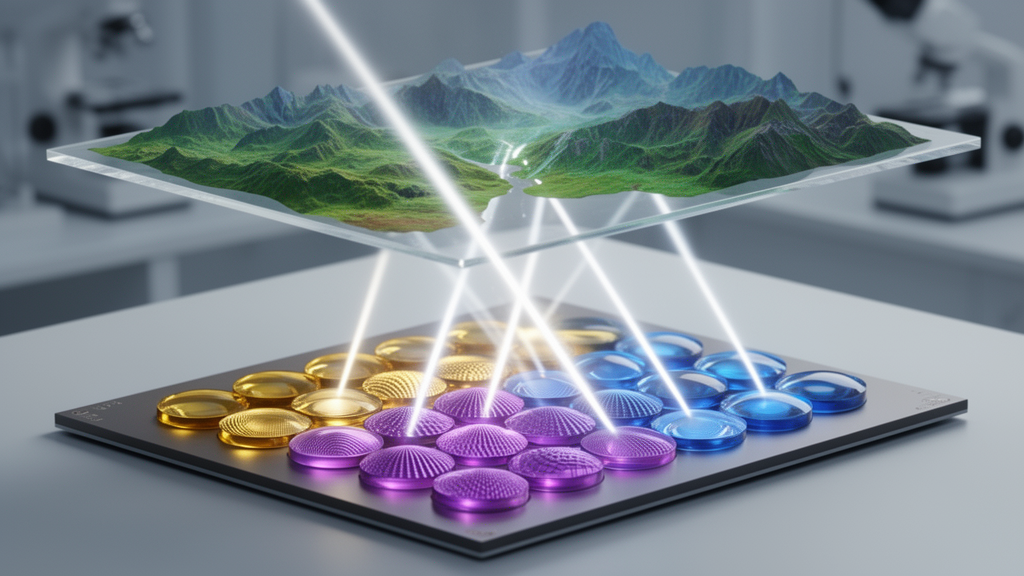
A heterogeneous metalens array has enabled a light-field near-eye display with a 50-degree field of view, approximately four times the 13-degree field of view reported for a conventional light-field display, according to a peer-reviewed study in Light: Science & Applications . Their real-time rendering algorithm operated at 140 frames per second on a laptop with integrated graphics. Near-eye displays based on binocular parallax can produce a conflict between the vergence and accommodation demands placed on the eyes, a condition known as vergence-accommodation conflict that can cause visual fatigue and dizziness.
Holographic and light-field displays can provide VAC-free 3D viewing, but their fields of view are intrinsically constrained by diffraction and aberrations. Conventional light-field near-eye displays also use microlens arrays that develop severe off-axis aberrations, causing image quality to deteriorate rapidly as the field of view increases. Correcting those aberrations with multiple lens groups or freeform surfaces is generally impractical under the volume constraints of near-eye devices, while the fabrication limits of microlens arrays further restrict such solutions.
The new architecture departs from the conventional homogeneous microlens array, in which every lens unit has the same structure even though the units perform different imaging tasks. The researchers instead customized each sub-lens for its assigned field-of-view region. Every unit combines a focusing phase, equivalent to a convex lens, with a deflection phase, equivalent to a prism that redirects light.
This approach divides a complex off-axis imaging problem into two simpler operations: near-axis imaging and linear deflection. Because each field angle is matched with a corresponding customized lens, the array maintained imaging quality close to the diffraction limit across the demonstrated field of view. The design also supports a wide field of view on one lightweight optical element without introducing the depth conflict associated with binocular-parallax displays.
To make the heterogeneous array into a practical display module, the team combined a low-cost, large-area nanoimprint process with a high-refractive-index resist. The process produced centimeter-scale metalens arrays with a 7:1 aspect ratio, which the researchers described as reducing the barrier to mass production. The custom array also broke the linear geometric projection relationship assumed by conventional light-field rendering.
The team therefore developed a dedicated distortion-correction algorithm based on a nonlinear voxel-to-pixel mapping look-up table. During preprocessing, the algorithm corrected display distortion introduced by the heterogeneous elements and achieved the reported 140-frame-per-second rendering rate on a standard laptop with integrated graphics. The see-through prototype produced 3D content with physically accurate focus and defocus behavior, supporting reconstruction from 10 cm to 70 cm.
Its 50-degree field of view was experimentally demonstrated, compared with the 13-degree field of view of conventional light-field displays described in the study. The researchers also presented a see-through architecture intended to retain natural monocular 3D depth cues and thereby alleviate visual fatigue, although the supplied report does not provide a quantitative fatigue assessment or a comparison with users wearing the device. An extension to an 86-degree field of view was demonstrated only in simulation and would require a larger microdisplay.
The authors described that simulated limit as covering the approximately 80-degree extent of human stereoscopic vision, but it remains a projection rather than an experimental result. The findings identify heterogeneous metalens arrays as a hardware approach for wide-field-of-view light-field near-eye displays, with potential relevance to immersive extended-reality devices.
Subject of Research: Heterogeneous metalens arrays for wide-field-of-view light-field near-eye 3D displays
Article Title: Heterogeneous metalens array unlocks immersive XR displays
Article References: Heterogeneous metalens array unlocks immersive XR displays. Original publication (Bibliographic details unavailable.)
Image Credits: AI Generated
DOI: Not provided
Keywords: heterogeneous metalens, light-field display, near-eye display, extended reality, metasurface optics, nanoimprint fabrication, stereoscopic 3D, field of view, diffraction limit, real-time rendering, Heterogeneous, metalens
News Source: Bethany Barker. (October 26, 2026). Heterogeneous metalens array widens light-field XR displays. Scienmag.