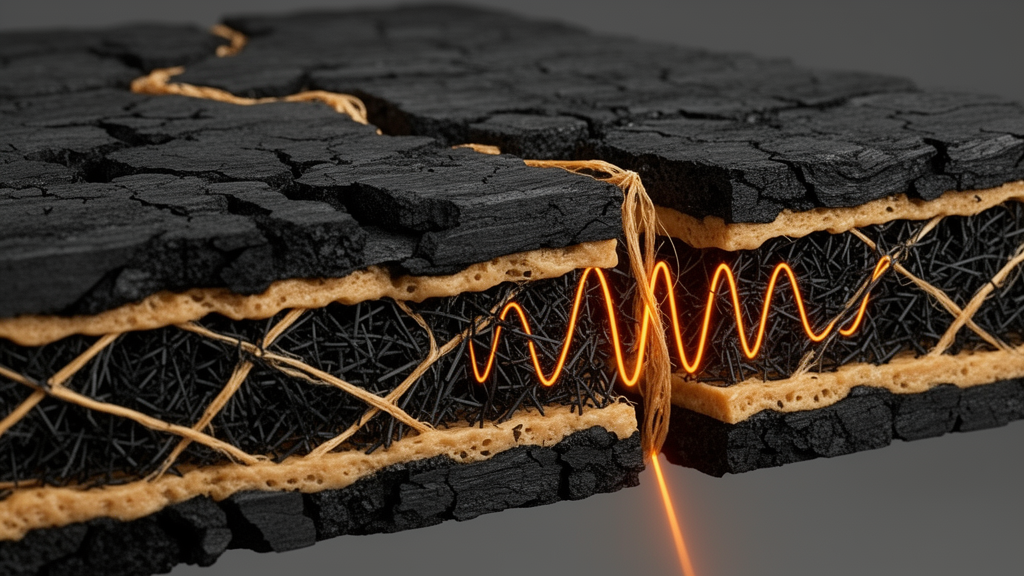
A laboratory composite made from bamboo-derived biochar and layered polymers achieved an average electromagnetic interference shielding effectiveness of 36.7 dB across the X-band frequency range, with 84% of the shielding contribution coming from absorption rather than reflection. The material also had a fracture toughness of 2.68 MJ m⁻³, 173% higher than that of a conventional PLA/PBAT blend. These results were reported in a peer-reviewed experimental study in Sustainable Carbon Materials by a team affiliated with Shenyang Agricultural University and collaborating institutions.
The researchers combined three processing elements to produce the multifunctional composite. First, they made biochar from bamboo and exposed it to flash Joule heating, an ultrafast treatment that briefly raised its temperature to approximately 3,000 K. The treatment restructured the carbon framework and improved the biochar’s conductive properties. Second, they modified the heated biochar with APTES, a silane coupling agent used to improve its compatibility with the surrounding polymer matrix.
Third, rather than mixing the conductive biochar uniformly throughout the polymer, they placed it between alternating layers of polylactic acid, or PLA, and polybutylene adipate-co-terephthalate, or PBAT. The resulting layer-by-layer structure formed continuous conductive regions while introducing interfaces that redirected cracks and redistributed mechanical stress. The optimized material combined improved electromagnetic shielding with substantial gains in mechanical performance.
Its tensile strength increased from 14.1 MPa in the conventional PLA/PBAT blend to 25.5 MPa, an improvement of about 81%. Elongation at break more than doubled, rising from 11.5% to 24.7%, while toughness increased from 0.98 to 2.68 MJ m⁻³. Microscopic observations showed that the layered architecture made cracks follow more complex paths, allowing the composite to dissipate more energy before failure.
The composite’s electrical conductivity reached 12.8 S cm⁻¹. For comparison, a conventionally prepared composite containing the same amount of modified biochar achieved an electromagnetic interference shielding effectiveness of only 7.5 dB, demonstrating the measured advantage of the layered design over uniform mixing in this experimental comparison. The composite also demonstrated electrothermal behavior.
It reached approximately 58 °C at an applied voltage of 9 V and maintained consistent performance through repeated heating and cooling cycles. These findings characterize the tested laboratory formulation under the reported conditions; the study did not test the material in a finished electronic device or establish its behavior in an applied field setting. The research nevertheless shows that arranging modified biochar in a deliberately layered polymer structure can provide conductive pathways for electromagnetic absorption while improving toughness, tensile strength and extensibility.
The authors identified potential applications in electromagnetic protection, smart electronics and thermal management, but the reported evidence is experimental and material-focused rather than a demonstration of those applications.
Subject of Research: Experimental development of a bamboo-biochar polymer composite for electromagnetic interference shielding, mechanical toughening and electrothermal heating
Article Title: Flash heating and layered design create tougher, greener materials that block electromagnetic interference
Article References: Flash heating and layered design create tougher, greener materials that block electromagnetic interference. Original publication (Bibliographic details unavailable.)
Image Credits: AI Generated
DOI: Not provided
Keywords: bamboo biochar, electromagnetic interference shielding, flash Joule heating, layered polymer composite, electromagnetic absorption, mechanical toughening, conductive materials, electrothermal heating, PLA, PBAT, sustainable materials, Flash
News Source: Bethany Barker. (October 26, 2026). Flash-heated bamboo biochar produces tougher, absorption-dominant shielding composite. Scienmag.