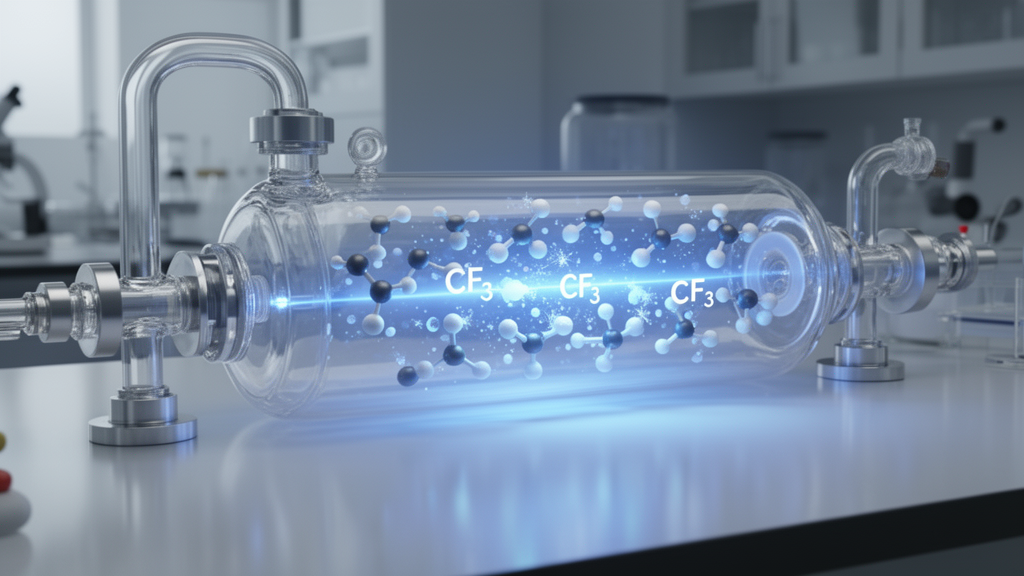
Researchers at Hokkaido University have developed a light-driven laboratory method for converting fluoroform, an industrial byproduct and potent greenhouse gas, directly into reactive trifluoromethyl radicals, or CF₃ radicals. The process uses light energy, a ketone catalyst and a base under relatively mild conditions, and the researchers reported the peer-reviewed findings in the Journal of the American Chemical Society. By pairing computational chemistry with experiments, the team identified a pathway that activates fluoroform despite its strong carbon–hydrogen bond, allowing the resulting radicals to add trifluoromethyl groups to a range of molecular structures.
Trifluoromethyl groups are widely used in pharmaceuticals because they can improve the metabolic stability and membrane permeability of organic molecules. One way to introduce them involves highly reactive CF₃ radicals. The study notes that many existing approaches to generating these radicals rely on expensive, corrosive or potentially explosive reagents and can produce unwanted waste. Fluoroform, by contrast, is inexpensive and readily available, with relatively low toxicity to humans, but its chemical stability has limited its use as a direct radical source. It is also produced as a byproduct of Teflon manufacturing and has a global warming potential about 15,000 times that of carbon dioxide, giving its conversion into useful chemical building blocks an additional environmental rationale.
The researchers used the Artificial Force Induced Reaction method, a computational technique developed at Hokkaido University’s WPI-ICReDD, to search for an alternative activation pathway. Their calculations suggested that a thioxanthone-derived alkoxide intermediate could release a CF₃ radical when excited by light. Experiments subsequently supported this prediction. “Fluoroform is an attractive source of trifluoromethyl groups, but its chemical stability has made it difficult to use directly as a radical source,” said Kosaku Tanaka III, a co-author of the study. “By combining computational chemistry with experiments, we found a new way to activate it using light.” The work is a laboratory chemical-synthesis study rather than an investigation of medicines or clinical outcomes.
The researchers successfully used the method to introduce CF₃ groups into a broad range of substrates, including alkenes, alkynes and aromatic compounds. They also incorporated the group into complex bioactive molecules and their derivatives, demonstrating the method’s applicability to late-stage modification of compounds relevant to drug discovery. In another demonstration, the team reacted fluoroform with inexpensive methyl methacrylate to produce a higher-value compound used as an intermediate in pharmaceutical synthesis. This reaction achieved a yield of about 65 percent, and nearly all of the ketone catalyst could be recovered for reuse. Together, the experiments show that the light-assisted method can generate CF₃ radicals and couple them with several classes of molecules under the tested laboratory conditions.
Overall, the study presents a computationally guided, experimentally validated route for using fluoroform as a feedstock for radical trifluoromethylation. Its principal achievement is the activation of a chemically stable gas with light under relatively mild conditions, rather than the conventional use of costly or hazardous radical-generating reagents. The reported substrate scope, late-stage functionalization examples and pharmaceutical-synthesis demonstration establish the method’s versatility as a laboratory reaction. The researchers also identify the broader potential to provide new routes to fluorinated pharmaceuticals and functional materials while turning an underused industrial byproduct into a chemical resource.
Subject of Research: Light-driven conversion of fluoroform into CF₃ radicals for fluorinated chemical synthesis
Article Title: Turning a potent greenhouse gas into a valuable pharmaceutical building block using light
Article References: Turning a potent greenhouse gas into a valuable pharmaceutical building block using light. Original publication (Bibliographic details unavailable.)
Image Credits: AI Generated
DOI: Not provided
Keywords: fluoroform, trifluoromethylation, CF₃ radicals, photocatalysis, greenhouse gas, chemical synthesis, pharmaceutical intermediates, late-stage functionalization, Hokkaido University, Turning, potent, greenhouse
News Source: Bethany Barker. (October 26, 2026). Laboratory Study Converts Fluoroform into Trifluoromethyl Radicals with Light. Scienmag.