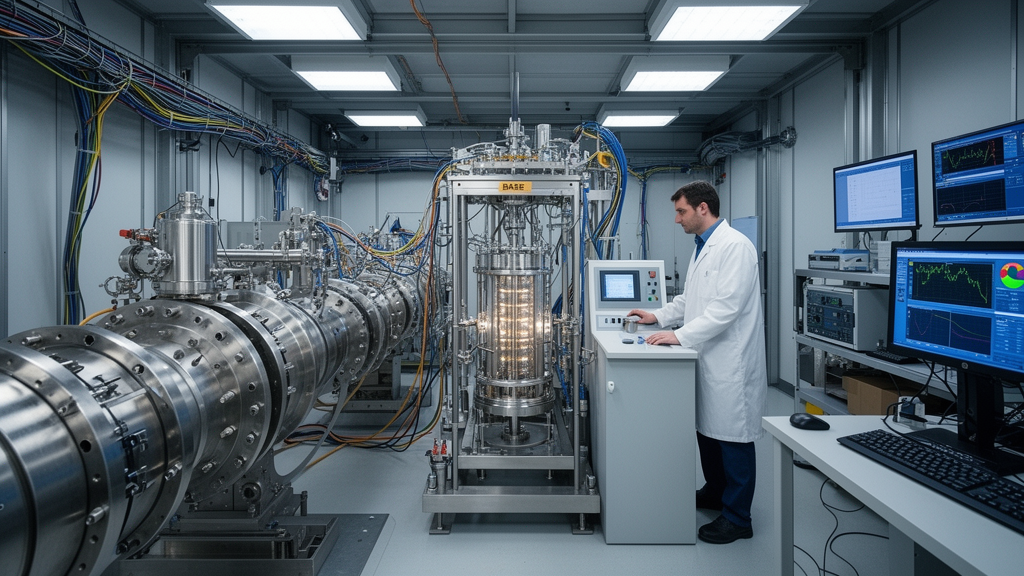
In a peer-reviewed experiment published in Nature on 16 September 2026, scientists transported 92 trapped antiprotons by road for the first time and then kept the particles under controlled observation for more than a month. The BASE collaboration loaded the particles into its purpose-built, mobile BASE-STEP Penning trap at CERN’s Antimatter Factory in Geneva, placed the apparatus on a truck and drove it around the CERN site for approximately 30 minutes over about eight kilometres. The team unloaded the trap without losing any of the stored antiprotons and continued to store and manipulate them after the journey.
The experiment also maintained an ultra-high vacuum of better than 2.2 × 10^-18 mbar throughout the storage period, substantially exceeding the collaboration’s design target of 1 × 10^-16 mbar. This was a transport and storage demonstration, not a new measurement showing that protons and antiprotons differ. The experiment was conducted by the BASE collaboration at the European Organisation for Nuclear Research, or CERN, under the leadership of Professor Stefan Ulmer and Dr Christian Smorra of Heinrich Heine University Düsseldorf.
BASE-STEP is an open, transportable Penning trap based at the Antimatter Factory, which the source describes as the only facility in the world where low-energy antiprotons can be produced, stored and studied. The same trap had previously carried a proton by road in October 2024, a result reported in Nature in May 2025. The March 2026 operation extended that demonstration to antiprotons, combining mobile confinement with long-term storage in an apparatus designed to accept particles by injection and permit their later extraction.
The reported journey remained within CERN, however, and was not a completed transfer between cities or countries. Comparisons of their fundamental properties, including mass and magnetic moment, are intended to search for differences between matter and antimatter. The team has previously measured the intrinsic magnetic moment of protons with an accuracy of 0.3 parts per billion and that of antiprotons with an accuracy of 1.6 parts per billion.
Within the accuracy achieved in those measurements, no difference has been identified. Smorra said that operation of the Antimatter Factory causes magnetic-field fluctuations that affect the measuring equipment, preventing the collaboration from improving the measurements further at that facility. The mobile BASE-STEP trap was therefore conceived as a way to move antiprotons to an external high-precision laboratory, with the team aiming for at least a 100-fold improvement in comparison precision.
For the antiproton trial, the researchers extracted 92 particles from the Antimatter Factory and stored them in BASE-STEP. The trap was then loaded onto a truck and driven around the CERN site for approximately half an hour, covering a distance of about eight kilometres. The team subsequently unloaded it again without losing any of the stored antiprotons.
After transport, the researchers continued monitoring the particles and were able to store and manipulate them in a controlled manner for more than one month in total. On day 27, one antiproton annihilated during a particle-extraction test, according to the source’s description of the experiment. The road journey itself caused no loss, and the remaining particles stayed safely stored after the transport.
These details distinguish the short journey from the subsequent longer storage phase: the transport was completed without a particle loss, while the single annihilation occurred later during deliberate extraction testing. The exceptional vacuum was central to the long-term result. The BASE-STEP system achieved a pressure of better than 2.2 × 10^-18 mbar throughout the storage period, a figure substantially better than the collaboration’s own design target of 1 × 10^-16 mbar.
Marcel Leonhardt, the doctoral researcher in physics at Heinrich Heine University Düsseldorf and lead author of the study, highlighted the vacuum as a particularly important achievement. The result shows that an open trap into which antiprotons can be injected and from which they can later be extracted can maintain a sufficiently isolated environment for controlled storage. It does not mean that the particles were immune to every loss mechanism: the source records the annihilation of one antiproton during the extraction test.
The transport milestone is intended to support a broader program of more sensitive proton–antiproton comparisons at the high-precision laboratory being established at Heinrich Heine University Düsseldorf by Ulmer’s team. The transport experiment did not itself perform the proposed precision measurements or report a new asymmetry between particles. Moving the trap away from the operational conditions at the Antimatter Factory is the first stage of that program; the antiprotons still have to be transferred into a high-precision laboratory and measured with protons under carefully matched conditions.
A gain of at least 100-fold in precision would allow the researchers to search for differences that previous measurements could not resolve, subject to the accuracy ultimately achieved. The present study instead establishes the physical capability required to move and preserve the particles between production and measurement. Longer-distance transport is the next objective rather than a feature of the completed trial.
Smorra described the March operation as a successful dress rehearsal that demonstrated the idea of using the mobile trap to transport antiprotons. He said the next target is to make the apparatus sufficiently autonomous to support a 10-hour journey from Geneva to Düsseldorf. Such a trip would go beyond the approximately eight-kilometre route around CERN and link the production facility with the planned precision laboratory.
The earlier proton transport and the March 2026 antiproton operation indicate that BASE-STEP can operate with different particles, but the reported experiment did not include the full Geneva-to-Düsseldorf journey. Nor did it include the subsequent high-precision comparison measurements that the team hopes will benefit from operating outside CERN. Ulmer framed the work as part of an attempt to answer one of physics’ most fundamental questions: why does a universe filled with matter exist?
If protons and antiprotons possess even a minute asymmetry, it could point toward the origin of a small excess of matter following the Big Bang, when matter and antimatter could have been produced in nearly equal amounts and much of the antimatter subsequently annihilated. That remains a scientific objective, not a demonstrated explanation. Existing BASE measurements have not found a difference within their achievable accuracy, and successful transport does not itself reveal one.
The significance of the new result lies instead in expanding the experimental conditions available for a future search, by making it possible to carry antiprotons in a high-vacuum trap from their production facility to a potentially quieter measurement laboratory. The transportable trap was developed within the STEP project of the BASE collaboration, which is funded by the European Research Council and headed by Smorra. BASE was established in 2012 and is based at CERN’s Antimatter Factory, with participating institutions in Germany, Japan, the United Kingdom and Switzerland.
The study, “Road Transport of Trapped Antiprotons,” therefore documents a technical advance in experimental antimatter handling rather than a new finding about the fundamental properties of matter. Its demonstrated result is specific but consequential: the BASE team moved 92 antiprotons on a truck without loss, maintained an ultra-high vacuum of better than 2.2 × 10^-18 mbar, and kept the particles under controlled observation for more than a month. By providing a practical bridge between the Antimatter Factory and an external precision laboratory, the experiment sets the stage for a more sensitive search for possible differences between protons and antiprotons, while leaving that search for subsequent measurements to determine.
Subject of Research: First road transport and month-long storage of trapped antiprotons in the mobile BASE-STEP Penning trap.
Article Title: Antiproton storage and transport records achieved
Article References: Antiproton storage and transport records achieved. Original publication (Bibliographic details unavailable.)
Image Credits: AI Generated
DOI: Not provided
Keywords: antiproton transport, antimatter storage, BASE collaboration, BASE-STEP, Penning trap, CERN, ultra-high vacuum, precision measurement, matter–antimatter symmetry, Antiproton, storage, transport
News Source: Bethany Barker. (October 26, 2026). BASE study demonstrates antiproton road transport and month-long storage. Scienmag.