Colorectal cancer remains one of the world’s most formidable malignancies, ranking as the third most common cancer worldwide and the second leading cause of cancer-related death. For decades, oncologists have attacked tumors by starving them of blood through antiangiogenic drugs that target endothelial cells, the lining of conventional blood vessels. Yet a growing body of research points to a troubling escape route: some tumor cells can construct their own vascular-like channels, a phenomenon known as vasculogenic mimicry, which sidesteps endothelial cells entirely and helps explain why antiangiogenic therapies so often lose their effectiveness.
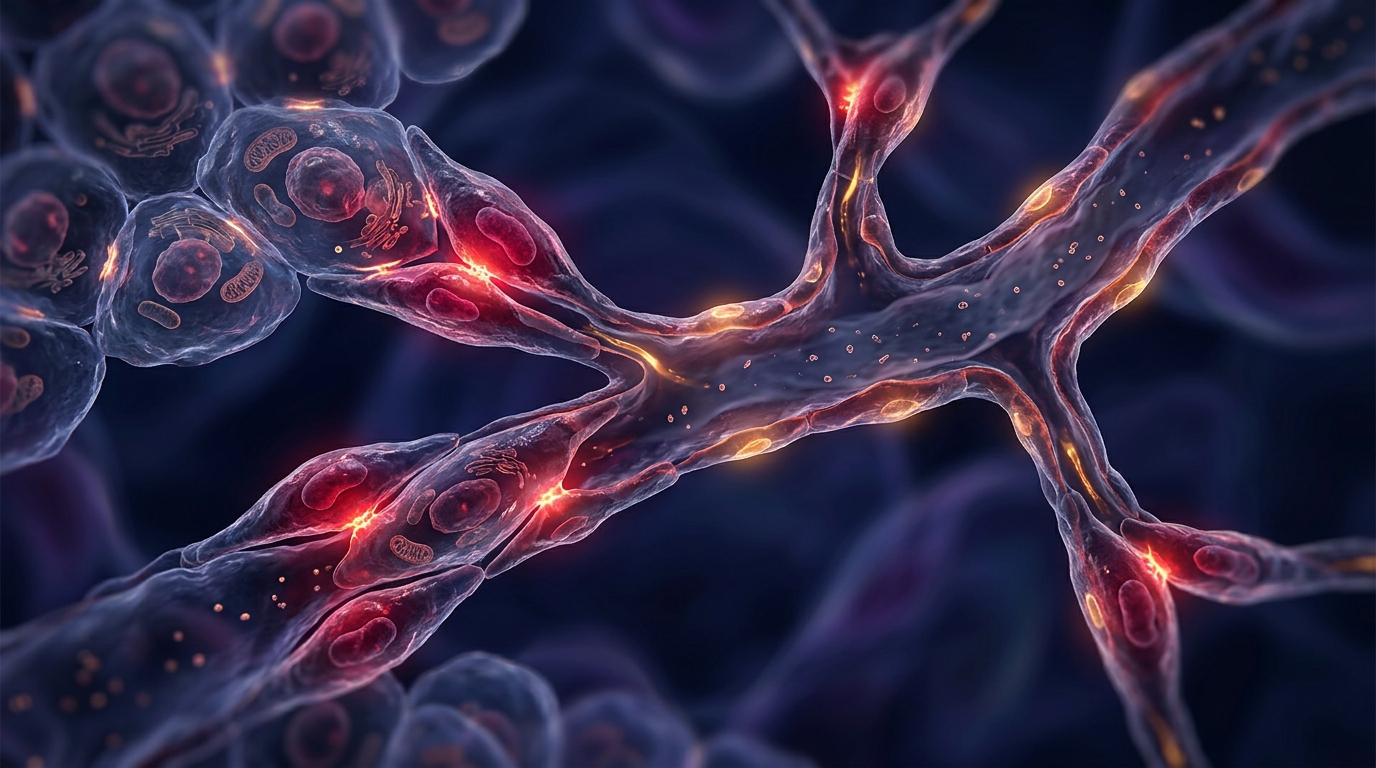
A comprehensive review published in the journal Cell Division now consolidates what is known about vasculogenic mimicry in colorectal cancer, from its molecular underpinnings to the experimental drugs that might block it. The authors, Jian Zewei and Zhao Haiyan, describe vasculogenic mimicry as a tumor blood supply mechanism distinct from traditional endothelial-dependent vasculature. In this arrangement, channels are composed solely of tumor cells and extracellular basement membranes, with no endothelial lining. The channels emerge within malignant tumors that require blood perfusion and have been identified in numerous solid tumors, including glioblastoma, gallbladder cancer, breast cancer, and lung cancer, particularly among highly aggressive malignancies.
The biological signature of these channels is distinctive. Unlike genuine blood vessels, which stain positive for both the endothelial markers CD31 or CD34 and Periodic Acid-Schiff, vasculogenic mimicry channels are negative for CD31 and CD34 staining but positive for PAS staining. The concept was first described by Maniotis and colleagues in 1999, when tumor cells in a remodeled extracellular matrix were observed morphing into vascular-like tubular structures surrounded by basement membranes of variable thickness. The transformed cells, generated through the differentiation of cancer stem cells into vasculogenic endothelial-like cells, fail to express the characteristic surface markers of genuine endothelial cells. Vascular endothelial growth factor receptor 2 and vascular endothelial cadherin are recognized as molecular markers of the phenomenon.
Clinically, the stakes are high. Research indicates that tumors exhibiting vasculogenic mimicry demonstrate greater proliferative, invasive, and metastatic potential, along with poorer prognosis, than those without it. In colorectal cancer specifically, patients with vasculogenic mimicry have a poorer prognosis than those without, indicating a more aggressive and treatment-resistant form of the disease. The channels themselves are unstable, prone to shedding tumor cells into the bloodstream and facilitating distant metastasis, while the surrounding connective tissue degradation further promotes spread. As tumor volume increases, the microcirculation pattern transitions from vasculogenic mimicry to mosaic vessels and finally endothelial-dependent vessels, with tumor cells in the walls of mimicry vessels progressively replaced by endothelial cells.
The review identifies four interlocking mechanisms that drive channel formation in colorectal cancer. The first is epithelial mesenchymal transition, a process in which epithelial cells characterized by polarity and intercellular adhesion transform into mesenchymal cells with enhanced invasive and migratory capabilities. Some researchers prefer the term epithelium-to-endothelium transition, which shares identical key molecular regulators with epithelial mesenchymal transition, as a more accurate description of the biological changes promoting vasculogenic mimicry. Transcription factors involved in this transition, including Twist, Snail, Slug, and ZEB1, can regulate channel formation. Twist1 reduces E-cadherin expression while increasing VE-cadherin, and knockdown of Twist1 suppresses VEGFR2, which is overexpressed in vasculogenic mimicry. ZEB1 regulates VE-cadherin expression, and ZEB2 overexpression is also associated with channel occurrence.
In colorectal cancer specifically, the evidence for epithelial mesenchymal transition’s role is concrete. Qi discovered that Wnt3a regulates vasculogenic mimicry formation through the Wnt/β-catenin/VEGFR2 pathway, while Liu reported that ZEB1 can promote channel formation by inducing epithelial mesenchymal transition. The Wnt pathway affects the epithelium-to-endothelium transition, with Wnt3a enhancing VEGFR2 and VE-cadherin expression through Wnt/β-catenin signaling activation. The Notch pathway regulates the transition by influencing Snail expression, and Nodal, another key molecule in the TGF-β superfamily, upregulates Slug through the Smad2/3 pathway while Snail and c-Myc induce the transition, thereby promoting channel formation.
The second mechanism involves cancer stem cells. The American Cancer Society defines these as a small fraction of tumor cells possessing the ability for self-renewal and the potential for multiple types of differentiation. Not all tumor cells can form vascular channels; only a small subset of stem-like tumor cells are crucial for the process. Under specific microenvironmental conditions, these cells can acquire and express certain protein phenotypes of vascular endothelial cells, differentiating into endothelial-like cells that participate in channel formation. Markers including CD133, CD44, aldehyde dehydrogenase, and STAT3 are involved in the process across different cancer types. In colorectal cancer, ALDH1 expression is positively correlated with vasculogenic mimicry, SOX2 may further promote channel formation by promoting the stemness of cancer cells, and stem cells of adipose origin can promote the phenomenon through Cyr61. Both the TGF-β pathway and the p38 pathway of JNK signaling can regulate the transformation of mesenchymal stem cells into endothelial-like cells in colorectal cancer, and phosphorylation of STAT3 promotes channel formation.
Extracellular matrix remodeling constitutes the third mechanism. The extracellular matrix functions as a structural scaffold for cells and tissues, and when exposed to specific stimuli it undergoes changes in biological properties and mechanical characteristics. In solid tumors including colorectal cancer, this remodeling is a common feature, enabling tumor invasion and distant metastasis. Matrix metalloproteinases are crucial for proteolytic degradation of the matrix, and MMP2, MMP9, and MMP14 are involved primarily in regulating vasculogenic mimicry. In the early stages of channel formation, MMPs alter the structure of the matrix, releasing growth factors and signaling molecules such as TGF-β, fibroblast growth factor-2, and VEGF-A that are essential for the process. MMP-14 activates pro-MMP-2, and the activated MMP-2 then cleaves the laminin-5 γ-2 chain, ultimately promoting channel formation in what is recognized as the classical pathway for channel development. Liu demonstrated that EphA2 and VEGFA promote vascular mimicry in colorectal cancer through the PI3K/AKT/mTOR and ERK1/2 signaling pathways, and MMP2 is positively correlated with the phenomenon in colorectal cancer.
The fourth mechanism is the hypoxic microenvironment. Most solid tumors possess hypoxic regions, especially rapidly growing malignant masses, and tumor cells activate various signaling pathways to adapt. Hypoxia-inducible factor-1α is a pivotal transcriptional regulator mediating these adaptive responses, playing critical roles in energy metabolism, angiogenesis, proliferation, apoptosis, invasion, metastasis, and drug resistance. HIF-1α can directly induce the release of VEGFA and promote channel formation, and in hypoxic environments the stemness of cancer stem cells can be activated or enhanced, with the Notch signaling pathway essential for maintaining that stemness. Matrix metalloproteinases are directly regulated by HIF-1, with MMP-2, MMP-9, and MMP-14 as target genes. Hypoxia also downregulates E-cadherin, upregulates Smad, Twist, Snail, ZEB1, and ZEB2, and modulates the Wnt/β-catenin pathway to promote epithelial mesenchymal transition. In a study comparing 50 cases of colorectal cancer with 50 cases of colorectal adenoma, Wu found that vascular mimicry is present in colorectal cancer tissues under severe hypoxia. Zhang detected PRDX2 and the channel-related factors VEGFR2, MMP-2, and LN-5γ2 in 70 cases of colorectal cancer tissues and adjacent normal tissues, demonstrating that PRDX2 may promote channel formation by activating the ERK1/2 pathway.
On the therapeutic front, the review catalogs experimental agents that target these mechanisms. Traditional antiangiogenic therapies reduce intratumoral vascular density but concurrently exacerbate ischemia and hypoxia within the tumor, stimulating factors such as TGF, angiopoietin-2, and matrix metalloproteinases that promote compensatory vascular networks including vasculogenic mimicry. Xianglin reported that sTie2 inhibited the proliferation, migration, and invasion of colorectal cancer cells by suppressing the phenomenon and was anticipated to inhibit both angiogenesis and channel formation. Tao demonstrated through in vitro experiments that coix seed oil inhibited the ability of HCT116 cells to undergo angiogenic mimicry, possibly through downregulation of Mig-7 protein expression. Wang verified that batching can reverse the hypoxic microenvironment of tumors, downregulate HIF-1α, VEGF, MMP2, and VE-cadherin, and inhibit vasculogenic mimicry in vivo and in vitro. Hou proposed that a traditional Chinese herbal formula affects channel formation by regulating HIF-1α and epithelial mesenchymal transition, while Du suggested that sennoside may inhibit channel formation by downregulating Cldn9 and inhibiting the EMT process and the MAPK signaling pathway. Zong reported that an Astragalus and Atractylodes mixture effectively inhibits migration and channel formation by suppressing the ROS/HIF-1α/MMP2 pathways, and Zeng discovered that wu zhu yu can inhibit MMP2 and MMP9 expression, reducing channel formation in HCT116 cells. The review also highlights focal adhesion kinase and HIF-2α as molecules of interest, noting that while no definitive evidence proves FAK enhances channel formation in colorectal cancer, indirect evidence suggests it may, and that HIF-2α, which promotes channel formation in melanoma and pancreatic carcinoma, remains unstudied in colorectal cancer despite its potential. No definitive targets or direct pathways have yet been identified to specifically inhibit the phenomenon in colorectal cancer, but the authors argue that combining VM-targeted strategies with conventional antiangiogenic therapies may represent a promising new direction, creating a dual-pronged treatment strategy against tumor microcirculation.
Subject of Research: Vasculogenic mimicry mechanisms and therapeutic targets in colorectal cancer
Article Title: Research progress on vasculogenic mimicry in colorectal cancer: mechanisms and therapeutic
Article References: Zewei, J., & Haiyan, Z. (2026). Research progress on vasculogenic mimicry in colorectal cancer: mechanisms and therapeutic. Cell Division, 21(1), Article 5. https://doi.org/10.1186/s13008-025-00171-z
Image Credits: AI Generated
DOI: 10.1186/s13008-025-00171-z
Keywords: colorectal cancer, vasculogenic mimicry, antiangiogenic therapy, epithelial mesenchymal transition, cancer stem cells, extracellular matrix remodeling, hypoxia, HIF-1α, matrix metalloproteinases, tumor blood supply, drug resistance, VEGFR2
News Source: Nathaniel Bowman. (November 4, 2026). Tumor Cells Build Their Own Blood Vessels in Colorectal Cancer, Review Finds. Scienmag.