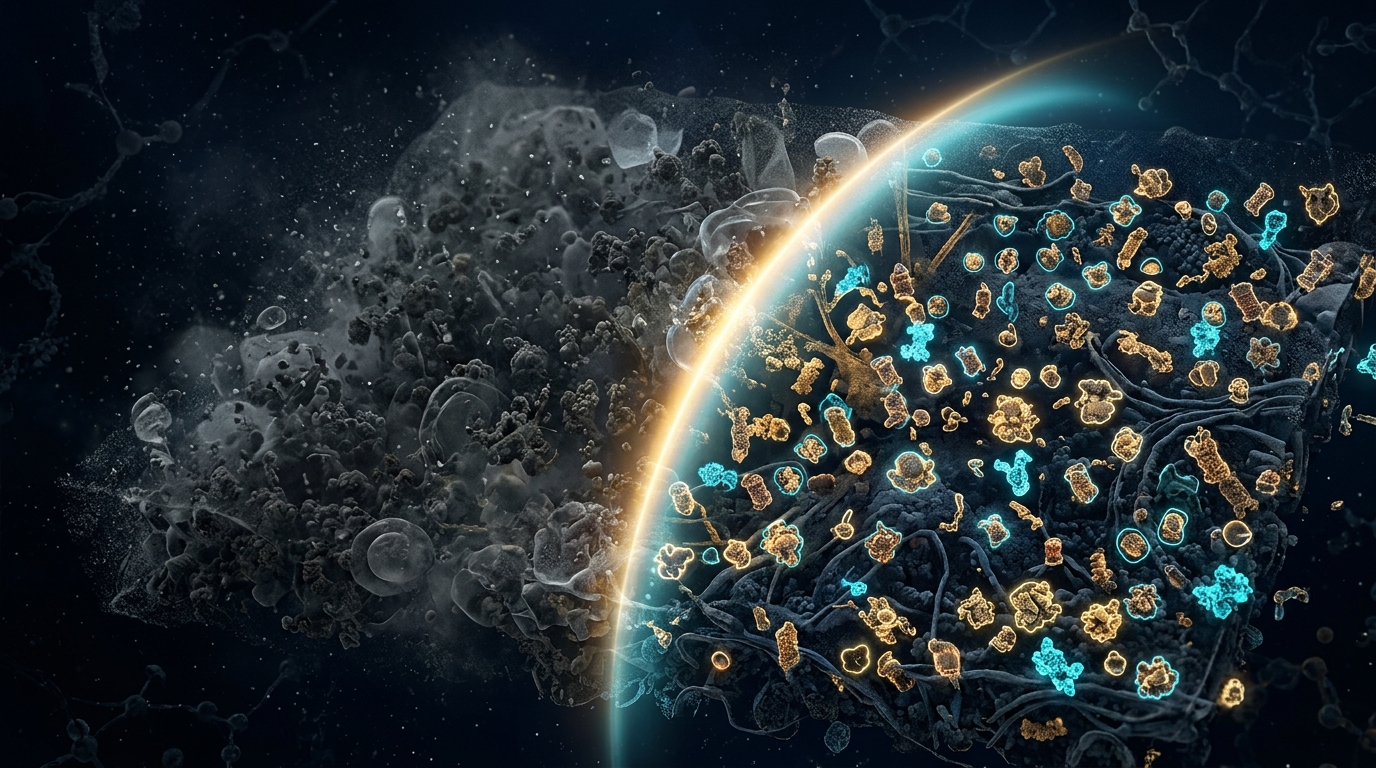
RobPicker, a meta-learning framework for identifying macromolecules in cryo-electron tomograms, addresses two persistent weaknesses in deep learning-based particle picking: annotation noise in training data and imbalanced distributions of macromolecule species. The method automatically learns to correct label errors and places greater emphasis on smaller and rarer macromolecule species, according to the study published in Nature Methods.
Accurate particle picking of macromolecules of diverse types, shapes and sizes in cryo-electron tomography is critical for understanding the molecular architecture of biological systems in their native state. Current deep learning methods have shown potential for identifying macromolecules in tomograms, but they remain vulnerable to annotation noise and to imbalanced species distributions, limitations that RobPicker was designed to mitigate.
The framework combines bi-level optimization with distribution reweighting and label correction to enable robust macromolecule segmentation. In evaluations across diverse cryo-ET datasets with noisy labels and imbalanced species distributions, RobPicker substantially outperforms state-of-the-art methods, particularly in identifying small and rare macromolecules.
The robustness and efficiency of RobPicker led to improved resolution in 3D density maps of protein structures, enabling high-resolution cellular structural biology analysis. Subtomogram averaging using RobPicker’s picks was compared with ground-truth annotations and with picks from PyTom, demonstrating the quality of the particles selected by the framework.
Benchmarking extended across multiple independent datasets. RobPicker improved particle picking on the CZII benchmark and showed high accuracy and strong cross-organism generalizability. It also outperformed DeepFinder on the SHREC 2019 dataset, providing further evidence of its performance against established approaches.
The work involved researchers from multiple institutions, including contributions from groups associated with cryo-electron tomography and machine learning, and was published in Nature Methods in 2026. The study positions RobPicker as a practical tool for cellular structural biology, where identifying small and rare macromolecules in crowded cellular environments has been a limiting step for high-resolution analysis.
Subject of Research: A meta-learning framework for robust macromolecule identification in cryo-electron tomography
Article Title: RobPicker: a meta-learning framework for robust identification of macromolecules in cryo-electron tomograms
Article References: Liang, Y., Hosseini, R., Rahmani, H., Singh, D., Zhang, R., Zhang, L., Guo, H., Choe, S., Lee, J., Xu, M., Segal, E., Zou, J., Williamson, J., Villa, E., Grotjahn, D. A., & Xie, P. (2026). RobPicker: a meta-learning framework for robust identification of macromolecules in cryo-electron tomograms. Nature Methods. https://doi.org/10.1038/s41592-026-03250-3
Image Credits: AI Generated
DOI: 10.1038/s41592-026-03250-3
Keywords: cryo-electron tomography, particle picking, meta-learning, noisy labels, species imbalance, macromolecules, subtomogram averaging, structural biology, deep learning, RobPicker, framework, robust
News Source: Blake Davidson. (November 4, 2026). RobPicker cleans noisy labels to spot small, rare macromolecules in cryo-ET. Scienmag.