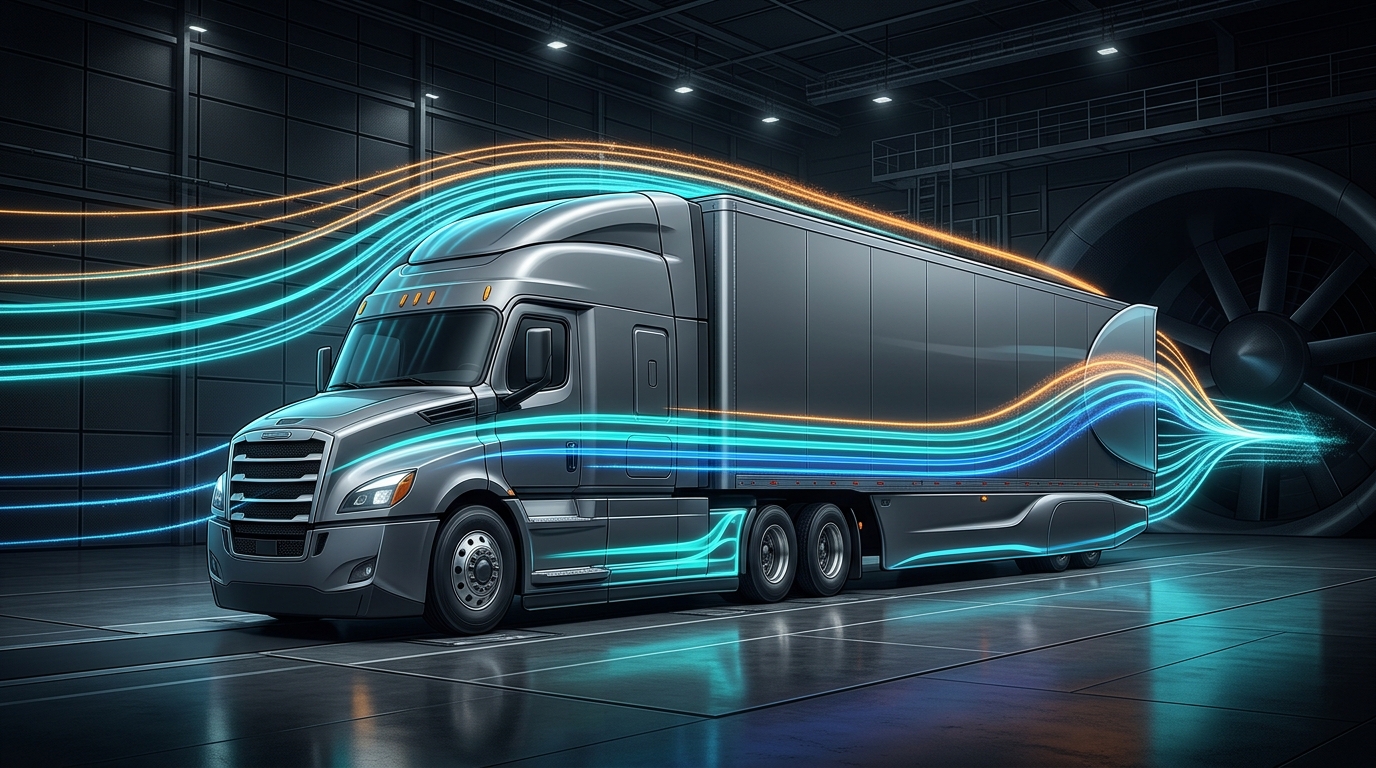
Aerodynamic drag is one of the biggest energy drains on a heavy-duty truck, and a new systematic review of 25 years of research concludes that stacking several drag-cutting devices together can slash aerodynamic drag by as much as 45% and deliver fuel savings of up to 8%. The review, published in European Transport Research Review, pulls together 347 studies published between January 2000 and January 2025 to map what actually works on a freight truck, what has been tested only in simulations, and where the field is still falling short.
The analysis was carried out by David Moreno-Garcia, Juan-Ignacio Latorre-Biel, Alexia Torres-Salcedo and Jose-Ramon Alfaro-Lopez, who applied the PRISMA methodology for systematic reviews and used the screening software Rayyan to filter an initial haul of 5,438 articles down to the final set. Their search drew on the Web of Science and Scopus databases, restricted to English, German and Spanish publications, and covered research articles, reviews, books and book chapters while excluding patents and conference papers. The screening was performed independently by all the authors, with disagreements resolved through discussion inside the Rayyan tool.
The stakes are considerable. Heavy-duty vehicles account for around 29% of the energy consumption and 22% of the gas emissions of all vehicles operating on European roads, and the transport sector as a whole represents almost a quarter, 23.2%, of total greenhouse gas emissions in the EU-27. Within transport, heavy-duty vehicles and buses account for 21.3% of the sector’s carbon dioxide emissions, roughly 5% of the total. Aerodynamic losses represent around half of the total energy of a semi-trailer truck travelling at 100 km/h, which is why the review’s authors treat drag reduction as a direct lever on both fuel bills and emissions.
Not all drag is created equal. For a bluff body such as a road vehicle, pressure drag, the resistance created by the pressure difference between the front and rear surfaces as flow separates and a low-pressure wake forms behind the vehicle, accounts for about 90% of aerodynamic losses. Friction drag, generated by viscous forces in the thin boundary layer where air slides over the bodywork, makes up only the remaining 10%. That imbalance shows up starkly in the literature the reviewers screened: 260 articles addressed pressure drag optimisation while just 10 tackled friction drag, a proportion the authors read as a signal of friction drag’s smaller influence on total aerodynamic resistance.
On the pressure drag side, the review catalogues the familiar arsenal of add-on devices. Cab roof deflectors, side fairings, trailer-front fairings, tractor and trailer side skirts, boat tails and base flaps, gap splitters and vortex generators all appear in the screened studies, each with its own measured drag reduction values. Boat tails, the extensions fitted to the rear of a trailer to cover the wake region, show a nearly quadratic relationship between drag reduction and the ratio of device length to trailer width, with performance plateauing once that ratio exceeds 0.5. Side skirt performance, meanwhile, improves as the yaw angle, the angle of wind incidence, increases. The review notes that covering the wake region with fairings was found to be the easiest way to reduce drag, and that rear-end flow matters as much as the frontal side of the vehicle.
The best-performing pressure drag solutions in the compiled results were vertical splitter plates and an integrated passive package combining gap fairing, side skirts and boat tail, both achieving drag reductions over 25%. At the other end of the scale, dielectric barrier discharge plasma actuators and continuous blowing managed drag reductions of 10% or less. The authors attribute the strong showing of splitter plates and the integrated package to their action on near-wake structures. Vortex generators, while capable of smaller gains than some rivals, earn a mention for being economical and easy to install. Cooling drag, the extra resistance created by airflow entering the vehicle to cool the engine and thermal systems, can represent up to 8% of total drag in a heavy truck, and the literature describes countermeasures such as changing the cooling air outlet angle from 90 degrees to 45 degrees and placing the air inlet at ram pressure with the smallest possible inlet area.
Topology modification, which goes beyond surface shaping to redesign the body’s structure, features prominently through active flow control. Jets, whether continuous, pulsed, synthetic or delivered through fluidic oscillators, are characterised by their momentum coefficient and reduced frequency, and nozzle size, pattern and position still need further testing. Pulsed jets driven by micro-electromechanical systems proved more energy efficient than valve-based alternatives. The review also flags a caveat that applies to every active solution: most have not yet been comprehensively evaluated in terms of the energy they consume to operate, so the net balance between aerodynamic benefit and running cost remains an open question.
How the numbers are obtained matters as much as the numbers themselves. Across the full 2000 to 2024 window, wind tunnel studies outnumber computational fluid dynamics work, with 134 wind tunnel papers, 49.6% of the total, against 116 CFD studies, or 43.0%. But in the last five years the balance has flipped, with CFD accounting for 32 studies, 52.5%, compared with 27 wind tunnel papers, 44.3%. Discrepancies between the two methods have been explicitly evaluated in the literature and substantially reduced, yet wind tunnels remain the essential validation tool, with CFD generally used to sift through many design alternatives early and wind tunnel testing reserved for detailed validation of the most promising candidates. Full-scale on-road validation, typically through coast-down tests that determine the drag coefficient along with rolling and mechanical resistance, remains limited across the field, and the authors call for standardised test configurations, procedures, instrumentation and calculation methods to make studies comparable.
Two newer strands get their first systematic treatment here. Biomimetic approaches, adapting forms and surface textures from nature, show promise but sparse coverage: a bio-inspired truck cabin modelled on a rainbow trout achieved a drag reduction of up to 40.7% in one study, while shark-like groove patterns and other non-smooth surfaces drawn from bat pelage and pigeon feathers delivered friction resistance reductions of up to 11%. The authors note that no study on bio-inspired surfaces for road vehicles was published before 2011 despite extensive aeronautical work. Artificial intelligence appears even more rarely in the analysed bibliography, but the reviewed examples are instructive: one artificial neural network optimising five input parameters of an active side skirt achieved an 8.1% drag reduction, and another ANN exploring 64 rear shapes of a sedan found a maximum drag reduction of 5.6%. A shape mining framework for integrating heterogeneous design data has also been demonstrated on car aerodynamic parameters including drag and lift.
Electrification gives the whole field fresh urgency. Battery weight, initial vehicle costs, range anxiety and charging infrastructure still make electrifying heavy trucks challenging, and aerodynamic improvement is one of the few levers available to extend the limited driving range of electric HDVs. One reviewed economic study of electric semi-trucks detailed an inverse proportionality between aerodynamic efficiency and payback period, and a ducted rear-end model applied to an electric car cut the drag coefficient by 14.3% while extending range. The review also finds that aerodynamic add-ons deliver considerably more benefit on long-distance routes than in urban operation, in some cases more than twice the aerodynamic advantage, making them particularly suited to long-haul HDVs. Combined devices generally act additively, with cumulative drag reductions of up to 41% reported, though tractor-trailer interactions are complex and some pairings, such as front trailer devices coupled with fin devices, can reduce the overall benefit. Despite decades of proven gains, industrial implementation remains limited, held back by operational difficulties, low economic return and the complexity of fleet-wide integration, and the authors identify technology transfer, large-scale on-road validation, deeper biomimetic research, AI integration and electric-vehicle-specific aerodynamics as the priorities that could finally move these devices from the wind tunnel onto the road.
Subject of Research: Aerodynamic drag reduction technologies for heavy-duty freight trucks and their impact on energy efficiency
Article Title: Review of the state-of-the-art on aerodynamic solutions in freight transport trucks for improving energy efficiency
Article References: Moreno-Garcia, D., Latorre-Biel, J.-I., Torres-Salcedo, A., & Alfaro-Lopez, J.-R. (2026). Review of the state-of-the-art on aerodynamic solutions in freight transport trucks for improving energy efficiency. European Transport Research Review, 18(1), Article 104. https://doi.org/10.1186/s12544-026-00859-5
Image Credits: AI Generated
DOI: 10.1186/s12544-026-00859-5
Keywords: aerodynamics, heavy-duty vehicles, drag reduction, fuel efficiency, freight transport, CFD, wind tunnel testing, biomimetics, artificial intelligence, electric trucks, greenhouse gas emissions, systematic review
News Source: Denise Maddox. (November 4, 2026). Truck aerodynamics review finds combined drag-cutting devices can trim fuel use by up to 8%. Scienmag.