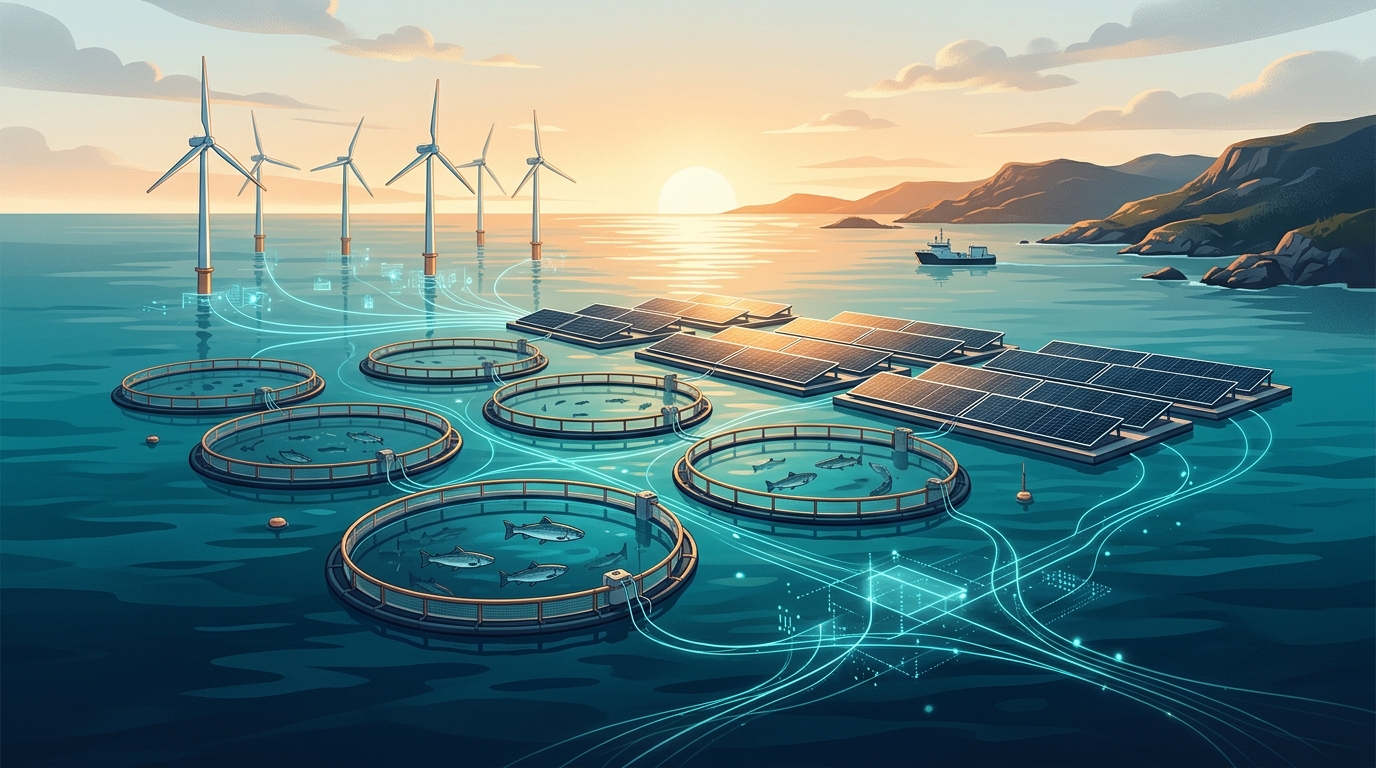
Aquaculture is expanding fast, but its farms still run largely on fossil fuels, and a new structured review argues that the water-energy-food nexus offers the clearest framework for changing that. The review, published in Energy Reports, pulls together renewable-energy technologies, modelling approaches and case studies to assess how solar, wind, wave and hybrid systems could decarbonise fish and shellfish production while keeping water and food demands in balance.
The authors, from a team led by Ana Glavina and Hrvoje Mikulčić, conducted a structured, semi-systematic literature review covering publications from 2001 to 2025, retrieved from ScienceDirect, Scopus and Web of Science with a final search in December 2025. Of 10,419 records identified, 639 survived initial screening and 66 studies formed the final qualitative synthesis, supplemented by 133 contextual references. Most of the synthesis corpus is recent: 86.4 percent of the included studies were published from 2018 onward, with a median publication year of 2021.
The review’s bibliometric analysis underscores how young the field remains. A Scopus corpus of 1,326 documents on renewable energy in aquaculture grew roughly thirty-four-fold, from seven publications in 2001 to 237 in 2025, yet that output still represented only about 9 percent of the broader aquaculture-energy literature in 2025. China leads publication output, followed by the United States, the United Kingdom, India, Italy, Spain, Germany, Norway, Australia and Indonesia, and roughly 27 percent of documents involve international co-authorship organised around a Europe-China-US core.
On the demand side, the review documents the sector’s heavy fossil-fuel dependence. Capture fisheries consumed an estimated 40 billion litres of fuel in 2011, releasing 179 million metric tons of CO2-equivalent emissions, while aquaculture-related energy consumption in 2017, including grow-out activities and production of feed and hatchery inputs, was linked to 245 million tonnes of greenhouse gas emissions. In farmed catfish operations, electricity dominates, particularly for aeration, followed by diesel and petrol, and farms have gradually shifted from diesel engines to electric aerators. Wild-capture fisheries such as Alaskan salmon operations still rely primarily on diesel for vessels, tenders and processing generators.
Among the technologies reviewed, solar photovoltaics emerge as the most developed option. In a comparison for shrimp farming in Thailand, Nookuea and colleagues found that PV outperformed wind at equal cost; a PV-only system reached roughly 53 percent reliability at a life-cycle cost below US$1 million, while adding battery storage lifted reliability to about 90 percent. Floating PV offers side benefits: comparative research has reported 7.4 to 27.7 percent higher energy yields than ground-mounted PV due to cooling effects, and covering 95 to 100 percent of a reservoir’s surface can prevent nearly 90 percent of water loss. In Spain, floating PV reduced evaporation by 25 percent of a reservoir’s total capacity, and a 1 MW system in Visakhapatnam, India, saved about 42 million litres of water.
Aquavoltaics, where panels sit above fish ponds, show similar dual-use promise. Covering up to 60 percent of ponds had only minor effects on production while enabling cultivation of seaweeds, mussels, tilapia and perch under the panels, and installing PV above water can reduce evaporation by up to 85 percent. The review also flags a caution: excessive coverage can cut light availability and primary productivity and alter water quality, and cheaper on-site renewable energy could encourage intensification that partly offsets environmental gains, echoing rebound effects documented for irrigation modernisation in Spain and solar-powered groundwater pumping in Tunisia.
Offshore wind offers another pathway. Chen and colleagues validated a semi-submersible floating wind turbine integrated with an offshore aquaculture cage against wave-basin tests, finding that adding the cage slightly increased horizontal motions but improved stability by reducing pitch, raised mooring tensions modestly within design limits, and left average power production largely unchanged. Liu and colleagues explored a 5 MW turbine paired with an open-ocean aquaculture ship using AQWA simulations, showing generally reliable behaviour, though further site-specific testing is needed. The review cautions that biofouling on nets and structures, which increases cleaning frequency, maintenance labour and downtime, is seldom quantified in techno-economic assessments, so feasibility estimates for co-located systems may be optimistic.
Wave energy remains less mature but potentially useful for offshore farms. An assessment of offshore finfish aquaculture estimated an average electricity demand of about 700 kWh per day with daytime peaks of 100 to 120 kW; meeting the full daily requirement would need a wave-power resource of roughly 30 kW per metre of wave front, assuming a 30 percent capacity factor and a combined capture width of 3 to 4 metres. Resources of 20 to 40 kW per metre were considered potentially sufficient, while 5 to 20 kW per metre could support hybrid systems, though summer availability may limit continuous supply.
On the modelling side, the review organises approaches into six families: environmental impact assessment, techno-economic evaluation, dynamic systems and scenario analysis, spatial planning, operational prediction, and adoption and behavioural modelling. Life-cycle assessment studies reveal how dominant feed is: at Greek and Albanian sea bass cage farms with feed-conversion ratios of 2.01 and 2.13, feed contributed 76.5 to 99.9 percent of impact categories and 90.6 percent of global-warming impact at the Greek farm, while fry production accounted for 99.0 to 99.9 percent of water consumption. Optimisation work includes a mixed-integer linear programming model for renewable-powered recirculating aquaculture systems that cut costs by roughly 35 percent with payback periods around seven years, and a hybrid PV-wind-hydrogen system for aeration that reduced annual CO2 emissions by about 20 percent compared with grid-powered paddlewheel aeration.
The review’s most distinctive contribution is conceptual: it identifies time-varying biological demand, such as fish oxygen needs and growth requirements, as the coupling variable that could join biological monitoring to renewable-energy dispatch. Existing studies address at most two of the three planes an energy-aware aquaculture digital twin must join: biological and water-quality state, operational decision-making, and energy supply. The authors propose a six-stage pathway, anchored to approaches already demonstrated separately in the literature, and conclude that the limiting factor for intelligent, energy-aware aquaculture is integration rather than component availability. They stress that the contribution is conceptual and organisational rather than empirical, and that feasibility ultimately depends on local resource availability, site conditions, grid access, technology maturity, maintenance and biofouling challenges.
Subject of Research: A structured review of renewable-energy integration in aquaculture through the water-energy-food nexus, covering technologies, case studies and modelling approaches
Article Title: Renewable energy integration in aquaculture through the water-energy-food nexus: A structured review of technologies and modelling approaches
Article References: Glavina, A., Jurić, F., Wang, B., & Mikulčić, H. (2026). Renewable energy integration in aquaculture through the water-energy-food nexus: A structured review of technologies and modelling approaches. Energy Reports, 16, Article 109854. https://doi.org/10.1016/j.egyr.2026.109854
Image Credits: AI Generated
DOI: 10.1016/j.egyr.2026.109854
Keywords: aquaculture, renewable energy, water-energy-food nexus, solar photovoltaics, floating PV, offshore wind, wave energy, life-cycle assessment, digital twins, techno-economic analysis, biofouling, aquavoltaics
News Source: Faith Mcneil. (November 4, 2026). Renewable energy in aquaculture: review maps solar, wind and modelling tools. Scienmag.