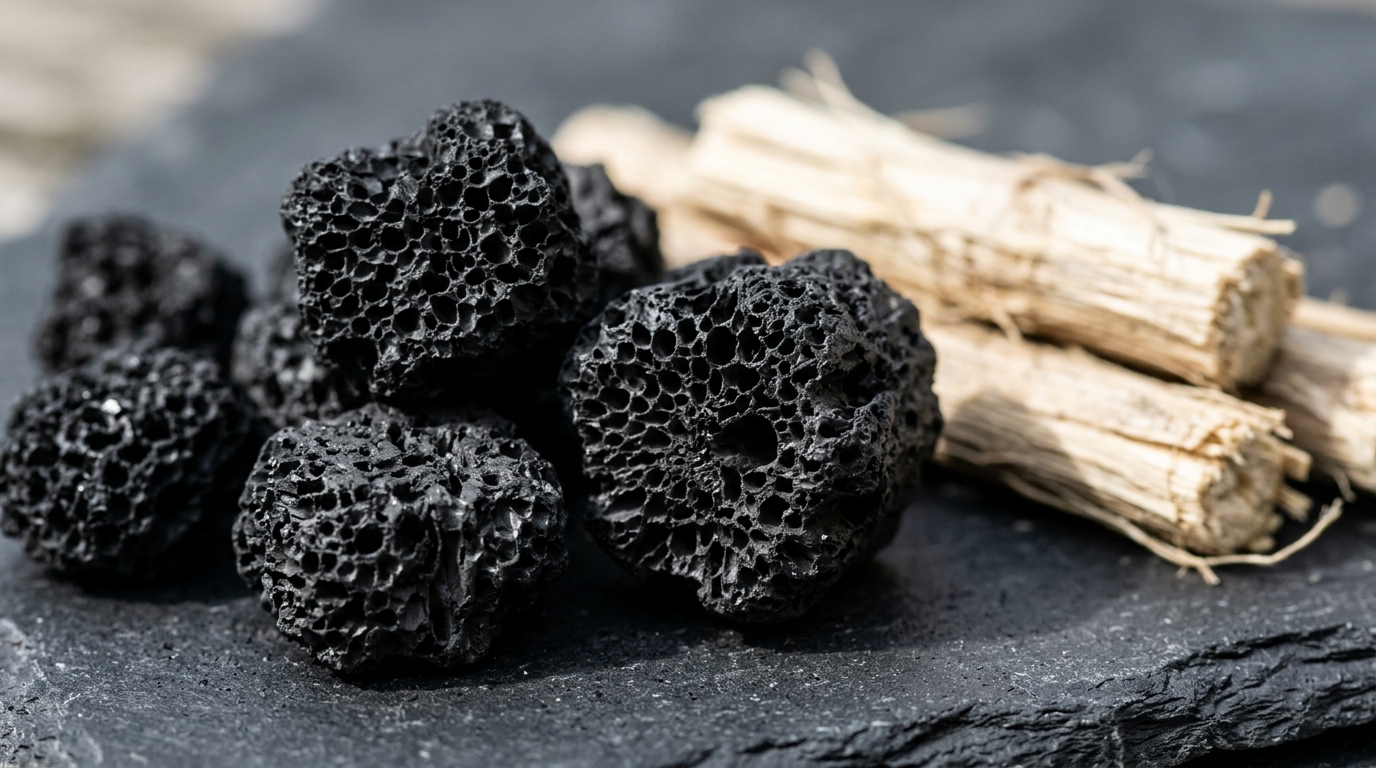
Waste jute sticks from Bangladesh have been transformed into an ultrapure, highly porous carbon material using a pressurized carbon dioxide activation route that breaks one of the long-standing rules of carbon manufacturing. In work published in Carbon Research, Md. Amirul Islam and Bidyut Baran Saha of Kyushu University report that raising the CO2 pressure during activation increased both the yield of the final material and its porosity at the same time, contradicting the conventional trade-off in which a more aggressively activated carbon comes at the cost of a smaller recovered mass. At 800 °C and 10 bar of CO2, held for one hour in a custom-built Inconel reactor, the process delivered a 57.4 wt% yield, a total surface area of 1182 m2 g–1, and a total pore volume of 0.4746 cm3 g–1, while the resulting carbon adsorbed between 141 and 149 mg of CO2 per gram across all samples tested.
The starting material was Bangladeshi jute stick, the sturdy stem left behind after jute fiber extraction. In rural areas without natural gas access, these sticks are commonly burned as cooking fuel, a practice the authors describe as inefficient and a source of hazardous pollutants including PAHs, benzene, 1,3-butadiene, carbon monoxide, and carbon dioxide. Converting the residue into activated carbon instead adds value while reducing those health and environmental impacts. The precursor also carries a practical advantage: elemental analyses of raw jute sticks revealed no trace of silicon, which matters for industries such as pharmaceuticals, food and beverage processing, and device manufacturing where silicon-free activated carbon is required for safety reasons.
The synthesis began with carbonization. Thermogravimetric analysis of the raw biomass under nitrogen showed roughly 2.6% weight loss up to 100 °C from adsorbed water, then a critical decomposition phase between 200 and 500 °C in which approximately 74.1% of the sample mass was lost, largely through the elimination of hydrogen and oxygen. Beyond 600 °C, mass change was insignificant, indicating that only very stable carbon particles remained. Carbonization trials at 500 and 600 °C showed that the 600 °C samples consistently outperformed those prepared at 500 °C in porosity, so the team fixed carbonization at 600 °C with a heating rate of 10 °C min–1 under a nitrogen flow of 100 mL min–1.
Activation then took place in a tubular reactor fabricated from Inconel 725, a nickel–chromium–molybdenum–niobium alloy chosen for its corrosion resistance, tensile strength, and thermal stability under the severe conditions of 700 to 1000 °C and 1 to 10 bar. A three-zone tubular furnace with independently regulated heating zones replaced a single-zone configuration after preliminary trials produced unstable temperature profiles and inconsistent pore development. Approximately 0.2 g of carbonized sample sat on an alumina boat at the reactor center while CO2 pressure was set with a controller and excess gas bled out through a partially opened safety valve at a controlled exhaust flow of 50 mL min–1. Screening of activation temperatures showed that 700 °C gave high yield but poor surface area, while 900 to 1000 °C produced substantial porosity but yields typically below 10 wt% from excessive reaction, leaving 800 °C as the balanced optimum. Similarly, durations from 5 minutes to 3 hours were tested, and 1 hour was selected.
The central surprise emerged when CO2 pressure was varied from 1 to 10 bar. Instead of the expected inverse relationship, the activation yield rose nearly proportionally with pressure, gaining roughly 20 wt% as pressure climbed from 1 to 10 bar, while surface area and micropore volume from nitrogen adsorption also increased consistently. The authors propose a mechanistic hypothesis to explain this. Biomass-derived precursors like jute stick contain intrinsic capillary channels. At atmospheric pressure, gas diffusivity is limited and only surface regions or low-density structures with wider pores are activated, producing moderate porosity and lower yield. As pressure rises, CO2 penetrates deeper into narrower channels within the carbonized matrix, enabling internal activation and deeper pore formation. Under high pressure and temperature, the confined environment may also hinder the escape of reaction byproducts such as carbon monoxide, promoting secondary reactions or partial decomposition of CO and CO2 that contribute to higher carbon retention and a greater final yield.
Support for this picture came from several directions. Particle size analysis showed that up to 5 bar the average particle size remained relatively stable between 32 and 38 μm, but at 7.5 bar the minimum particle size rose to 1.39 μm and at 10 bar to 3.19 μm, with the mean, median, and mode converging near 40 μm, indicating a more uniform distribution. The authors interpret these shifts as consistent with improved yield, minimized surface damage, and enhanced porosity at elevated pressures. Scanning electron microscopy revealed progressively rougher surfaces with increasing pressure, attributed to deeper CO2 penetration and more extensive gasification generating more pore openings, although the visible openings of roughly 50 to 200 nm do not reflect the intrinsic micro- and ultra-microporous structure measured by sorption analysis.
The pore architecture itself is hierarchical. Micropores were predominantly distributed between 0.75 and 2.0 nm, while ultra-micropores, defined as pores below 0.7 nm, were narrowly centered between 0.34 and 0.38 nm with a sharp maximum near 0.358 nm. Combining nitrogen-derived measurements with carbon dioxide adsorption data collected at 0 °C over 0 to 110 kPa, the team found that ultra-micropores contributed 25% to 32% of the total surface area and 11% to 19% of the total pore volume across the five samples. For the best material, 844 m2 g–1 of the 1182 m2 g–1 total surface area came from regular micro- and mesopores, with the remaining 29% from ultramicropores, and 13% of the pore volume was ultramicroporous. X-ray diffraction added another observation: nanocrystalline structures appeared in samples activated near atmospheric pressure, but crystallinity declined at higher pressures, possibly because CO2 reached and reacted with metal or carbon–metal nanocrystals that were then expelled through the exhaust, enhancing purity. Raman spectroscopy confirmed that the most amorphous character belonged to the high-pressure-activated samples, which the authors consider preferable for adsorption applications.
The reaction chemistry behind the pressure effect draws on decades-old gasification studies. Under low-pressure conditions, the classical pathway treats CO2 adsorption at a vacant carbon active site as producing one carbon monoxide molecule and a carbon–oxygen surface complex, which then desorbs to release another CO molecule and regenerate the active site. At higher pressures, Blackwood and Ingeme proposed an additional set of reactions in which CO itself adsorbs on the carbon surface, and subsequent reactions with CO2 and CO generate additional active sites, with the gasification rate showing second-order dependence on CO2 partial pressure. Other researchers documented that the rate-enhancing effect of CO2 pressure diminishes at high pressure, with two proposed explanations: produced CO adsorbs on the carbon surface and competes for active sites, delaying the reaction, or an irreversible reaction occurs between CO and chemisorbed oxygen. The authors link this slowing, irreversible chemistry to the increased activation yields observed at higher pressures in their jute-derived samples.
CO2 capture performance was measured for all five samples at 0 °C from vacuum to 110 kPa, slightly above atmospheric pressure. Uptakes ranged from 141 to 149 mg g–1, values the authors note are comparable to commercial adsorbents such as Maxsorb III and activated carbon fiber ACF-A15, despite those commercial materials having surface areas roughly two to four times higher. The comparable capture is attributed to the enrichment of ultramicropores, whose strong confinement effects and enhanced adsorbate–adsorbent interactions are particularly effective for small molecules like CO2. Against their own earlier work with waste sawmill wood activated under similar conditions, the jute-derived samples showed 33% to 39.6% higher CO2 adsorption capacity, a 72.8% improvement in surface area, and a 67.3% higher pore volume, which the authors attribute to precursor characteristics and activation duration.
The authors position pressurized CO2 activation as the least energy-intensive option among common activation routes. CO2 is a high-pressure gas at room temperature, so no energy is spent on phase change as with steam, no carrier gas is needed, and pressure is easily controlled for systematic study. Using CO2 as the sole activating agent eliminates chemical post-treatment and preserves product purity, while pressure-rated equipment costs are partially offset by higher yields, simplified processing, and reduced waste treatment. The team cautions that the extrapolated trend suggesting a hypothetical 100 wt% yield near 31 bar could not be experimentally validated due to safety constraints, and they call for pilot-scale validation and techno-economic assessment. Beyond post-combustion carbon capture with low-grade-heat regeneration, the stability and tunable micro- and ultramicroporosity of the material, they argue, also support adsorption-based cooling, energy storage, and gas separation, offering emerging-economy industrial clusters a low-footprint path to porous carbon manufacture from agricultural residues.
Subject of Research: Pressurized CO2 activation of Bangladeshi jute stick waste to produce high-purity microporous biochar for CO2 capture
Article Title: Functionalized biochar with pressurized CO2 activation: toward superior porosity, yield, and CO2 capture efficiency
Article References: Islam, M. A., & Saha, B. B. (2026). Functionalized biochar with pressurized CO2 activation: toward superior porosity, yield, and CO2 capture efficiency. Carbon Research, 5(1), Article 41. https://doi.org/10.1007/s44246-026-00275-3
Image Credits: AI Generated
DOI: 10.1007/s44246-026-00275-3
Keywords: biochar, pressurized CO2 activation, jute stick biomass, microporosity, ultramicropores, carbon capture, activated carbon, adsorption, waste valorization, surface area, gas separation, adsorption cooling
News Source: Sloane Callahan. (November 5, 2026). Pressurized CO2 Turns Jute Stick Waste into High-Yield Porous Carbon for Carbon Capture. Scienmag.