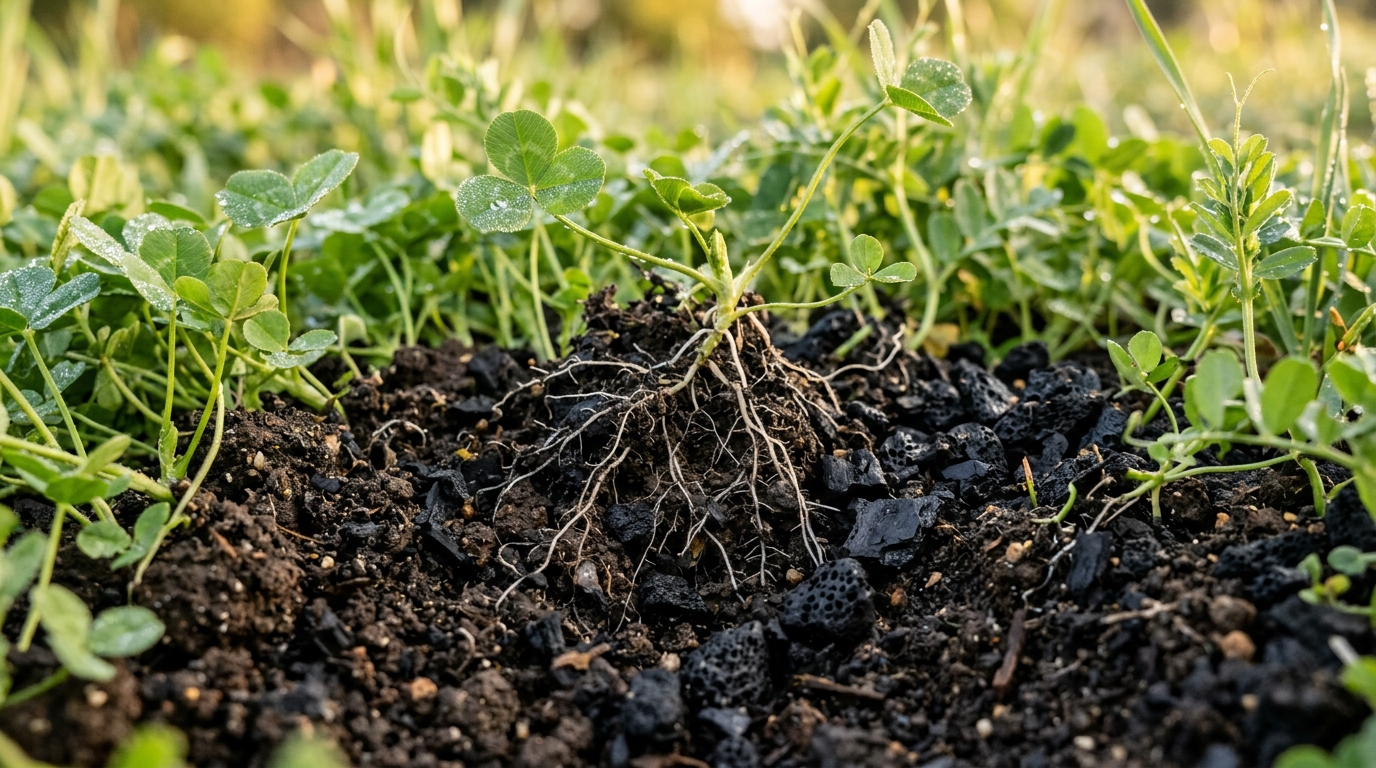
Chinese researchers have shown that pairing a winter green manure crop with biochar can dramatically improve farmland soil quality even when nitrogen fertilizer is cut back by nearly a third. In a three-year field experiment on the North China Plain, the combined treatment raised a composite soil quality index by 66.67 to 116.67 percent compared with leaving fields bare over winter, and it did so under both conventional fertilization and controlled-release fertilizer regimes.
Validation against measurable proxies such as soil water content, soil organic carbon, and total nitrogen produced Pearson correlation coefficients of 0.88 to 0.92 and R-squared values of 0.77 to 0.84, confirming the indices reliably captured their target functions.
The results showed that green manure alone improved soil properties, but adding biochar amplified nearly every response. In the first experimental period, the combined treatment increased total porosity and field capacity, with the greatest gains under 45 percent controlled-release fertilizer reduction reaching 13.19 percent and 13.04 percent respectively. Green manure alone reduced bulk density by 3.31 to 7.74 percent, while the combined treatment lowered it further by 8.61 to 9.80 percent. Chemically, both treatments raised mineral nitrogen, available phosphorus, available potassium, total nitrogen, and soil organic carbon across fertilization systems, with the highest available nutrient and organic carbon levels occurring under the combined treatment with 30 percent fertilizer reduction.
Biological responses were the fastest and most pronounced. The combined treatment outperformed green manure alone in enhancing microbial biomass carbon, microbial biomass nitrogen, and the activities of β-1,4-glucosidase and L-leucine aminopeptidase, showing the greatest increase in microbial biomass carbon at 20.9 percent and glucosidase activity at 27.3 percent under 30 percent fertilizer reduction. By the third period, these improvements had persisted and, in several cases, strengthened. Under the combined treatment with 45 percent fertilizer reduction, total porosity rose 15.40 percent, field capacity rose 17.39 percent, and bulk density fell 12.41 percent compared with winter fallow. The researchers attribute the physical changes to biochar’s porous structure directly increasing porosity while green manure roots and their decomposition products promote soil aggregate formation and stability.
Under 30 percent controlled-release fertilizer reduction, the combined treatment delivered the strongest performance across nearly every functional index. In the third period, carbon sequestration reached 0.68, nitrogen fixation 0.67, nutrient supply 0.81, microbial diversity provision 0.75, and the overall soil quality index 0.77. The mechanism appears to involve complementary carbon inputs: readily decomposable organic matter from green manure supplies microbial growth substrates, while biochar forms a stable carbon pool that improves habitat structure, aeration, water retention, and pH regulation.
Yield outcomes reinforced the practical case for moderate reduction. Under the combined treatment, maize yield reached its highest value at 100 percent controlled-release fertilizer, between 10,195.75 and 10,418.87 kilograms per hectare, and even under 30 percent reduction yield was maintained without a decrease. Partial factor productivity of nitrogen fertilizer increased significantly with controlled-release fertilizer compared with conventional fertilization and rose further as application rates decreased. However, the 45 percent reduction level told a different story: maize yield was significantly reduced compared with conventional fertilization, and soil mineral nitrogen, available phosphorus, and available potassium all fell to their lowest levels, indicating that substantial nitrogen cutbacks hinder nutrient accumulation even with organic amendments in place.
Beyond the field results, the study compared three soil quality assessment frameworks. A framework based on all soil function indices achieved the highest precision, matching the total-dataset index with an R-squared of 0.981 to 0.988 and a root mean square error of 0.020 to 0.022, but required the most indicators. A six-indicator minimum dataset built through principal component analysis balanced efficiency and accuracy well, achieving an R-squared of 0.946 to 0.960. A four-indicator minimum dataset derived from network analysis, using soil organic carbon, total nitrogen, capillary porosity, and L-leucine aminopeptidase activity, maintained reasonable accuracy with an R-squared of 0.834 to 0.910 while dramatically reducing measurement burden. The researchers recommend the function-index or principal-component frameworks for high-precision mechanism research and the network-analysis framework for large-scale rapid screening and monitoring.
Bayesian regression and structural equation modeling revealed the pathways through which the amendments act. Microbial diversity provision emerged as the key factor enhancing soil quality, with green manure and biochar acting principally by boosting this function and soil water retention to indirectly enhance carbon sequestration and nutrient supply. Nitrogen fixation instead enhances soil quality indirectly by supporting nutrient supply and carbon sequestration. Green manure and biochar each showed comparable standardized total effects on soil quality improvement, both at 0.47.
The study has clear limitations. Both sampling periods came from a single region, so the framework’s generalizability to other climates and soil types remains untested. The authors also note that seasonal factors and interannual climatic variability were not incorporated, which may introduce deviations in calculated soil quality and yield values. The observed decline in soil functions under substantial nitrogen reduction offers a critical reference point for establishing sustainable nitrogen thresholds, and the authors suggest diversifying organic inputs by combining green manure with crop straw, livestock manure, and other resources of varying carbon-to-nitrogen ratios to achieve graded nutrient release when deeper cutbacks are pursued.
Subject of Research: Field experiment testing green manure combined with biochar under reduced controlled-release nitrogen fertilizer to improve soil quality in North China Plain maize cropping
Article Title: Synergistic effects of green manure and biochar for a win-win in nitrogen reduction and soil health: insights from multiple assessment frameworks
Article References: Zhao, L., Zhang, X., Ning, X., Yin, W., Zhao, Q., Li, P., Wang, F., Qiu, H., Fan, Z., Hu, F., Chai, Q., Chen, H., Abdalla, M., Karbin, S., & Smith, P. (2026). Synergistic effects of green manure and biochar for a win-win in nitrogen reduction and soil health: insights from multiple assessment frameworks. Biochar, 8(1), Article 123. https://doi.org/10.1007/s42773-026-00638-4
Image Credits: AI Generated
DOI: 10.1007/s42773-026-00638-4
Keywords: biochar, green manure, soil quality index, nitrogen reduction, controlled-release fertilizer, North China Plain, maize, microbial diversity, carbon sequestration, soil functions, entropy weight method, structural equation modeling
News Source: Alan Morgan. (November 5, 2026). Green Manure Plus Biochar Boosts Soil Health While Cutting Nitrogen Fertilizer. Scienmag.