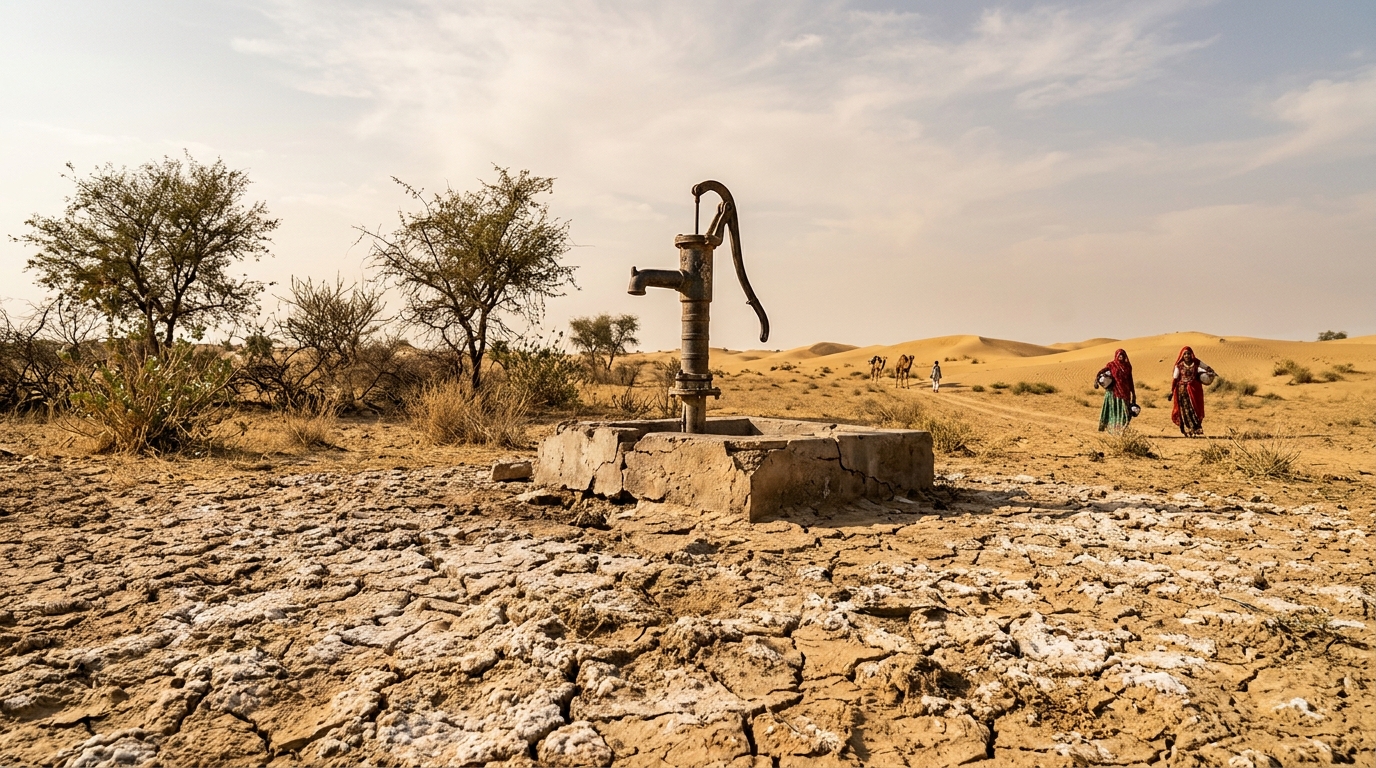
Fluoride in the groundwater of Jaisalmer district, in India’s Thar Desert, is closely tied to the fluoride stored in the soils above it, according to a new study that paired soil and water samples from 94 villages across the district.
The samples were collected during a single sampling campaign in November 2025, from villages in the Jaisalmer district, in a post-monsoon study. Groundwater matters enormously here: the Thar Desert setting means communities depend heavily on aquifers for drinking water, and low recharge combined with high evaporation rates concentrates dissolved fluoride in the water that people draw from wells. In arid regions, this enrichment makes fluoride contamination a significant environmental and public health problem.
The measurements revealed a wide range of contamination. Soil fluoride contents spanned from 0.05 to 9.25 milligrams per kilogram, while groundwater fluoride ranged from 0.12 to 11.8 milligrams per litre. Because the study collected 94 pairs of soil and groundwater samples, the researchers could evaluate the spatial relationship between soil fluoride and groundwater fluoride.
It does. The paired measurements showed a significant positive correlation between soil fluoride and groundwater fluoride, with a Pearson correlation coefficient of 0.455 and a p-value below 0.001. In plain terms, villages with fluoride-rich soils tended, on average, to have fluoride-rich wells. A simple global regression model, Ordinary Least Squares, confirmed the pattern: the slope was 0.461, also significant at p < 0.001, and soil fluoride alone accounted for 20.7 percent of the total variance in groundwater fluoride.
The key methodological move was Geographically Weighted Regression, or GWR, a technique that fits the soil–water relationship separately at each location instead of forcing one coefficient to describe the entire district. The improvement was substantial. GWR reduced the Akaike Information Criterion, a statistical measure where lower values indicate a better-fitting model, from 347.70 under OLS to 331.33. The local analysis also revealed high spatial heterogeneity: the strength of the soil–groundwater relationship varied considerably from place to place, with the highest local coefficients and local R² values concentrated in the Mohangarh, Nachana and Sankra blocks. Those three blocks are identified as the major fluoride hotspots in the district.
Rather than treating Jaisalmer as a uniform contamination zone, the GWR results show that fluoride mobilisation from soil into groundwater is geographically uneven, and that local models outperform global ones for evaluating contamination in this arid aquifer system.
The study also fills a gap in the prior literature. Earlier research in the region had evaluated groundwater quality, but the spatial variation in the correlation between soil fluoride and groundwater fluoride was not well known. By sampling both media at the same 94 locations and applying both global and local regression frameworks, the team demonstrated that the relationship is real, positive and statistically robust, yet far from uniform across the desert landscape.
There are limits worth keeping in mind. The sampling occurred during a single post-monsoon campaign, so the results capture one snapshot of conditions rather than a full seasonal cycle, and the study is described as a post-monsoon study for that reason. The correlation coefficient of 0.455, while highly significant, still leaves most of the variance in groundwater fluoride unexplained by soil fluoride alone, pointing to other geochemical and hydrological factors at work in the aquifer. The findings are specific to the Jaisalmer district’s arid setting and should not be assumed to transfer automatically to other regions.
Pairing soil and groundwater sampling with geographically weighted statistics turns a diffuse contamination problem into a mappable one, showing exactly where the connection between land and water is tightest.
Subject of Research: Spatial variability of fluoride in soil and groundwater in Jaisalmer District, Rajasthan, India
Article Title: Spatial variability and geographically weighted assessment of fluoride in soil and groundwater of Jaisalmer District, Rajasthan, India: a post-monsoon study
Article References: Yadav, A. K., & Yadav, S. (2026). Spatial variability and geographically weighted assessment of fluoride in soil and groundwater of Jaisalmer District, Rajasthan, India: a post-monsoon study. Environmental Geochemistry and Health, 48(17), Article 678. https://doi.org/10.1007/s10653-026-03575-0
Image Credits: AI Generated
DOI: 10.1007/s10653-026-03575-0
Keywords: fluoride, groundwater, soil, Jaisalmer, Thar Desert, Rajasthan, geographically weighted regression, arid aquifer, water contamination, spatial analysis, Spatial, variability
News Source: Bethany Barker. (November 5, 2026). Soil and groundwater fluoride link mapped across India’s Thar Desert. Scienmag.