Rising temperature volatility, severe water deficits, and multiple pollution sources are destabilizing food supplies for smallholder farmers, industrial cultivators, and biotechnologists alike, according to an editorial introducing a research collection in Frontiers in Sustainable Food Systems. The collection, titled Crop Responses and Adaptation Strategies Under Global Climate Change, assembled twelve contributions—ten original research articles and two reviews—spanning crop health under elevated atmospheric ozone, drought stress resilience, water management, and the interactive effects of multiple concurrent climatic factors. The editors argue that traditional, single-trait agricultural practices are no longer sufficient to deal with rapid climate shifts, and that modern agronomy is transitioning toward a multi-layered framework connecting high-precision remote sensing, multivariate genotypic mapping, advanced multi-omics, and tailored regional policy.
The vulnerabilities threatening agricultural systems operate at both local socioeconomic and macro-industrial scales. Akafu and colleagues examined the climate change vulnerability of smallholder coffee farmers across five districts in Western Ethiopia using the Livelihood Vulnerability Index and the Livelihood Vulnerability Index-Intergovernmental Panel on Climate Change framework. Drawing on data from 642 households, the LVI analysis identified Gimbi as the most vulnerable district because of heavy reliance on agriculture, while the LVI-IPCC framework flagged Haru as most vulnerable because it possesses the lowest adaptive capacity to environmental stresses. Across all districts, vulnerability was primarily driven by high water need, low crop diversification, severe exposure to fluctuating minimum temperatures, and a severe lack of local early warning systems and formal credit options.
At the industrial scale, Wulandari and colleagues evaluated the multidimensional impacts of climate change on global oil palm plantations, focusing on Malaysia and Indonesia. Their systematic literature review projects that climate change threatens to contract land suitability by over 220,000 square kilometers by 2030, cut yields by up to 41 percent, and drive an absolute 100 percent infection rate of Basal Stem Rot disease in certain regions by 2100. The review underlines that extreme weather and habitat loss harm small farmers and contribute to human-wildlife conflicts and water shortages. The authors recommend that the oil palm industry adopt Climate-Smart Agriculture, expand sustainability certifications, and deploy artificial intelligence early warning systems to build long-term resilience. These are projections and recommendations from a review, not observed outcomes to date.
Near-surface ozone pollution is one atmospheric shift actively reshaping regional agricultural structures. Using spatial panel cointegration data from Chinese cities, Liu and Guo uncovered a U-shaped relationship between ground-level ozone concentrations and cash crop cultivation. Mild ozone exposure below a critical inflection point of 64.81 parts per billion could slightly boost cash crop shares by stimulating plant defenses, but concentrations exceeding this level induce severe toxic effects that reduce photosynthetic efficiency. Because valuable cash crops display ozone sensitivity 1.5 to 3 times greater than staple food crops, an alarming 98.22 percent of surveyed cities now sit on the destructive right side of this tipping point, pushing risk-averse farmers to reduce cash crop land in favor of ozone-tolerant food crops.
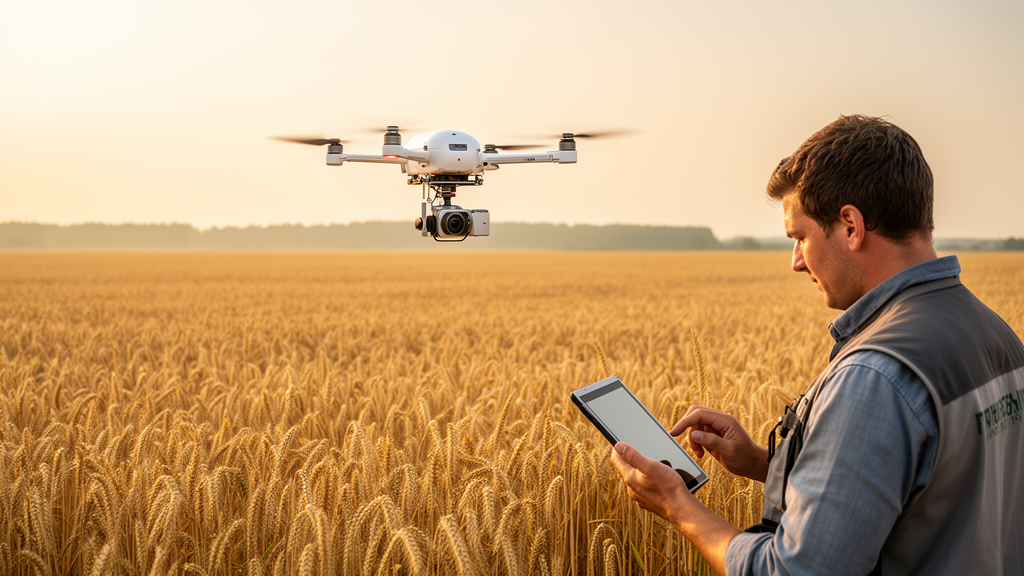
To counter these threats, agronomists are deploying high-throughput digital phenotyping and aerial remote sensing. In South Sulawesi, Indonesia, Musa and colleagues pioneered high-precision predictive modeling to optimize nitrogen fertilization for early-maturing rice varieties. By coupling field components with remote-sensing vegetation indices captured via unmanned aerial vehicles, they built a robust multiple regression model integrating the Normalized Difference Vegetation Index and yield per clump, which delivered superior yield prediction performance. Blending drone-derived spectral indices with field measurements, the authors noted, allows producers to practice high-precision agriculture, minimizing over-fertilization while maintaining high-yielding, rapid crop rotations.
In the same vein, Anshori and colleagues developed an automated screening framework for evaluating coastal rice resilience under severe hydroponic salinity stress of 120 millimolar, combining image-based phenotyping—morphometric and colorimetric indexes—with systematic statistical validation. Cross-validation against biochemical markers showed that the colorimetric indicators directly match chlorophyll preservation and high relative water content while reflecting structural tissue tolerance. The colorimetric index emerged as a highly reliable early proxy for field adaptability, allowing breeders to eliminate subjective visual injury scores and accelerate development of climate-resilient coastal rice varieties.
Breeding for water-limited tropical environments is also shifting toward multi-trait selection to remove the biases of evaluating single traits in isolation. Azrai and colleagues evaluated the screening efficiency of combining yield-based indices with the Multi-Trait Genotype-Ideotype Distance Index to identify drought-tolerant tropical maize genotypes across rainfed lowland locations in South Sulawesi. Field trials of 33 hybrid genotypes showed that drought stress reduced overall grain yield by 23 percent, leaf area by 20.7 percent, and plant height by 12 percent. Four yield-based indices isolated six superior hybrids, and further refinement via the MGIDI approach left three elite genotypes—GE13, GE21, and GE32—closest to the ideal multi-trait ideotype.
The multivariate strategy proved similarly efficient in India, where Yadav and colleagues unraveled root system architecture plasticity under osmotic stress. Water deficits severely suppressed growth of 36 regionally important rice genotypes, and stepwise multiple regression modeling identified six highly interactive traits, with shoot fresh weight serving as the strongest positive indicator of early seedling vigor and carbon assimilation under osmotic stress. Integrating Response Stability Index tracking with MGIDI multivariate mapping eliminated single-trait selection bias and prioritized five elite varieties with the most balanced root configurations and robust stability, positioning them as promising parental donor lines for breeding climate-resilient crops. Complementing this work, Suriani and colleagues assessed the resistance of 19 hybrid corn genotypes to Bacterial Stalk Rot caused by Dickeya zeae across tropical ecosystems in South Sulawesi. Molecular profiling of the housekeeping gene dnaX verified the aggressive isolate BSR_SH100, showing 99.12 to 99.56 percent genetic similarity with global soft-rot strains, and artificial field inoculations revealed three elite hybrid lines with exceptional disease suppression. Integrated Pearson correlation and path analyses showed that minimum temperature, maximum temperature, and rainfall exerted strong positive direct effects on initial disease incidence, accelerating bacterial multiplication and stem tissue maceration during the crop’s generative phase.
At the cellular scale, Mashifane and colleagues studied mature dry pigeonpea seeds from harsh semi-arid tropical climates, mapping the biochemical foundation of seed viability. Heat Shock Proteins comprised 3.14 percent of the total stress-related protein fraction within the dry seed proteome, and structural modeling revealed highly conserved C-terminal EEVD and EEVK motifs essential for securing co-chaperone complexes. Three-dimensional visualizations confirmed 65.79 to 66.41 percent structural overlap with reference chaperones, indicating the seeds retain critical ATP-dependent binding domains needed to prevent protein denaturation during storage. Translating molecular insight toward field solutions, Ben-Laouane and colleagues outlined a systems biology framework for engineering climate resilience in woody plants, integrating high-throughput multi-omics, precision genome editing, and microbiome engineering. Combining transcriptomic, proteomic, and metabolomic datasets with machine learning can map cellular networks and isolate key biomarkers, while CRISPR/Cas9 editing performs targeted genetic adjustments and rhizosphere microbiome engineering designs synthetic microbial consortia that break down stress-induced ethylene precursors, stabilize soil structures, and neutralize harmful reactive oxygen species.
Natural biological alternatives face their own field realities. Using a randomized complete block design in Ethiopia, Marie and colleagues combined three onion varieties—Nafis, Adama Red, and Bombay Red—with four levels of moringa leaf extract concentration (0, 2, 4, and 6 percent) under field conditions. A 4 percent foliar application emerged as the optimal treatment, delivering high productivity and an optimal marginal rate of return. Yet a rigorous two-year study of organic potato production in Hungary by Papp and colleagues warns that open-field efficacy of beneficial microbial inoculants is mainly limited by baseline agrotechnical factors. The experiment tested four individual bacterial and fungal strains—Pseudomonas brassicacearum, Trichoderma asperelloides, Rhizophagus irregularis, and Paraburkholderia phytofirmans—alongside their consortia across two potato varieties under irrigated and rainfed conditions. Variety choice, seasonal irrigation, and annual climate variation exerted a greater influence on yield than microbial inoculation, which failed to produce notable differences due to barriers including a restrictive alkaline soil pH of 7.9 and intense competitive exclusion by resilient native microbial communities. The editors conclude that sustaining long-term agricultural resilience requires synchronized, multi-layered approaches rather than universal single-factor interventions: digital early warning frameworks, funded multi-trait breeding programs, cross-regional compensation for far-reaching constraints like ozone, and expanded rural microfinance, rainwater harvesting infrastructure, and off-farm income diversification.
Subject of Research: Crop responses and adaptation strategies under global climate change
Article Title: Editorial: Crop responses and adaptation strategies under global climate change
Article References: Ait-El-Mokhtar, M., Jing, L., Hu, S., & Chen, T. (2026). Editorial: Crop responses and adaptation strategies under global climate change. Frontiers in Sustainable Food Systems, 10, Article 2032049. https://doi.org/10.3389/fsufs.2026.2032049
Image Credits: AI Generated
DOI: 10.3389/fsufs.2026.2032049
Keywords: climate change, crop breeding, drought stress, ozone pollution, remote sensing, multi-trait selection, oil palm, rice, maize, microbial inoculants, food security, digital phenotyping
News Source: Alan Morgan. (October 29, 2026). From Ozone Tipping Points to Drone Phenotyping: Twelve Studies Map Crop Adaptation Under Climate Change. Scienmag.