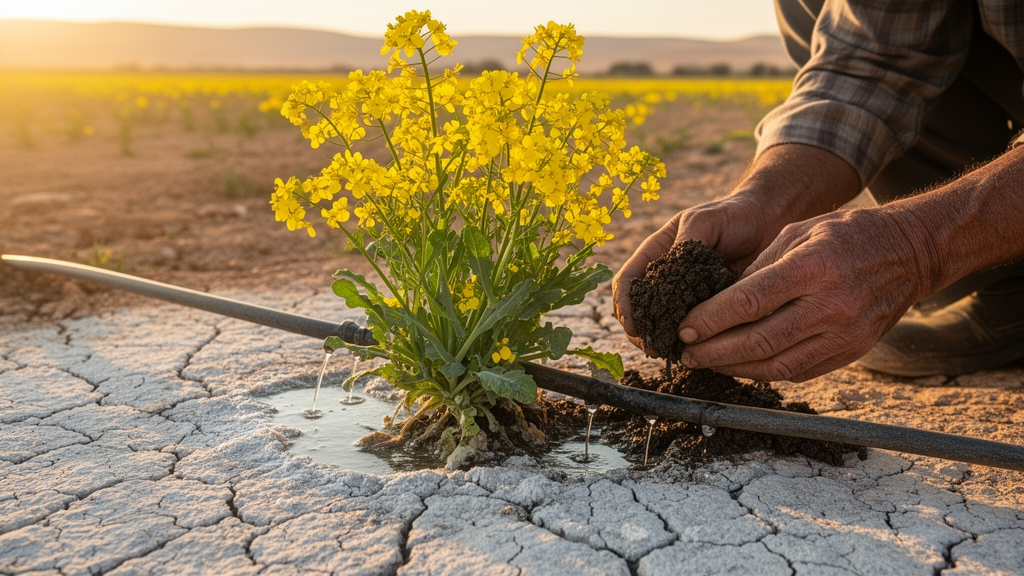
Rapeseed can do two jobs at once in the parched farmland of the Eastern Mediterranean: yield edible oil and animal feed on water that would ruin most crops, and pull salt out of the ground while it does so. The results show how oilseed brassicas performed in this trial when irrigated with saline water and treated wastewater, water sources that conventional agriculture generally cannot use.
The experimental logic is straightforward. Climate change, water scarcity and soil salinization are converging constraints on crop production across the region, and they bite hardest in marginal lands where conventional freshwater irrigation is simply not an option. The researchers asked whether stress-tolerant rapeseed germplasm, paired with non-conventional water sources, could sustain production and simultaneously improve degraded soils.
The water quality itself shaped how the plants grew. Crops irrigated with saline water matured earlier, while biomass and seed yield were greater under treated wastewater. Under treated wastewater, by contrast, the plants built more biomass and produced more seed. Across the full panel of accessions, seed production rose by 43.7 percent and oil yield by 37.2 percent under the treated wastewater regime compared with saline irrigation. That gap matters, because treated wastewater has a lower electrical conductivity (2.0 dS m⁻¹) than the saline water (5.8 dS m⁻¹), exposing the crop to less salt stress.
The standout performers were identified by name. Olga, a Brassica napus accession, produced 3.13 tonnes of seed per hectare under saline irrigation. Gisilba, a Sinapis alba accession, was the productivity champion under treated wastewater, producing 4.49 tonnes of seed and a remarkable 40.15 tonnes of straw per hectare. Profit, another B. napus accession, achieved the highest oil content at 47.73 percent. Together these three lines illustrate that no single accession wins on every trait: one tolerates salt, one converts water into sheer biomass, one packs oil into every seed.
The soil results may prove the most consequential. After two years of rapeseed cultivation, soil salinity fell by 2.30 to 3.40 percent, and the crop removed between 78.48 and 111.60 kilograms of sodium per hectare per year. The study reports that rapeseed contributed to soil remediation, reducing soil salinity by 2.30 to 3.40 percent and removing 78.48 to 111.60 kilograms of sodium per hectare per year.
There was also evidence that the system improves with age. Yields increased by 15.1 percent in the second year without additional inputs, which the researchers interpret as indicating progressive system improvement. Whether that trajectory continues in later years, and how it interacts with the salt balance in the root zone, are questions the two-year window cannot fully answer.
The byproducts deserve attention in their own right. Rapeseed straw at 40 tonnes per hectare is a substantial biomass resource, and the seed cake left after oil pressing is a high-protein animal feed. The abstract states that rapeseed germplasm can support climate-smart agriculture in arid environments by producing edible oil and high-protein animal feed, strengthening food security, and contributing to soil desalination under saline water and treated wastewater irrigation. The authors frame this as climate-smart agriculture, combining stress-tolerant crops with non-conventional water sources to sustain production while improving soil conditions.
The study’s scope has limits worth stating plainly. The sodium removal figures describe what the crop extracted from the experimental plots, not a guarantee for every degraded field. Earlier maturity under saline irrigation came with lower biomass and seed yield than under treated wastewater, so farmers choosing between water sources face a trade-off.
Even with those caveats, the findings land at a moment when the Eastern Mediterranean needs them. If oilseed brassicas can convert saline water and treated wastewater into food, feed and lower soil salinity at the yields documented here, rapeseed may earn a place in the region's driest fields.
Subject of Research: Field evaluation of 48 rapeseed accessions in Jordan for seed and oil yield, feed quality, and soil desalination under saline water and treated wastewater irrigation.
Article Title: Rapeseed accessions as a climate smart agriculture strategy and food security in arid regions: yield, oil quality, and soil remediation under saline and wastewater irrigation
Article References: Salahat, M., Al-Rifaee, M. K., Hammoudeh, A., Al-Abdalla, M., Abuobid, A., Al-Kharouf, A., Al-Hadede, L., & Abo Dalo, A. (2026). Rapeseed accessions as a climate smart agriculture strategy and food security in arid regions: yield, oil quality, and soil remediation under saline and wastewater irrigation. Frontiers in Agronomy, 8, 1928284. https://doi.org/10.3389/fagro.2026.1928284
Image Credits: AI Generated
DOI: 10.3389/fagro.2026.1928284
Keywords: rapeseed, Brassica napus, Sinapis alba, treated wastewater, soil salinity, phytoremediation, climate-smart agriculture, food security, arid agriculture, Jordan, oil yield, saline irrigation
News Source: Alan Morgan. (October 30, 2026). Rapeseed Grows and Strips Soil Salt in Jordan Using Saline Water and Treated Wastewater. Scienmag.